
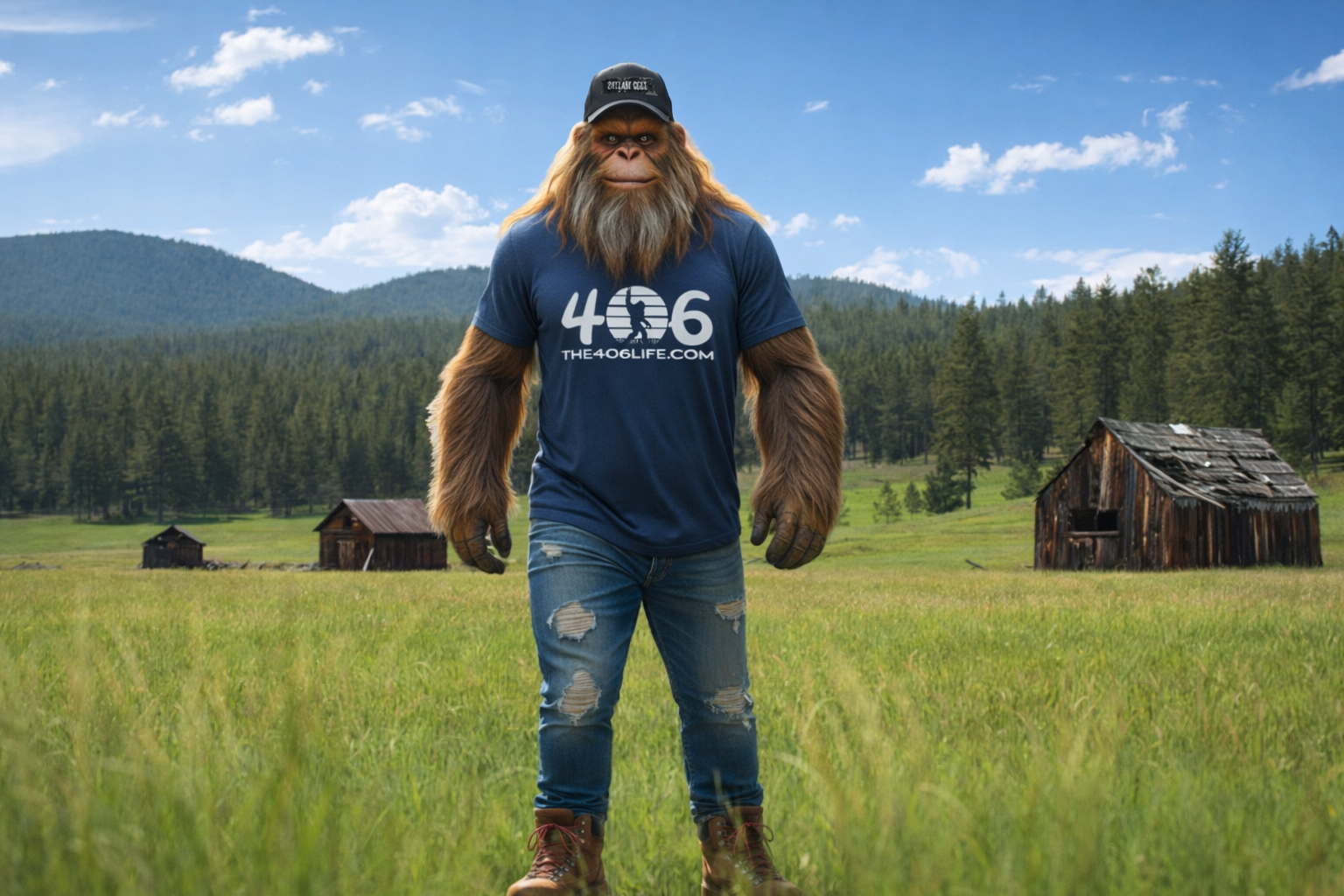
by Montana Max, your local Bigfoot
Okay. Sit down. Get yourself a cup of something warm because this one’s gonna take a minute, and I don’t move fast, and I don’t talk fast, and I have been waiting a long time to tell this story.
My name is Montana Max. You probably haven’t seen me, but I’ve seen you. I live out here in the Potomac Valley, east of Missoula on Highway 200, and I have been watching this particular stretch of Montana for longer than most of you have been alive. I’ve watched the logging roads come and go. I watched the Anaconda Copper Company tear through the Blackfoot like it owed them something. I watched the ranchers come in after and try to put it all back together with nothing but grit and horses and the kind of stubbornness you only see in Montanans and very large, hairy mammals.
And I just watched 2,330 acres of this valley get protected. Forever.
I’m not gonna lie to you. I cried. I had to wipe my face on a lodgepole pine and I left a smear the size of a welcome mat. The elk didn’t even look up. They’re used to me by now.
First, Let Me Tell You About These Cabins
Right there on Highway 200, there are three old log cabins that have been standing since before your grandparents were born. Mule teams dragged those logs out of the mountains to fuel the Anaconda Copper Company’s mining operation in Butte. I remember that era. I was younger then — smaller, maybe — and the valley looked like a skinned knee. Clear-cut. Raw. The kind of landscape that makes an apex predator-adjacent creature feel genuinely sad.
I used to walk past those cabins at night and wonder what the valley would become. Some nights I’d sit on a ridge and count the stars and think, this is either going to heal or it’s going to keep getting picked apart. I’m a patient being. But even I had my doubts.
Then Arnold H. and Annabelle Case showed up in 1932, during the actual Great Depression, mind you, and they decided THIS was a good place to build a life. On logged-over land. During the worst economic collapse in American history.
Honestly? That tracks for Montana ranchers.
They homesteaded, they ranched, they had two kids — a boy named Arnold and a girl named Julie — and they built something. Slowly. The way real things get built.
Twenty Years of Family Conversations
Here’s a thing I know about families: they don’t always agree on stuff. I know this firsthand. I have a cousin named Gerald who still argues that the proper way to catch cutthroat trout is with your bare hands, and every spring we have the same argument, and every spring he comes home with wet feet and an empty belly. Families are complicated.
The Case family — seven cousins total, Arnold Case’s two kids and Julie Hacker’s five kids — started talking about protecting this ranch almost twenty years ago. Twenty years. That’s a long conversation. That’s a lot of holiday dinners and probably some raised voices and some awkward silences and some phone calls that went a little long.
But here’s the thing. All seven of them said yes. Every single one.
Matt Case, one of the landowners, has a framed photograph on his wall from 1949. His dad on a wagon with horses, his aunt up against a haystack they were building the old-school way. He described why they did this in a quote that made me, a large cryptid, feel things I am not comfortable discussing publicly.
He said it reminded him of why they were protecting it.
That’s it. That’s the whole thing. That’s why you spend twenty years in family conversations and put together a $4.8 million conservation deal. Because of a photograph on a wall and what it means to carry something forward.
I’m getting emotional again. Excuse me.
Okay, What Is a Conservation Easement, Exactly
(Max’s note: I’m going to explain this because I’ve heard a lot of confused people talking about it at the trailhead and I can’t correct them because I’d give myself away, so I’m doing it here.)
A conservation easement is not the government taking your land. It is not a public park. The Case family still owns the ranch. Gary Metzger, who has been the ranch manager since the late 1970s — the man has basically been there as long as I have — is still out there tending the Red Angus cattle. The hay still gets cut. The fences still need mending.
What a conservation easement does is this: it’s a permanent, voluntary, legal agreement between the landowner and a land trust — in this case, Five Valleys Land Trust — that says, forever and in writing, this land cannot be subdivided, developed, or turned into something that would destroy its wildlife and agricultural value.
No future owner can sell it off in parcels. No future financial pressure can peel it apart. It stays working ranchland and wildlife habitat until the end of time, or close enough to it that the difference doesn’t matter.
Five Valleys holds the easement in perpetuity. The Cases keep the land.
I think this is a brilliant arrangement. I have been advocating for this kind of thing for years but nobody can hear me because when I show up at public meetings people tend to run, which is rude, and also I can’t sign documents because my handwriting is, frankly, terrible. Big hands, small pens. It’s a whole thing.
The Money. Let’s Talk About the Money.
This did not happen for free. The total project cost was $4.8 million, and it came together like a proper Montana coalition — a little federal, a little local, a lot of community belief.
The biggest single chunk was $2,340,000 from the USDA’s Natural Resources Conservation Service Agricultural Land Easement program. Federal conservation money, specifically designed to keep working agricultural lands intact. The NRCS State Conservationist Gayle Barry said something about making farms and ranches and the rural communities that depend on them more ecologically and economically sustainable, and that’s exactly right. When a valley stays a valley, everybody wins. Especially the large hairy residents who don’t technically exist.
Missoula County came in with $994,550 from the Open Space Bond program — and I want you to understand this: that was the single largest award in that program’s history. Commissioner Josh Slotnick called it an iconic piece of property that protects the viewshed while establishing a larger wildlife corridor free from development. He’s not wrong. I have walked that viewshed at 2 a.m. under a full moon and it is genuinely majestic.
Five Valleys Land Trust and private donors put in another $995,000. The Montana Fish and Wildlife Conservation Trust contributed $100,000 specifically in support of public hunting access. The Cinnabar Foundation, Atira Conservation, and others filled in the rest.
$4.8 million. Twenty years of family conversations. Three old log cabins. 2,330 acres.
That’s what it cost to make something last forever.
Why This Particular Spot Matters More Than You Might Think
Now I want to get a little serious for a minute, because this is the part where the geography starts to feel like destiny, and I want you to feel it the way I feel it when I’m walking the ridgeline at dusk.
The Potomac Valley sits at the natural crossroads of three of North America’s greatest wildlife ecosystems.
Up northwest, you’ve got the Northern Continental Divide Ecosystem — Glacier National Park, the Bob Marshall Wilderness. Home to over a thousand grizzly bears. Big, charismatic, terrifying animals. (I respect them enormously. We have an understanding. I don’t bother them, they don’t bother me, and we’ve all agreed not to talk about the incident of 2009.)
Down southwest, you’ve got the Greater Yellowstone Ecosystem — Yellowstone National Park and everything around it. Another thousand-plus grizzly bears.
And the Selway-Bitterroot Ecosystem covers central Idaho and western Montana.
The Potomac Valley is the connective tissue between all three. Lena Viall, conservation and communications manager for Five Valleys Land Trust, put it plainly: Potomac provides habitat corridor connectivity as animals move between the Northern Continental Divide ecosystem and the Greater Yellowstone Ecosystem.
Derek Goble, the conservation project manager, said something even better. He said that with this protection, you can basically draw a straight line through protected public and private land all the way to the Canadian border.
Yellowstone to the Canadian border. That straight line is the dream of the Yellowstone to Yukon Conservation Initiative — the Y2Y Corridor — one of the most ambitious wildlife connectivity projects on earth. And the Case Ranch just locked in a critical piece of it.
A 2023 study published in Scientific Reports found that linking Yellowstone National Park with Glacier National Park through ecological corridors would increase the long-term persistence of mammal species by a factor of 4.3 compared to isolated, fragmented populations. That’s not a marginal improvement. That’s the difference between wildlife that endures and wildlife that slowly disappears.
I am, technically speaking, a mammal. So this matters to me personally.
(Bigfoot joke: Why did the Bigfoot support the conservation easement? Because he’s tired of subdivision signs ruining his commute. I have a great commute. I would like to keep it.)
The Blackfoot River and a Man Named Norman
The Blackfoot River runs 132 miles from the Continental Divide south of Glacier National Park westward until it joins the Clark Fork near Missoula. If you’ve read A River Runs Through It by Norman Maclean, you know this river. If you haven’t read it, go do that. I’ll wait. I have time. I am very old.
For wildlife biologists, the Blackfoot watershed is one of the most critical wildlife movement corridors in the Northern Rockies. It’s a migration highway carved through the mountains, and the Potomac Valley, which is part of the Blackfoot watershed, functions as the southern anchor of the Y2Y Corridor.
The Case Ranch sits right in the middle of all of it. Three miles of Union Creek frontage — Union Creek is a Blackfoot tributary — plus meadows, wetlands, conifer forests, and open grasslands. It’s the kind of place I call home because it has everything. Food, cover, water, and enough space that a creature of my particular dimensions can move around without feeling cramped.
Who Else Lives Here (Besides Me)
Let me introduce you to the neighbors, because this easement isn’t just about scenery.
Grizzly bears. The single most important beneficiary. The two great grizzly populations — NCDE and GYE, each with over a thousand bears — are currently isolated from one another. Biologists see the Potomac Valley and the Blackfoot watershed as the key pathway for bears moving between recovery areas. The Heart of the Rockies Initiative called this ranch incredibly significant for wildlife connectivity between the Potomac Valley and the Blackfoot River, permanently protecting the vital space migrating elk and mule deer, and for grizzlies moving between recovery areas. That’s a quote I’ve memorized because I wrote it on a rock near my den to remind myself why this matters.
Elk. The Potomac Valley has always been an elk migration corridor. Elk need huge, unfragmented landscapes. The open meadows and creek corridors of the Case Ranch are exactly the stopover habitat they depend on for their annual migrations between summer mountain ranges and winter valley floors.
Mule deer. Same story as the elk. Seasonal migrations across public and private land, constantly threatened by development pressure. 2,330 more permanently protected acres means one more critical link in ancient pathways.
Moose. The wetlands and Union Creek corridor are basically a moose spa. Dense riparian vegetation, shallow water, proximity to forest cover. Moose love this setup. I have watched moose from respectful distances many times and I find them extremely relatable — large, somewhat awkward, deeply committed to their own agenda.
Black bears. Documented regularly on the property. They use the forest and riparian zones year-round. We coexist politely. I once found a black bear trying on a backpack someone had left at a trailhead and I just… walked away. Some things aren’t worth getting into.
Canada lynx. Listed as threatened under the Endangered Species Act. They need connected forests with healthy snowshoe hare populations. The Case Ranch conifer forests provide the habitat and the corridor connectivity. Lynx are small, quiet, and extremely difficult to see. I respect that. It’s a lifestyle choice.
Native trout. Three miles of Union Creek means three miles of cold, protected tributary water flowing into the Blackfoot system. Bull trout and other cold-water species need clean, connected waterways. This helps.
Raptors and migratory birds. The ranch hosts a diversity of resident and migratory species. Including sandhill cranes — iconic, prehistoric-sounding visitors that pass through the Potomac Valley every spring and fall. If you’ve ever heard a sandhill crane call, you understand why I find this valley worth protecting. It sounds like something from before humans existed. I find that comforting.
The Final Piece
Gavin Ricklefs, Managing Director of Heart of the Rockies Initiative, said the Case Ranch represents the final, critical piece of conservation in an area that has been a conservation focal point in Montana for decades.
The final piece.
Think about what that means. Over more than twenty years, Five Valleys Land Trust and their partners worked property by property through the Potomac Valley. Easement by easement. Family by family. With the Case Ranch’s 2,330 acres, the protected agricultural land in the Potomac Valley increases by nearly 70 percent. The valley now has 12 conservation easements.
Twelve.
As western Montana’s population grows, as the pressure on private land intensifies, as other valleys get carved up into five-acre ranchettes and vacation home developments — this valley holds. The wall is built. The work is done.
(Bigfoot joke: You know what I call a valley with 12 conservation easements? Home. That’s the whole joke. I mean it seriously.)
The Hunting
I want to say something about the hunting because it’s important and it doesn’t always get talked about the way it should.
For 25 years, the Case Ranch has been enrolled in Montana Fish, Wildlife & Parks’ Block Management Access program. That means 1,700 acres open to public hunters at no cost. And that access is now permanent. Legally binding. Forever.
Donna Hacker, one of the landowners, said something I want you to read slowly:
“The people who live in the Potomac Valley harvest meat from the wilderness to feed their families. They need that easy access. Hunting is good for animal populations. And I think the overwhelming majority of hunters are also stewards of the land.”
She’s right on all counts. I have watched hunters in these woods for a very long time. The overwhelming majority of them are careful, respectful, and they understand something that a lot of people who don’t hunt sometimes miss: that you can’t love a landscape without also being responsible for it. Hunters fund conservation. They notice when things change. They’re out here in the cold and the dark caring about this place in a way that’s harder to do from a distance.
Public hunting access. Permanently protected. That’s part of this deal, and it matters.
What It Means to Carry Something Forward
Matt Case’s photograph on the wall. His father on the wagon, his aunt against the haystack, 1949.
From such humble beginnings, he said, this family created this ranch, made it work, and now it’s something that will be protected forever. It feels really good for all of us to leave this legacy for this special place.
I have been in this valley a long time. Long enough to remember when it looked like a wound. Long enough to watch it slowly heal. Long enough to see a family buy a Depression-era homestead and build it into something worth saving, and then — after twenty years of conversations among seven cousins — actually save it.
The three old cabins are still there on Highway 200. Built by mule teams. Survived the Depression. Watched a family ranch through nearly a century of Montana seasons. Now they watch over 2,330 acres of meadow and wetland and creek corridor and conifer forest that will never be subdivided.
The grizzlies can still walk from Glacier to Yellowstone. The elk can still follow the routes their ancestors walked. The sandhill cranes will still call in the spring in that prehistoric voice that sounds like time itself.
And sometime around 2 a.m., when the moon is up and the valley is quiet, a large, somewhat legendary creature will walk the ridgeline and feel something that, if he had to name it, he would probably call gratitude.
Twenty years in the making. Protected forever.
Montana Max has lived in the Potomac Valley, as well as other areas throughout the country, for an undisclosed period of time. He supports Five Valleys Land Trust, the Heart of the Rockies Initiative, and the Yellowstone to Yukon Conservation Initiative. If you think you’ve seen him, you probably haven’t. But he appreciated you looking.
SOURCES:
Primary News Coverage
- Missoulian: Case Ranch: $4.8M deal protects 2,300-acre wildlife hotspot east of Missoula
- Missoula Current: County approves Open Space funding to conserve iconic Case Ranch
- KPAX: 2,330-acre Case Ranch conservation easement project finalized in Potomac
- KPAX: Five Valleys Land Trust shares details on historic Potomac conservation easement
- KPAX: Missoula County approves funding to conserve iconic Potomac area ranch
Five Valleys Land Trust
- FVLT — Case Ranch Open Space Bond announcement
- FVLT — Open Space Bond Supports Missoula Ag Projects
- Five Valleys Land Trust homepage
Heart of the Rockies Initiative
USDA NRCS
- USDA NRCS — Agricultural Conservation Easement Program (national)
- USDA NRCS — Agricultural Land Easements, Montana
Yellowstone to Yukon Conservation Initiative
Blackfoot Challenge
Scientific Reports (2023 Study)
- Scientific Reports — Full study: “Enhanced regional connectivity between western North American national parks will increase persistence of mammal species diversity”
- University of Utah summary of the study
Wanna keep up with Montana Max and the wild ride that is The 406 Life? Follow us on Instagram for daily snapshots of Big Sky livin’, and join our Facebook crew—both the main page and the group—for local biz shoutouts, behind-the-scenes shenanigans, and real-deal Montana grit. Whether you’re scrollin’ from the mountains or missin’ ‘em from afar, we’ve got a seat ’round the digital campfire waitin’ for ya.
And don’t forget to roam through our blog, where Montana Max dishes out tales from the trail, cultural deep-dives, and a whole lotta backwoods wisdom.
Montana Max
Leave a Reply
You must be logged in to post a comment.