
By Montana Max | The 406 Life
Imagine answering your country’s call during one of the deadliest wars in history. You leave your home in Montana, travel thousands of miles across the Atlantic Ocean, put on a military uniform, and serve under the command of the United States Army. You perform your duties so well that you’re entrusted with an important assignment involving some of the most powerful leaders in the world. Then, when the war is over and you finally return home, your own government tells you that you weren’t really a soldier.
That might sound like the beginning of a particularly frustrating argument with a government office, but for one determined woman from Helena, Montana, it became a decades-long fight for justice. Her name was Merle Egan Anderson, and although her story isn’t nearly as familiar as those of the generals and presidents she helped serve, her contribution to American military history was extraordinary.
Merle was one of the women known as the Hello Girls, telephone operators who served with the U.S. Army Signal Corps during World War I. These women helped maintain the communications that military commanders depended on, often working under demanding conditions and extraordinary pressure. Their skills were essential, their responsibilities were serious, and their service took them thousands of miles from home. Yet when the war ended, they discovered that the military didn’t officially consider them veterans.
For Merle, that wasn’t simply an administrative inconvenience. It was a matter of principle, and she would spend much of the rest of her life fighting to make sure the women who answered their country’s call received the recognition they deserved.
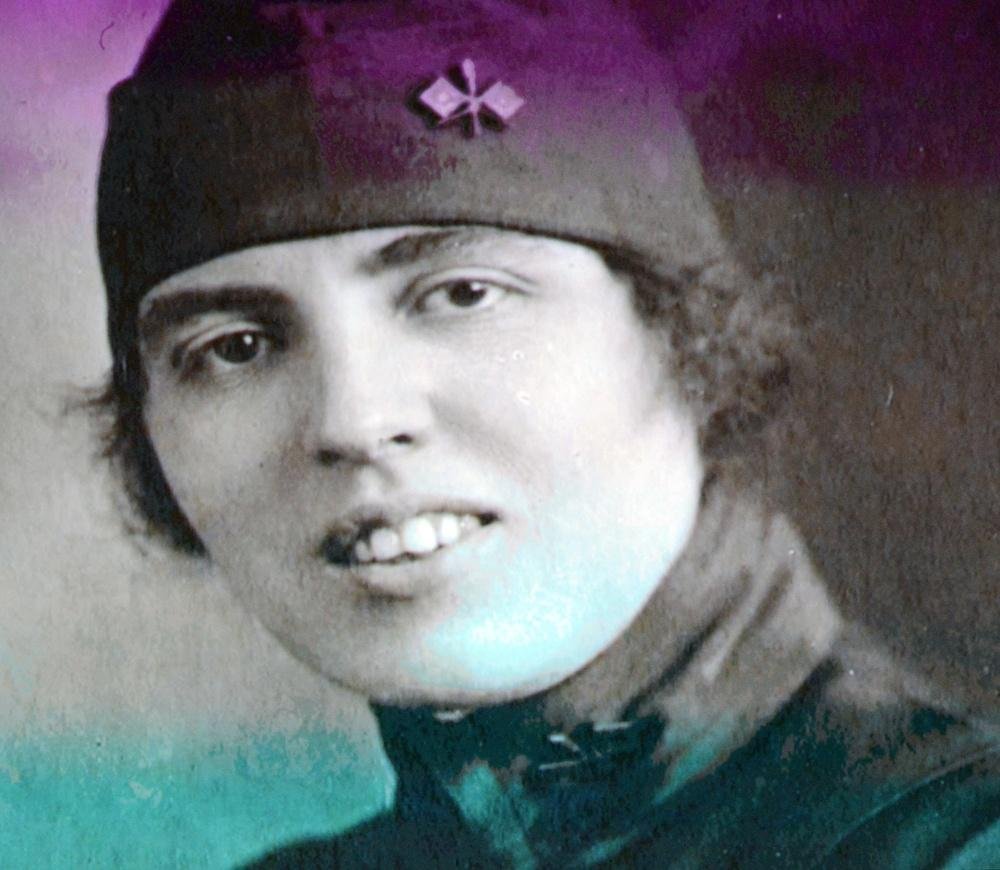
Merle Egan of Helena, Montana, wearing her U.S. Army Signal Corps uniform in 1918. Source: Mountain States Monitor, September 1918. Public domain.
A Montana Telephone Operator Answers the Call
Long before she became part of military history, Merle Egan was building a successful career in Montana’s telephone industry. By the time the United States entered World War I in 1917, she had accumulated eleven years of experience working with telephone systems, including operating switchboards, supervising telephone traffic, and helping improve service in communities around the state.
Telephone service in those days required considerably more human involvement than it does now. There were no smartphones, automated calling systems, or digital networks connecting people at the touch of a screen. When someone needed to place a telephone call, a skilled operator often had to physically connect the appropriate lines at a switchboard. Operators needed quick hands, excellent concentration, technical knowledge, and the ability to manage multiple conversations without turning the whole operation into a tangled mess.
I have enough trouble untangling fishing line, and I’ve got considerably more fingers than most folks. The idea of keeping an entire telephone exchange functioning with a maze of cords and plugs sounds like something best left to people with a little more patience than this old Bigfoot.
Merle, however, was exceptionally well suited to the work. Her experience extended beyond simply connecting calls. She understood telephone equipment, knew how to solve technical problems, and had worked with systems in rural Montana communities where dependable communication wasn’t always easy to maintain. Those practical skills would eventually make her particularly valuable to an Army preparing for modern warfare on an enormous scale.
When the United States entered World War I, American military leaders faced the monumental task of moving soldiers, equipment, supplies, and information across the Atlantic. General John J. Pershing, commander of the American Expeditionary Forces, understood that communication would be vital to military operations. The existing telephone infrastructure in France was not sufficient for the rapidly expanding American presence, and the Army needed an organized system that could connect military headquarters, command posts, supply operations, and other essential facilities.
There was just one problem. The Army needed experienced telephone operators, and in the United States, many of the people best qualified for those jobs were women.
The military began recruiting skilled operators, particularly women who could speak both English and French. Thousands applied for the opportunity to serve overseas, even though the assignments would take them into a country devastated by years of war. The women selected for service became known as the Hello Girls, a nickname that reflected the familiar telephone greeting of the era.
Among those who answered the call was Merle Egan of Helena, Montana.
From Rural Montana to Wartime France
In August 1918, Merle arrived in France to begin her service with the Army Signal Corps. She had left behind the familiarity of Montana for a European continent that had endured nearly four years of devastating warfare. American troops were engaged in major military operations, and the pressure on the communications network was tremendous.
Merle’s first assignment turned out to be somewhat different from what she had expected. Instead of simply operating a telephone switchboard, she was assigned to Tours, France, where she would teach male soldiers how to operate military telephone equipment. The Army had discovered that the field switchboards used in some of its operations resembled systems Merle had already encountered during her years working in rural Montana.
It was an unexpected example of how experience gained in small communities could become valuable on the other side of the world. The same skills that helped Merle maintain and improve telephone operations in the Treasure State were now being put to work supporting an army engaged in a global conflict.
Unfortunately, her experience and qualifications didn’t immediately impress everyone.
In her later recollections, Merle described encountering soldiers who weren’t particularly enthusiastic about taking instruction from a woman. The idea that a female telephone operator could teach them something important apparently struck some of the men as amusing. Merle, however, understood the seriousness of the assignment and wasn’t about to let their attitudes interfere with the job.
She reminded her students that the safety of an entire military division might depend on the soldier operating a telephone switchboard. A missed connection, delayed instruction, or communication failure could have consequences far beyond the telephone room. Military commanders needed accurate information to coordinate troop movements, request assistance, and respond to conditions that could change rapidly during a battle.
According to Merle’s account, that explanation helped put an end to the foolishness.
I’ve always figured there’s a difference between being confident and actually knowing what you’re doing. Sometimes the fellow making the most noise in the room is the one who needs the lesson the most. Merle didn’t need to win an argument about whether a woman belonged in charge of training soldiers. She needed those soldiers to understand their responsibilities, and she had the knowledge to teach them.
Her work demonstrated something military leaders were beginning to recognize: modern warfare depended on far more than the soldiers carrying rifles. Behind every major operation was an enormous network of people whose specialized skills helped keep the Army functioning. Telephone operators were an important part of that system, even if their contributions weren’t always visible to the public.
For Merle, the opportunity to demonstrate those skills was about to become even greater.
A Helena Woman at the Paris Peace Conference
On November 11, 1918, an armistice brought an end to the fighting on the Western Front. After years of destruction and unimaginable loss, the guns finally fell silent. Soldiers and civilians throughout Europe began looking toward the possibility of peace, while American service members hoped that the end of fighting would eventually mean a return home.
Merle’s journey, however, was about to take another remarkable turn.
Just two days after the armistice, she learned that she had been selected to become chief operator for the American Peace Commission in Paris. It was an assignment that placed a telephone operator from Helena in the middle of one of the most consequential diplomatic gatherings of the twentieth century.
The Paris Peace Conference brought together representatives of nations attempting to establish the terms of peace after World War I. Among the prominent leaders involved were American President Woodrow Wilson, British Prime Minister David Lloyd George, French leader Georges Clemenceau, and Italian Prime Minister Vittorio Orlando. Their negotiations would influence national boundaries, international relationships, and political developments for decades to come.
Merle’s responsibility was not to participate in those negotiations, of course. Her job was to help maintain the telephone communications that supported the American delegation. She later recalled handling calls associated with some of the most influential political figures in the world, an extraordinary responsibility for someone whose career had begun with telephone operations in Montana.
Consider how much her circumstances had changed in just a few months. She had traveled from Helena to France during wartime, trained soldiers on military communications equipment, and then found herself overseeing telephone operations connected to international peace negotiations. The technical knowledge she’d developed in Montana had carried her into a position she could hardly have imagined when she first entered the telephone business.
Now, I’ve wandered across a fair amount of this country, and I’ve found myself in some unusual situations. But I can’t say I’ve ever gone from working on a problem in rural Montana to helping keep communications running for a gathering of world leaders. That’s quite a career move, even by Montana standards.
Merle continued her work in Paris until late May 1919. When her assignment ended, she returned to the United States with an impressive record of service and a commendation for meritorious service from General Pershing. She had answered the Army’s call, carried out her duties, and contributed to an operation of tremendous national importance.
What she didn’t know was that the most frustrating chapter of her story was still ahead.
When the Army Said She Wasn’t a Soldier
After returning to Montana, Merle married Harold R. Anderson, who also worked in the telephone industry. Her husband was understandably proud of her service during the war, and he wanted her to receive the World War I Victory Medal. Believing she had earned the recognition, he wrote to the Army to inquire about obtaining it.
The response was not what either of them expected.
The Army informed the Andersons that Merle had been classified as a civilian employee rather than a member of the military. Despite her service overseas, her military uniform, her oath, and her work under Army authority, she was not considered eligible for the recognition she had expected.
The distinction wasn’t merely a matter of wording. Being officially classified as a civilian rather than a veteran affected the recognition and benefits available to the women who had served as Signal Corps telephone operators. Their service had been essential enough for the Army to recruit them, send them overseas, and place them under military command, yet the government’s interpretation of their status did not acknowledge them as military veterans.
It was a complicated legal and administrative issue rooted in the military regulations of the period, particularly the way women’s service was classified. But for Merle and the other Hello Girls, the contradiction was difficult to accept. They had been recruited to serve their country, had fulfilled their assignments, and had followed the military’s rules. Now they were being told that their work didn’t qualify as military service.
I suspect most of us have dealt with government paperwork that didn’t make much sense. Maybe you’ve spent an afternoon trying to convince an office that you actually exist, or that the document you’re holding is the same document they insisted you bring. But Merle’s situation was considerably more serious than an inconvenient form or a missing signature. It involved the official acknowledgment of what she and hundreds of other women had done for their country.
Merle believed the decision was wrong, and she wasn’t willing to accept it simply because it came from the War Department.
What began as a request for a medal eventually became a decades-long campaign for recognition.
A Battle That Lasted Longer Than the War
Merle wasn’t the only Hello Girl who believed her military service had been unjustly classified. Other operators had experienced the same disappointment, and efforts to obtain recognition began long before the issue finally reached a successful conclusion.
The women had substantial evidence to support their case. They had taken military oaths, worn Army uniforms, traveled under military authority, and followed the orders of military officers. Their assignments were documented, and their work had been performed in direct support of American military operations overseas.
Yet changing the government’s position proved remarkably difficult.
Over the following decades, Merle worked with fellow operators, veterans’ organizations, lawmakers, and other supporters to pursue official recognition. Congressional efforts were introduced, but progress was slow. Some proposals failed, others stalled, and the women continued growing older while the question of their military status remained unresolved.
Merle also faced personal challenges that affected her ability to devote time to the campaign. During the Korean War, her son was seriously wounded, and she later recalled temporarily stepping away from the recognition effort while dealing with family responsibilities. Her determination to see the matter resolved, however, did not disappear.
By the 1970s, renewed attention was being directed toward the Hello Girls and other groups whose wartime service had not been formally recognized. Advocates gathered documents, researched military records, and worked to demonstrate that the women had served under conditions that warranted veteran status.
A Seattle attorney named Mark Hough became involved in the effort in 1975, helping develop the legal case and working with other supporters, including Patricia Leeper. Merle provided firsthand testimony describing her experiences in France and the circumstances under which the women had served.
Her testimony was especially important because she could speak directly to the Army’s treatment of the operators. She had been there. She knew the assignments she’d received, the orders she’d followed, and the responsibilities she’d carried. She could explain how the Army had recruited and supervised the women during the war, as well as the contradiction between their actual service and their later classification.
The effort wasn’t simply about correcting an old bureaucratic mistake. It was about preserving an accurate record of American military history and acknowledging the contributions of women who had served their country during a critical period.
As the years passed, that mission became increasingly urgent. Many of the original Hello Girls had already died, and those still living were elderly. Every additional delay meant fewer women would survive to receive the recognition they had sought for so long.
Merle continued pressing forward, determined that their service would not be forgotten.
Finally, the Recognition They Deserved
On November 23, 1977, President Jimmy Carter signed legislation establishing a process through which certain groups previously classified as civilian employees could receive recognition for their wartime service. The law represented an important breakthrough for the Hello Girls, although additional administrative steps were needed before qualifying women received their official military documentation.
After more than half a century of advocacy, the long campaign was finally reaching a successful conclusion.
On August 28, 1979, Merle Egan Anderson attended a ceremony at Fort Lawton in Seattle, Washington, alongside fellow Hello Girls Marjorie McKillop and Alma Hawkins. There, the women received their honorable discharge papers, officially documenting the military service they had performed more than sixty years earlier.
It’s difficult to imagine what that moment meant to Merle. She had been a young woman when she traveled to France in 1918, eager to do her part during a world war. By the time she received her discharge papers, she had spent decades trying to convince the government to acknowledge the very service for which it had recruited her.
In the years between, America had endured another world war, the Korean War, and the Vietnam War. Presidents had come and gone, generations had grown up, and the world had changed in ways that would have been almost unimaginable in 1918. Yet Merle had continued pursuing the recognition she believed the Hello Girls deserved.
The outcome was a victory, but it also carried a measure of sadness. Many of the women who had served alongside her were no longer alive to see their military service officially recognized. Their contributions had been made during World War I, but the acknowledgment came so many years later that some never had the opportunity to receive it personally.
Merle lived long enough to see that change, and her persistence helped ensure the records of the Hello Girls would finally reflect their service.
For a woman who had once been told she was merely a civilian employee, receiving those discharge papers must have been a remarkable moment.
The Legacy of the Hello Girls
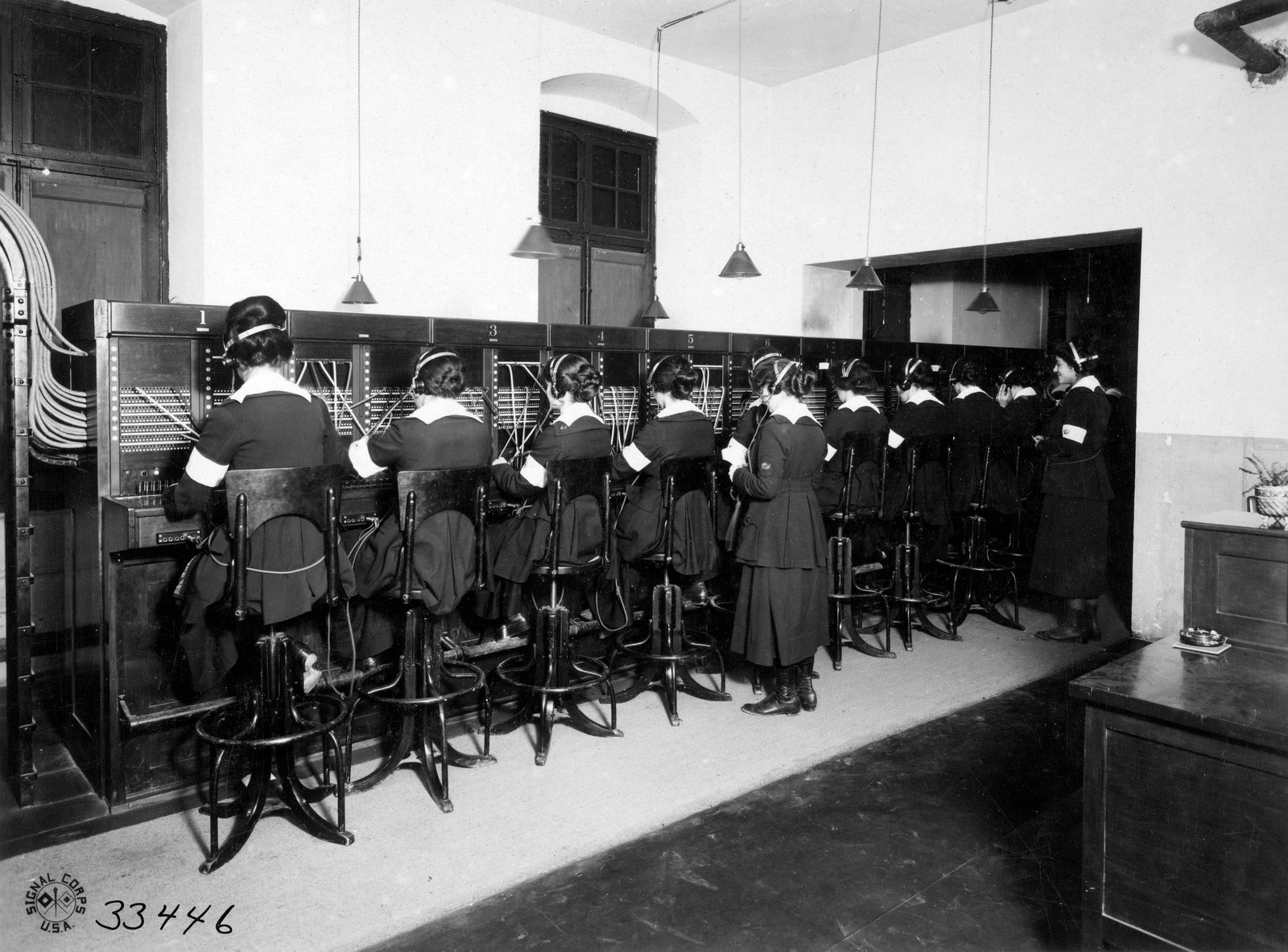
U.S. Army Signal Corps telephone operators working at General Headquarters in Chaumont, France, during World War I. National Archives, 111-SC-33446. Public domain.
Merle Egan Anderson died in 1986, but the story of the Hello Girls continued to gain recognition. Historians, military organizations, researchers, and descendants worked to preserve the experiences of the women who served with the Army Signal Corps during World War I.
Their photographs, uniforms, letters, and military records became important pieces of the historical record, helping later generations understand the significant role women played in military communications. Their service also demonstrated how specialized civilian skills could become indispensable during wartime, even when the institutions relying on those skills had not yet developed fair or consistent ways to recognize the people providing them.
In December 2024, more than a century after the Hello Girls traveled overseas, Congress authorized a Congressional Gold Medal honoring the women collectively for their contributions during World War I. The legislation represented another milestone in a recognition effort that had begun generations earlier.
That continuing acknowledgment says something important about how history is remembered. We tend to focus on the people whose names appear in textbooks, the generals who commanded armies, and the presidents who shaped national decisions. Those figures certainly played important roles, but their achievements depended on countless other people whose work rarely attracted the same attention.
During World War I, communications operators helped military personnel exchange vital information, coordinate operations, and carry out orders. Their work didn’t always happen where photographers or newspaper correspondents were looking, but that didn’t make it any less necessary.
Merle Egan Anderson understood the importance of that work because she’d performed it herself. She also understood that the women who served deserved more than a passing mention in the historical record. They deserved to have their contributions acknowledged as military service.
Her determination helped make that possible.
A Montana Veteran Worth Remembering
Every Veterans Day, Americans pause to honor the men and women who have served in the United States Armed Forces. We remember their sacrifices, their courage, and their willingness to accept responsibilities that often demanded more than most people can imagine.
Merle Egan Anderson’s story offers a reminder that military service has always taken many forms. Not every important assignment takes place on a battlefield, and not every person who contributes to a military operation becomes a familiar name in history. Sometimes the work happens behind a telephone switchboard, in a communications center, or in one of the countless supporting roles that allow an army to function.
Merle was an experienced Montana telephone operator who answered her country’s call during World War I. She used her skills to train soldiers, helped manage communications during the Paris Peace Conference, and returned home believing she’d served her country honorably. When the government refused to recognize that service, she spent decades working to correct the record.
Her efforts helped secure recognition not only for herself but also for other women who had served alongside her. It was a legacy built on professional skill, military service, patience, and an extraordinary amount of determination.
I’ve spent a good many years wandering around Montana, and if there’s one thing I’ve learned about the people who call this place home, it’s that we can be a mighty stubborn bunch when something matters to us. Sometimes that stubbornness makes life more complicated than it needs to be, but every so often, it helps accomplish something remarkable.
Merle Egan Anderson was a pretty good example of the latter.
So this Veterans Day, when we remember those who served our country, let’s also remember a telephone operator from Helena who traveled halfway around the world, helped the Army communicate during one of history’s most devastating wars, and then spent much of her life fighting to make sure that service would never be forgotten.
Her name deserves a place in Montana history, and in the history of American military service.
And thanks to her determination, the Hello Girls finally received the recognition they had earned.
I’m Montana Max, and I appreciate you spending a little time exploring Montana’s remarkable history with me. If you enjoyed Merle’s story, share it with a veteran, a history lover, or someone who appreciates the extraordinary things ordinary people can accomplish.
You can hear more of this story on The 406 Life podcast, where we explore the people, places, legends, and adventures that make Montana one remarkable place to call home. Visit The406Life.com for more stories, and take a look at our 406 Life merchandise while you’re there. Your support helps keep these Montana stories coming.
Until next time, keep exploring, keep learning, and never underestimate a determined Montanan.
Sources for the article
- Montana Historical Society: Merle Egan Anderson
- Merle Egan Anderson’s congressional-hearing affidavit
- National Archives: Hello Girls
- HistoryLink: The Hello Girls and Their Recognition
- Public Law 95-202 (1977)
- U.S. House: Congressional Gold Medal Recipients
I’m Montana Max, and I appreciate you spending a little time exploring Montana’s remarkable history with me. If you enjoyed Merle’s story, share it with a veteran, a history lover, or someone who appreciates the extraordinary things ordinary people can accomplish.
You can hear more of this story on The 406 Life podcast, where we explore the people, places, legends, and adventures that make Montana one remarkable place to call home. Visit The406Life.com for more stories, and take a look at our 406 Life merchandise while you’re there. Your support helps keep these Montana stories coming.
Until next time, keep exploring, keep learning, and never underestimate a determined Montanan.
Leave a Reply
You must be logged in to post a comment.