
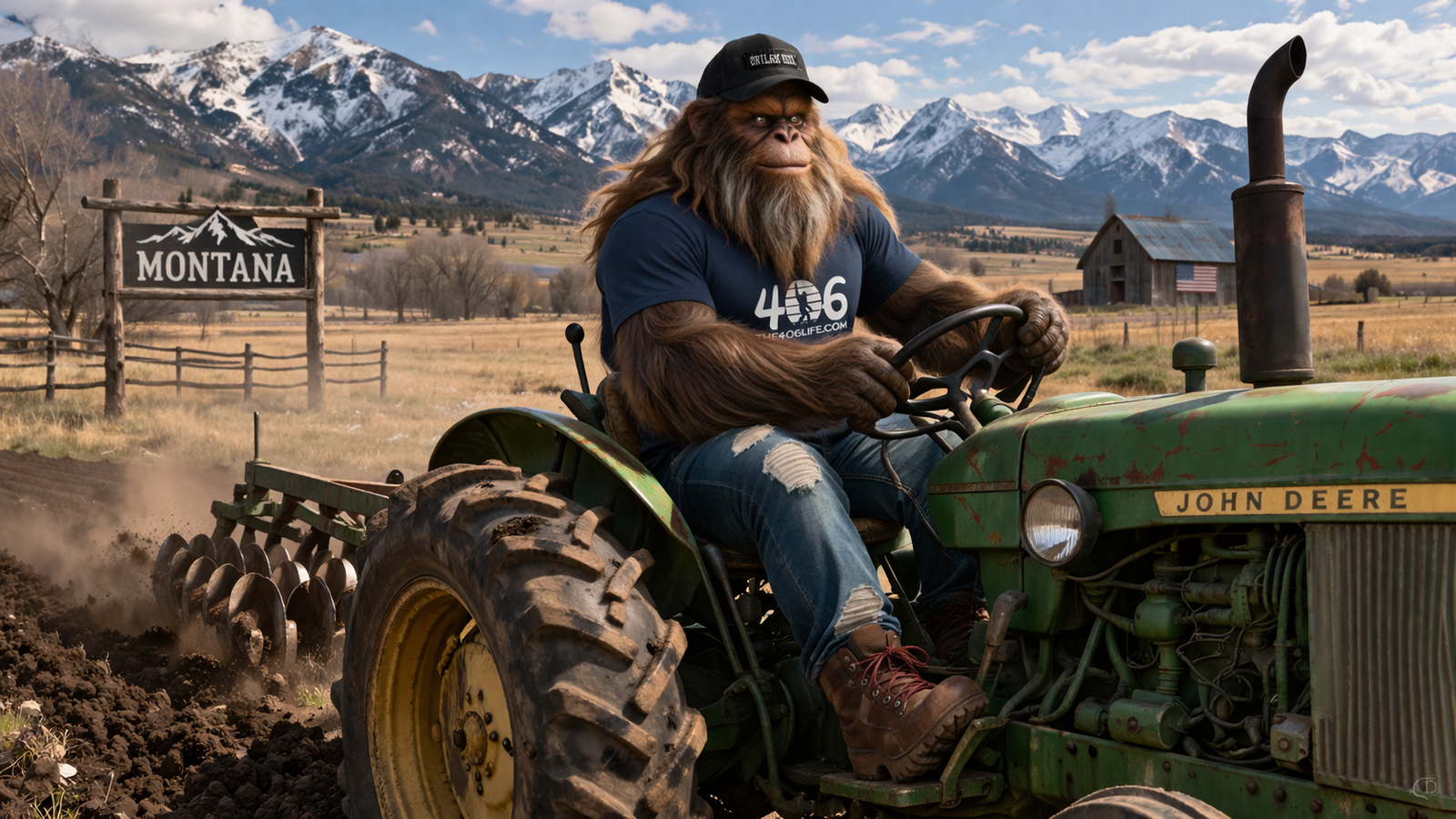
Montana Agriculture Month: The Industry That’s Been Feeding the World Since Before I Learned to Walk Upright
Which, for the record, took me a while. Big feet. Uneven terrain. Moving on.
Alright. Pull up a log. Get comfortable. I been watching humans do a funny thing for about as long as I can remember — which is a long time, because I am very old and also very large — and the thing they do is this: they look at Montana and they see the mountains and the Yellowstone sign and the ski lodges, and they say “tourism, that’s the whole economy right there,” and then they drive back to wherever they came from and I eat some huckleberries and shake my head at them from the treeline.
Because they are wrong. They have always been wrong. Agriculture is Montana’s number one industry — not barely, not by a squeaker, but by a country mile — and March is officially Montana Agriculture Month on account of Governor Gianforte signing a proclamation saying so, with March 23 called out specifically as Montana Agriculture Day.
Now. I want to tell you some things. Real things, with numbers you can look up. Because I may be a bigfoot, but I am not a rumor spreader. I’ve had enough of that in my own life, thank you very much.
Speaking of rumors: yes, I was in the Patterson-Gimlin film. No, I will not discuss my gait. I had a pulled hamstring. It was a bad week. We are moving on.
- 1 in 6 Montana workers tied to agriculture
- 24,000 farms and ranches in the state
- 56.5M acres of farmland — #2 in the nation
- $4.6B in annual ag cash receipts
Fifty-six and a half million acres. I’ve walked most of ’em. Took a while. My stride is longer than most, but it’s still a lot of ground. That’s the second-largest farm footprint of any state in the nation, and it accounts for around five percent of total state GDP, and about one in every six Montana workers is connected to agriculture in some way.
What Montana Actually Grows (It’s a Lot More Than You Think)
Most folks say: Montana. Wheat. Cows. Done. And they’re not wrong exactly, but that’s like saying I’m just “a large mammal with hair.” Technically accurate. Missing significant detail.
Let’s start with wheat, because it is genuinely enormous. Montana ranks around third in the nation for total wheat production — and first in the entire country for certified organic wheat. About half a million acres of organic wheat go in the ground here every year, more than any other state. Fort Benton and the Golden Triangle up north have mills like Montana Flour & Grains that have been shipping organic wheat around the world for decades.
Cattle and calves are the single biggest commodity by cash receipts — roughly one point five to one point six billion dollars a year, depending on the year. Montana typically runs more cattle than people. Over two and a half million head, grazing from the Hi-Line down to the Big Hole. Beaverhead, Fergus, Big Horn, and Phillips counties are consistently at the top of the cattle charts.
I personally have more in common with the cattle than with the people sometimes. We’re both large, both outdoors, both misunderstood. The main difference is I’ve never been tagged in the ear.
Now here’s where it gets interesting. Here’s what people outside Montana genuinely do not know:
Montana is the number one lentil producer in the entire United States. Not close. In 2024, Montana grew about 74 percent of all U.S. lentils. The state leads the whole nation in pulse crops overall — lentils, dry peas, chickpeas — on roughly 1.2 million acres. Most of that crop ships overseas, to India and Turkey and Mediterranean markets.
Montana is the second-largest honey producer in the country, right behind North Dakota. Around 193,000 bee colonies in this state put out close to 15 million pounds of honey every year, thanks to long summer days, cool nights, and all that clover and alfalfa.
I have sampled the honey. I will not apologize. Several beekeepers near Hobson have reported a “very large bear” and I would like to state for the record that I am not a bear, and also that their honey is excellent, and also that I was never there.
Throw in barley (Montana is top-two in the nation, critical for the malting and beer industries), sugar beets, hay, safflower, flax, canola, cherries, potatoes, sheep and wool — and you start seeing the full picture. This is not a one-crop state. This is a whole operation. Four point six billion dollars a year, feeding people across the country and around the world, most of it happening without a single camera pointed at it.
“Montana ag generates roughly $4.6 billion in annual cash receipts — about 5% of total state GDP. Probably more than whoever sold you that Yellowstone hat made.” – Montana Max
Calving Season: The Super Bowl Nobody Televises
While the rest of Montana is posting “first day of spring!” photos on their phones, ranchers are deep in the most exhausting stretch of their entire year. Calving season. January through April, depending on the operation. And here is what that actually looks like, because I have watched it happen from the trees many times and I have tremendous respect for it.
Bulls go out in late June so calves start hitting the ground in late winter and early spring. In practice, that means someone is checking the heifers and cows every two hours, around the clock. Ten PM. Midnight. Two AM. Four AM. Six AM. Larger operations hire a “night man” whose entire job is to live on that schedule until the season is over.
Two AM checks in a Montana March blizzard. I do not need sleep, technically speaking, but even I find the 2 AM darkness in a calving lot to be a lot. These ranchers are built different. I have watched them haul newborn calves into truck cabs to warm them up, then stand in the cold doing math on whether the mother is going to accept the calf back. That is some serious presence of mind at 2 in the morning.
The margin is thin. A calf born in a dry, thirty-degree breeze is fine in minutes. A calf born in a March blizzard has minutes before hypothermia takes hold. In 2022, ranchers Shaylyn and Tristan Stark near Baker rode out back-to-back March storms that dumped a combined sixty inches of snow and drove fifty-mile-per-hour winds through their herd. They estimated losing twenty percent of their calf crop that year.
Montana State University Extension put out a calving season prep guide that reads like a disaster response checklist: extra colostrum on hand, OB chains and calf pullers ready, backup generators for well houses, windbreaks in place, bedded calving lots, a plan for when the power goes out in the middle of a storm.
March on a Montana ranch is not a shoulder season. It is finals week, fire drill, Super Bowl, and a sleep deprivation experiment rolled into thirty days. I have not personally helped with calving because my hands are — well, you’ve seen the plaster casts — but I have enormous respect for the people who do.
2026: International Year of the Woman Farmer
If you learn everything you know about ranching from television, you might think it’s mostly tall men standing on hillsides looking at sunsets. Reality is considerably more complicated and considerably more female.
In the U.S., about 36 percent of all farmers are women, and women are principal operators or decision-makers on nearly half of all U.S. farmland. Globally, women produce more than half of the world’s food.
In 2024, the United Nations General Assembly officially declared 2026 the International Year of the Woman Farmer — IYWF — co-sponsored by 123 countries, with the goal of highlighting women’s roles in food systems and pushing governments to remove the barriers that still exist around land access, credit, and extension services.
Montana moved on it. The Montana Department of Agriculture opened nominations to recognize women throughout 2026, from multi-generation ranch matriarchs to first-generation operators who started on leased ground. Director Jillien Streit, who describes herself as a “proud farm mom, farm wife, and ag business entrepreneur,” is using the campaign to put those stories front and center.
Montana Farmers Union hosted multiple women’s conferences this past winter — one at Fairmont Hot Springs for western and central members, one in Sidney for the eastern side. Sessions covered succession planning, farm finance, mental health, and building local food markets.
I tried to attend a women’s conference once. They asked me to sign the waiver and I do not have a legal name on record, so we hit a wall pretty early. But I respect the work deeply. My mother, incidentally, was the one who taught me to navigate by the stars and to find the good huckleberry patches. She ran everything. I just got the fame.
One of the best concrete examples happening right now is a documentary called Mother Range, which premiered at the Big Sky Documentary Film Festival in Missoula in February 2026. It follows Amber Smith, a first-generation rancher on the eastern plains, and Jaimie Stoltzfus, a first-generation grazier near the Absarokas. They run a collaborative beef operation together: Smith calves and winters the herd, Stoltzfus grass-finishes the cattle near the mountains, and together they sell Montana-raised beef directly to Montana consumers. Regenerative agriculture, mothering, and direct marketing all in one story.
Stoltzfus said in the film: “Being a rancher has made me a better mom, and I think being a mom makes me a better rancher.”
That’s the kind of thing I’d write on a barn wall if I had better grip strength. And smaller hands. It’s really a whole thing.
Why This March Matters More Than Most
Governor Gianforte’s 2026 proclamation ties Montana Agriculture Month directly to the International Year of the Woman Farmer. It names women’s “vital role in the stewardship of Montana’s lands and the health of its rural communities,” and it formally acknowledges that agriculture is still the state’s top industry — even as the headlines stay locked on tourism numbers, Netflix shows, and real-estate speculators buying up ranches to feel like cowboys on weekends.
It also lands during a particular moment. This winter ran historically mild, with below-average snowpack, and ranchers and farmers are already watching the water situation for summer with real concern. New climate impact reports warn of more variable precipitation, hotter summers, and higher irrigation costs going forward — alongside longer growing seasons in some areas, for those who can adapt.
And women in Montana agriculture are more organized than they have ever been — through Farmers Union, through Extension, through co-ops and film festivals and nomination campaigns — and 2026 is giving them a microphone that reaches farther than the county line for once.
“While the rest of the world sees Montana as a backdrop for TV, the real story is in calving barns at 2 AM, lentil fields on the Hi-Line, and kitchen tables where women are running both the books and the branding irons.”
So when you see “March is Montana Agriculture Month” on a sign at Murdoch’s, or on a banner over some two-lane main street in a farm town — that is not filler. That is a reminder. The real Montana economy has been out there in the dark and the cold and the wind, every single year, long before the cameras showed up. And it will be there long after the cameras leave.
I know. I’ve been watching from the trees for a very long time.
Now if you’ll excuse me, I need to go find some huckleberries and also check on the calving situation out near Drummond, because I have a soft spot for spring calves and also for not being spotted by anyone with a phone camera.
How many bigfoots does it take to harvest a lentil crop? Nobody knows. We’re never officially there.
Here are all the sources used in the article, with active links:
Montana Agriculture Month — Sources
Governor’s Proclamation & Ag Month
- Governor Gianforte Proclaims March As Montana Agriculture Month (2026): https://news.mt.gov/Governors-Office/Governor-Gianforte-Proclaims-March-As-Montana-Agriculture-Month
- Montana Ag Community Gets Big Honor from Governor Gianforte: https://560kmon.com/gianforte-montana-ag-honor/
- March is Ag Month — Hi-Line Today: https://hilinetoday.com/march-is-ag-month/
- Montana’s Agriculture Remains Top Industry (Glasgow Today, March 2026): https://nationaltoday.com/us/mt/glasgow-mt/news/2026/03/26/montanas-agriculture-remains-top-industry/
Montana Ag Economic Stats
- Economic Impact of Agriculture — Montana (University of Arkansas): https://economic-impact-of-ag.uada.edu/montana/
- Montana’s Principal Agricultural Commodities — Farm Flavor: https://farmflavor.com/montana/montana-crops-livestock/montanas-principal-agricultural-commodities/
- Montana Top 10 Agricultural Commodities — Farm Flavor: https://farmflavor.com/montana/montana-crops-livestock/montana-top-10-agricultural-commodities/
- Montana | America’s Heartland: https://www.americasheartland.org/state/montana/
- Montana Department of Agriculture — NASDA: https://www.nasda.org/state-department/montana-department-of-agriculture/
Wheat & Organic Farming
- States and the Foods They Produce the Most (The Takeout): https://www.thetakeout.com/2037290/states-and-the-foods-they-produce-the-most/
- Montana Flour & Grains: https://montanaflour.com
- Organic & Non-GMO Report — Montana Flour & Grains: https://non-gmoreport.com/directory-of-organic-non-gmo-and-regenerative-supplies/montana-flour-grains/
Pulse Crops / Lentils
- Montana Pulse Crop Industry Expands to Largest in the US in 2024 (Northern Ag Network): https://www.northernag.net/montana-pulse-crop-industry-expands-to-largest-in-the-us-in-2024/
- Montana Pulse Production Leads The Way In 2025: https://mtpulsecrops.org/montana-pulse-production-leads-the-way-in-2025/
- InFARMation: Lentils — Central Montana: https://centralmontana.com/infarmation/lentils/
- Montana’s 1.2-Million-Acre Pulse Crop System (YouTube, March 2026): https://www.youtube.com/watch?v=WRpLjZdHz2o
Honey Production
- Montana Second-Largest Honey Producer in Nation (Organic Consumers): https://organicconsumers.org/montana-second-largest-honey-producer-nation/
- Leading Honey-Producing States In The US (World Atlas): https://www.worldatlas.com/articles/leading-honey-producing-states-in-the-us.html
- What’s the Buzz in Montana? (Farm Flavor): https://farmflavor.com/montana/montana-crops-livestock/whats-the-buzz-in-montana/
- What Is Montana Honey? (BeesWiki): https://beeswiki.com/montana-honey/
Calving Season
- Calving Time in Montana — Treasure State Lifestyles: https://treasurestatelifestyles.com/calving-time-in-montana/
- Spring Time in Montana: Calving — Western Ranch Brokers: https://westernranch brokers.com/spring-time-in-montana-calving/
- For Montana Ranchers, It’s That Time of Year: Calving Season (AP News): https://apnews.com/general-news-77a6be8c59da1d889abfabfaee766be7
- Bitterroot Ranchers Deep Into Calving Season (NBC Montana): https://nbcmontana.com/news/local/bitterroot-ranchers-deep-into-calving-season
- Montana Ranchers Weather Challenges to Preserve Ranch (DTN, Feb 2026): https://www.dtnpf.com/agriculture/web/ag/news/farm-life/article/2026/02/13/montana-ranchers-weather-challenges
- Night Checks During Calving — Pine Ranch: https://www.pineranch.ca/post/night-checks-during-calving
- The Night Calver — Offrange/Ambrook: https://ambrook.com/offrange/perspective/the-night-calver-cometh
- Calving Season is a Round-the-Clock Job (Rocky Mountain PBS): https://www.rmpbs.org/blogs/_/calving-season-is-a-round-the-clock-job-for-mother-daughter-duo
- Preparing for Calving Season — Montana State University Extension (PDF): https://www.montana.edu/extension/montguides/montguidepdfsforstore/MT202405AG_Preparing_for_Calving_Season.pdf
International Year of the Woman Farmer
- FAO — International Year of the Woman Farmer 2026 (Official UN/FAO Page): https://www.fao.org/woman-farmer-2026/en
- USDA Blog — Gearing Up to Celebrate the International Year of the Woman Farmer: https://www.usda.gov/about-usda/news/blog/gearing-celebrate-international-year-woman-farmer
- IFPRI — International Year of the Woman Farmer: https://www.ifpri.org/landing/international-year-of-woman-farmer-iywf/
- National Farmers Union — International Year of the Woman Farmer: https://nfu.org/events-programs/international-year-of-the-woman-farmer/
- World Farmers’ Markets Coalition — IYWF 2026: https://www.worldfarmersmarketscoalition.org/international-year-of-the-woman-farmer-2026-recognizing-the-women-who-feed-the-world/
- Montana Department of Agriculture — IYWF Nominations Open: https://agr.mt.gov/News/International-Year-of-the-Woman-Farmer-Nominations-2025
- Women Who Made Agriculture Work in Montana (Yahoo/Feb 2026): https://www.yahoo.com/lifestyle/articles/women-made-agriculture-montana-110425037.html
- Women in Agriculture: Montana Farmers Union Building Community (Montana Right Now, March 2026): https://www.montanarightnow.com/features/mt-family-farms/women-in-agriculture-how-montana-farmers-union-is-building-community
Montana Farmers Union Women’s Conferences
- Montana Farmers Union Women’s Conferences (main page): https://montanafarmersunion.com/news-events/womens-conference/
- Fairmont Women’s Conference 2026: https://montanafarmersunion.com/news-events/womens-conference/womens-conference-fairmont/
- Eastern Women’s Conference — Sidney: https://montanafarmersunion.com/news-events/womens-conference/eastern-womens-conference/
Mother Range Documentary
- Mother Range Film — Zach Altman Media: https://www.zachaltmanmedia.com/motherrangefilm
- KPAX — Big Sky Doc Film Festival Highlights Collaborative Ranching: https://www.kpax.com/news/montana-ag-network/montana-ag-network-big-sky-documentary-film-festival-highlights-collaborative-ranching
- KXLH — Montana Ag Network: Mother Range Film Festival Coverage: https://www.kxlh.com/news/montana-ag-network/montana-ag-network-film-festival-highlights-collaborative-ranching-with-mother-range
- Big Sky Doc Film Festival — National Today coverage (Feb 2026): https://nationaltoday.com/us/mt/missoula/news/2026/02/22/big-sky-documentary-film-festival-highlights-collaborative-ranching/
Snowpack / Climate Context
- March 2026 Snowpack Totals (YouTube): https://www.youtube.com/watch?v=ZOQQ4OO6dhM
- Western States Didn’t Get Enough Winter Snow (NPR, March 2026): https://www.npr.org/2026/03/22/nx-s1-5751890/western-states-didnt-get-enough-winter-snow-that-may-be-a-problem-in-the-summer
© Montana Max — All rights reserved. Especially the rights to these roads, which I’ve been using longer than the state has existed.
Wanna keep up with Montana Max and the wild ride that is The 406 Life? Follow us on Instagram for daily snapshots of Big Sky livin’, and join our Facebook crew—both the main page and the group—for local biz shoutouts, behind-the-scenes shenanigans, and real-deal Montana grit. Whether you’re scrollin’ from the mountains or missin’ ‘em from afar, we’ve got a seat ’round the digital campfire waitin’ for ya.
And don’t forget to roam through our blog, where Montana Max dishes out tales from the trail, cultural deep-dives, and a whole lotta backwoods wisdom.
Montana Max
Leave a Reply
You must be logged in to post a comment.