
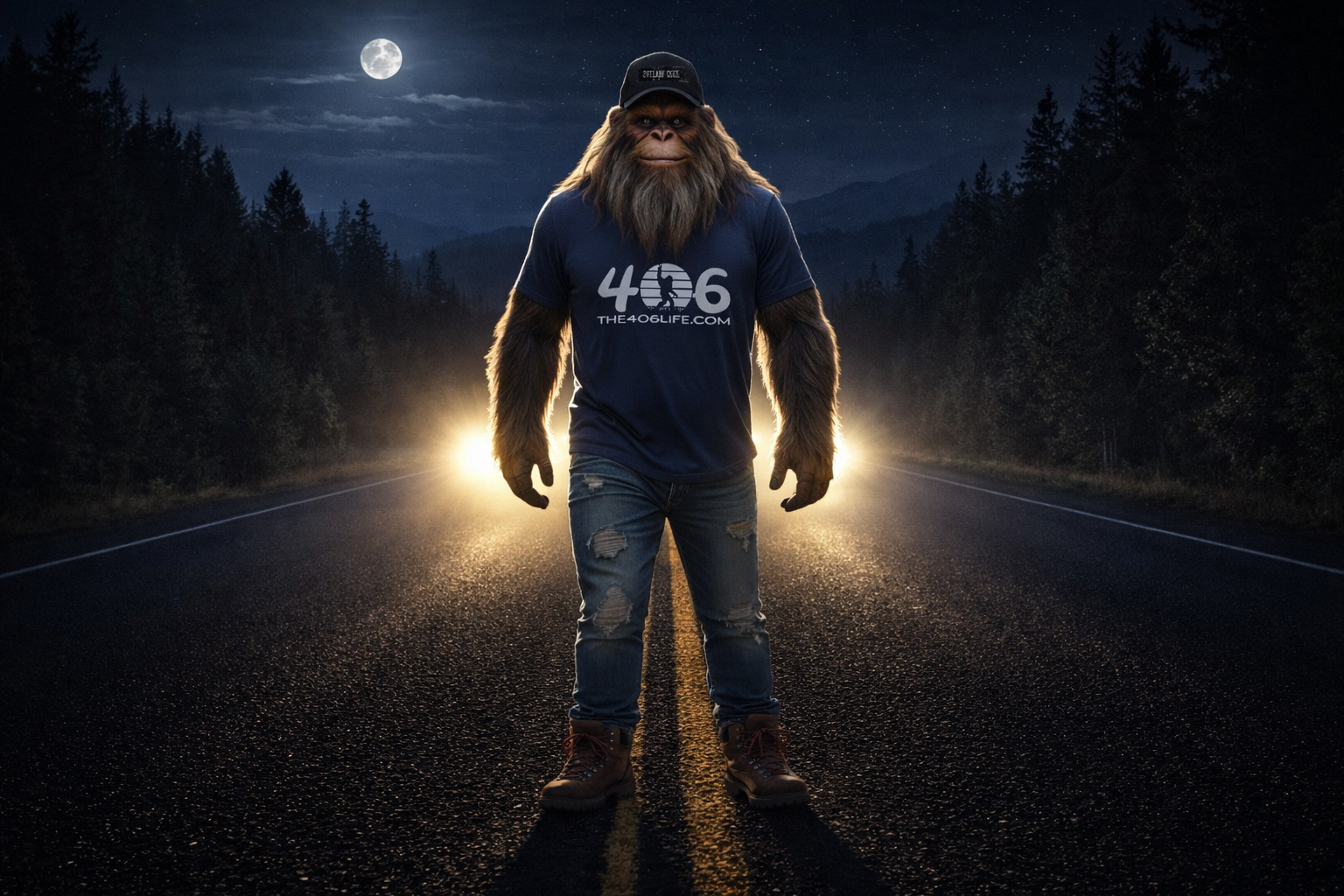
Montana Max’s Official Field Report • Est. Since Before Your Roads Existed
Written by Montana Max — Bigfoot, amateur road-safety expert, reluctant eyewitness
73,000 miles of haunted asphalt. One very large author. Zero liability.
Now look — I’ve been walking these Montana highways since long before you two-leggers paved them. I watched you go from wagon ruts to asphalt to whatever in tarnation a “roundabout” is supposed to be. And in all that time, wandering these 73,000-plus miles of open road, I have seen things that even I — a nine-foot-tall apex predator who lives alone in the wilderness — cannot fully explain.
So pull up a stump and listen close, because what follows is my comprehensive, deeply personal, occasionally terrifying account of Montana’s road ghosts, phantom collisions, and the spectral hitchhikers who have been scaring the living daylights out of your drivers for generations. I’ve cross-referenced the science, walked the corridors myself (carefully, after dark, staying off the road — I learned that lesson after the Tenley incident, more on that later), and added my own observations from decades of watching you folks drive past me and scream.
For the record: I have been misidentified as a “shadowy figure on the road” at least forty-seven times. Forty-seven. I’m not a ghost. I’m just big, dark, and tend to appear suddenly. We have more in common with these phantoms than I’m comfortable admitting.
The vast expanse of the Montana highway system — comprising more than 73,000 miles of publicly accessible roadways — serves as one of the most psychologically loaded landscapes on the continent. It’s where the sky is so wide and the roads so long that your brain starts making things up just to give itself something to do. And among all the strange reports that come out of these corridors, nothing is more consistently documented, more emotionally violent, or more stubbornly unexplained than what researchers call the “phantom collision.”
That’s the experience where a driver perceives a clear, unavoidable impact with a human figure or a vehicle — feels the thud, hears the crunch — only to discover zero physical evidence upon investigation. No dent. No blood. No body. No anything. Just you, your pounding heart, and a whole lot of empty Montana highway.
As someone who has personally startled over two hundred drivers on these very roads — unintentionally, I want to be clear — I take this topic seriously. Let’s get into it.
⁕ ⁕ ⁕
The Hitchhiker of Black Horse Lake: Highway 87’s Most Famous Specter
First and foremost, let’s talk about the one that started it all — the stretch of US Highway 87 in Cascade County running between Great Falls and Fort Benton. This corridor has earned the grim distinction of being recognized as the site of one of the most aggressive roadway hauntings in all of North America.
Consequently, I want you to understand what “aggressive” means in this context. Most ghost stories are passive. A lady in white. A floating orb. A whisper you’re not sure you heard. The Hitchhiker of Black Horse Lake is not that. This spirit takes an active, physical role in traumatizing passing motorists, and he’s been doing it — with remarkable consistency — for decades.
The Figure by the Lake That Isn’t There
Black Horse Lake is a seasonal body of water near the highway that, ironically, remains bone dry for most of the year — only filling during spring thaw and early summer. So already we’re dealing with a ghost that haunts a lake that mostly doesn’t exist, which feels appropriately poetic for Montana.
Motorists traveling at night or in the low-light hours of early morning report seeing a figure standing on the shoulder of the road near this lake. He is consistently described as a Native American man with long black hair, wearing a denim jacket and jeans or sometimes bib overalls. He stands still. He watches. He waits.
And then, as the vehicle approaches, he doesn’t step back. He doesn’t vanish gently into the ether like a considerate apparition. Instead, he launches himself — directly, deliberately — into the path of the car. He rolls over the hood. He strikes the windshield with what every single witness describes as a “deathly thud.” The impact is so real, so physically convincing, that drivers slam their brakes and pull over in a state of absolute panic.
I once startled a trucker on this same stretch — completely by accident, I was just crossing the road — and the man turned three shades of white I didn’t know existed. The difference is, when he got out to look, I was very much still there. Very large. Very embarrassed. We stared at each other for a solid thirty seconds before he got back in his truck. I waved. He did not wave back.
The Investigation That Finds Nothing
Here’s where it gets truly strange. Shaken motorists who exit their vehicles to search for the man they’ve just hit — the man they felt impact, the man whose strike on their windshield they heard — find absolutely nothing. Not a body in the ditch. Not a staggering, injured person on the shoulder. And most bafflingly of all: not a scratch or dent on the vehicle.
| Forensic Category | What Physics Says Should Be There | What Investigators Consistently Find |
|---|---|---|
| Mechanical Damage | Dents, cracks, fractured glass | Absolute absence — vehicle is pristine |
| Biological Trace Evidence | Blood, hair, tissue, clothing fibers | Complete absence — not a thread |
| Spatial Evidence | A body or moving person in the flat, open barrow pits | Nothing visible in any direction, despite clear sight lines |
Moreover, in several documented cases, drivers who searched the surrounding prairie and then glanced back at the road reported seeing the same figure — walking away in the distance, unhurried, as if nothing had occurred. Paranormal researchers classify this behavior as consistent with a “residual haunting”: a traumatic past event replaying itself in an infinite loop, completely independent of the living witnesses around it.
Local legend holds that this spirit is the ghost of a transient man killed in a hit-and-run decades ago — trapped in what some describe as “a personal hell,” forced to relive the moment of his death with every passing set of headlights. There are, notably, no official records of the accident that supposedly created him. This absence of documentation is itself part of the tragedy, as we’ll discuss when we get to the cultural weight of these stories.
“He rolls over the hood and strikes the windshield with a deathly thud — and when you stop, there is nothing but Montana and the dark.”
⁕ ⁕ ⁕
Why Your Brain Manufactures Road Ghosts: The Science of Highway Terror
Now, I’m not just a guy who lives in the woods and scares people — I’m also a guy who reads. And the scientific community has some genuinely fascinating explanations for why Montana’s highways are such a productive breeding ground for these experiences. Understanding the physiology, however, doesn’t necessarily make the events less terrifying. Trust me on that. I’ve witnessed a few myself.
Highway Hypnosis and the Dreaming Driver
Highway hypnosis — researchers abbreviate it HHy, which sounds like a cheerful little greeting, which it absolutely is not — is defined as a trancelike state in which a driver responds to external events correctly but has no conscious recollection of doing so. In plainer terms: your body is driving the car while your brain has gone somewhere else entirely.
Montana is essentially a perfect machine for producing this state. The northern plains of the state, combined with the long flat corridors leading in from North Dakota, offer hundreds of miles of terrain with minimal visual variation, minimal traffic, and the kind of hypnotic white-line repetition that can peel a person’s conscious mind right off the wheel.
Furthermore, during these states of extreme fatigue, the brain may briefly enter REM — rapid eye movement — sleep while the individual is still technically awake and upright. Dream imagery gets superimposed directly onto the real-world visual field. A hitchhiker appears because, physiologically speaking, your brain is half-dreaming one onto the shoulder of the road.
I have walked beside Highway 2 at 3 a.m. on many occasions, and I will tell you — the number of drivers who have stared directly at me and kept going, completely blank-eyed, is unsettling. I waved at one man for a full quarter mile. Nothing. Highway hypnosis is real, and frankly it makes me feel invisible. Which is saying something, given my size.
Hallucination Types You Might Encounter After Mile 400
| Hallucination Type | Mechanism | Common Road Manifestation |
|---|---|---|
| Hypnagogic Hallucination | Transition state between wakefulness and sleep | Clear, sudden images of pedestrians or animals that appear briefly and disappear |
| REM Sleep Disorder Intrusion | Unexpected REM-related imagery entering wakefulness | Complex interactions where the “ghost” may speak or appear to engage with the vehicle |
| Visual Pareidolia | Brain perceiving meaningful patterns in random data | Steam from pavement or headlight reflections interpreted as human figures — the “ghost jogger” effect |
The Thud as a Self-Defense Mechanism
Here’s the part I find most fascinating — and I say that as a creature whose own existence has been dismissed as mass hallucination for several decades. Some researchers theorize that the “phantom strike” isn’t just a hallucination. It’s a defensive hallucination.
The theory goes like this: as a driver sinks deeper into highway hypnosis, the brain detects that alertness has dropped to a dangerous threshold. Rather than gently nudging the driver awake, the subconscious does what any reasonable brain would do — it simulates the worst possible thing it can imagine. A fatal impact. A body on the hood. A sickening thud on the windshield. The resulting adrenaline surge jolts the driver back to full consciousness instantly, potentially saving their life.
In short: the ghost might be your own brain screaming at you to wake up and pay attention. I’ve been trying to tell you that for years. I just use a different method — standing very large at the edge of the road — and I keep getting maligned for it.
⁕ ⁕ ⁕
Regional Phantoms: Every Corner of Montana Has Its Own
Montana’s road ghosts are not a single monolith, mind you. They’re as varied as the terrain itself. Each corridor seems to manufacture its own specific specter, tied to the local history, the landscape, and — I suspect — the particular flavor of loneliness that each stretch of highway generates. Let me walk you through them, region by region.
The Bozeman Frontage Road: Two Ghosts for the Price of One
Near Bozeman, the Frontage Road between the city and the Bear Canyon interstate exit has developed a reputation as what I’d call a high-density haunt zone. The area sits at the forest’s edge, shaped by the historical presence of Fort Ellis, and it hosts not one but two primary spectral archetypes.
Apparition Report #1 — Bear Canyon Road
The Girl in the White Dress
Frequently sighted near Bear Canyon Road and the local campground. This entity is described as targeting female drivers specifically, attempting to lure them away from their vehicles or camping areas into the tree line. Interpretations range from the ghost of a murder victim who will only trust other women to find the site of her death, to something far darker — a “demon” wearing the appearance of a child. Whatever she is, she is consistent. And she has been seen by a remarkable number of people over a remarkable number of years.
Apparition Report #2 — Frontage Road Snowstorm Sightings
The Grizzled Man of the Woods
Appearing almost exclusively during severe snowstorms, this figure is seen walking along the Frontage Road with his head down, pressing forward through the elements in what witnesses describe as an “unremitting path.” He aligns unmistakably with the archetype of the early Montana mountain man or miner — someone who met a hard end in a Gallatin Valley winter and simply never stopped walking.
I am also frequently seen walking in snowstorms with my head down. For the record: I am not a ghost. I am just trying to get home. The weather up here is brutal and I did not bring a jacket because I have very thick fur, and even I regret that decision sometimes. If you see a large shape moving through a blizzard near Bozeman — just let me pass. I’m cold and I’m grumpy and I don’t want to be in your article.
Highway 287 Near East Helena: The Teleporting Hitchhiker
If you’re familiar with the classic Twilight Zone episode “The Hitch-Hiker,” then Highway 287 near East Helena will make the hair on the back of your neck stand at attention. Motorists on this corridor report seeing a young man wearing a hat standing by the side of the road. Standard enough. Except that after they pass him, the same man appears again a few miles down the road. And then again. And then again.
The spirit appears to keep pace with a vehicle moving at highway speed — teleporting or simply materializing ahead of the driver repeatedly, as if the road itself is looping. It’s less a haunting and more a glitch. A stutter in the landscape. And it has driven more than a few rational people to question their own sanity before they reached Helena.
The 1970s Woman of Lavina: A Ghost with Good Hair
At the intersection of Highways 3 and 12 near Lavina — north of Billings, in the vast flatness of central Montana — seasoned truckers report a very specific female ghost. She appears suddenly in headlights near a sign pointing south toward Lavina, identifiable by her unmistakably 1970s-era outfit and hairstyle. She vanishes before anyone can stop or offer a ride.
I find her fascinating because she is, as far as roadway spirits go, exceptionally well-dressed. Most of the phantoms out here are in jeans or work clothes. This woman has a look. She committed to an aesthetic, and she is maintaining it for eternity. I respect that.
Billings and the Weeping Woman of the Yellowstone
Along the riverbanks near Billings, travelers report a woman in a flowing white gown wandering the road, crying, only to vanish when approached. She is the quietest and most classically tragic of Montana’s highway specters — closer to the old folklore archetypes of the “weeping woman” or La Llorona than to the violent collision phantoms elsewhere.
On Airport Road in Billings, meanwhile, there are reports of a “ghost jogger” — a spectral runner who appears at night. Some believe it is the spirit of a man struck by a truck while exercising. Skeptics, reasonably, point out that steam rising from warm pavement can look startlingly humanoid to a tired driver. Both explanations are plausible. Both are unsettling in their own way.
⁕ ⁕ ⁕
The Phantom Mack Truck of Lolo: When the Ghost Weighs 80,000 Pounds
Most of Montana’s roadway phantoms involve a lone, solitary figure. A single person standing in the dark, vulnerable and terrifying. But Highway 93 near Lolo — a route carved into the side of a mountain — hosts something altogether different in scale and in horror.
On this narrow, mountain-hemmed corridor, drivers and truckers report the sudden appearance of a massive, old-fashioned Mack truck careening directly toward them in their lane. There is no shoulder. There is no room to swerve. There is the mountain face on one side and a drop on the other. Drivers describe bracing for a head-on collision that should, by all physical logic, be instantly fatal.
And then, in the blink of an eye — the truck passes through them. Or vanishes. And the driver is left shaking on a narrow highway in the mountains, questioning everything they know about the physical world.
Highway 93 near Lolo is, genuinely, one of my least favorite roads. I have a route I prefer — the back forest paths, obviously — but I’ve crossed 93 enough times to tell you: the energy on that stretch is strange even to me. There’s something about high-mountain transport corridors where tragedy has happened over and over, across generations, that changes the air. I don’t have a scientific explanation for it. I’m a Bigfoot, not a physicist. But I feel it, and I trust what I feel.
This mechanical phantom is thought to represent the industrial trauma of the region’s trucking history — the accumulated weight of every close call, every winter slip, every fatal run gone wrong on that treacherous mountain road. The ghost isn’t a person; it’s the job itself, replaying its worst day indefinitely.
⁕ ⁕ ⁕
The Randy Lee Tenley Case: When Folklore Gets Someone Killed
Now I have to tell you about something that hits close to home for me. Very close. Uncomfortably close. And I want to be clear upfront that what happened was a tragedy, full stop — a man lost his life, and two young women had to live with that night forever. There is nothing funny here, not even for me.
On the night of August 26, 2012, a 44-year-old man named Randy Lee Tenley of Kalispell made a decision that was, I have to say, extraordinarily poor in judgment. He dressed himself in a military-style ghillie suit — the kind of fringed, camouflage garment used by military snipers to blend into vegetation — and stood on U.S. Highway 93 in the dark.
His goal, reportedly, was to provoke a Bigfoot sighting. He wanted to stoke local rumors. He wanted to be me. Or at least, to be what you think I look like.
The camouflage worked too well. He was struck and killed in quick succession by two vehicles, both driven by teenage girls who simply could not see him against the dark backdrop of the highway.
I want to say something about this, as the actual Bigfoot in this equation. First: do not do this. Second: I have spent decades being careful around roads specifically because I understand that I am large, dark, and difficult to see at night. I cross at dawn. I use clearings. I stay back from the asphalt. If the real Bigfoot has figured out basic road safety, you can too. Wear reflective gear. Do not stand on a highway in a ghillie suit. This is not a hard rule to follow.
The Tenley case illuminated several critical realities about Montana highway fatalities that remain relevant today. Visibility thresholds are dangerously low at night — pedestrians without reflective gear are essentially invisible at highway speeds. Additionally, the “double hit” phenomenon is a brutal reality: a person struck on a high-speed Montana highway is likely to be struck again before the first vehicle can stop, because of the speeds and distances involved.
Finally — and this is the part that directly connects to everything else in this article — local Bigfoot folklore was powerful enough to motivate a man to take a fatal risk. The cultural weight of these legends is not abstract. It shapes behavior. It shapes perception. It shapes what we think we see on a dark road at midnight.
Since the accident, sightings of “shadowy figures” and “creatures” on Highway 93 have continued. Some locals now attribute these sightings to Tenley’s ghost — creating an entirely new layer of legend born directly from tragedy, folded immediately into the existing mythology of the road.
⁕ ⁕ ⁕
Digital Ghosts: When Your Car’s Sensors See What You Don’t
Here’s where things get genuinely modern and, I’d argue, even more unsettling than the folklore. The evolution of automotive technology has introduced a new kind of witness to these events — one that doesn’t hallucinate, doesn’t get tired, and has no cultural memory of Indigenous hitchhiker legends to draw upon.
Modern vehicles equipped with Advanced Driver Assistance Systems — ADAS — use LIDAR, radar, and camera-based pedestrian detection to scan the road ahead continuously. And increasingly, these systems are producing what can only be described as “digital testimony” for paranormal events.
Witness accounts from platforms like Reddit describe instances where a vehicle’s pedestrian alert system suddenly triggers emergency braking or an audible alarm on a completely empty road at midnight. In one notable case, a driver reported seeing a “foggy outline” at the exact moment their car’s sensor alarm fired — the system detecting the presence of a person where no person should have been.
| System Type | Detection Method | Reported Phantom Interaction |
|---|---|---|
| Pedestrian Alert (Camera) | Visual recognition of human silhouettes | False positives triggered by steam, fog, or “shadow figures” in empty locations |
| Emergency Braking (Radar/LIDAR) | Distance measurement via radio waves or light pulses | Sudden braking for apparently invisible obstacles on the roadway |
| Dash-Cam Records | Continuous video recording | Unexplained glimpses of figures visible only upon playback — invisible in real-time |
The implications are worth sitting with. These systems are engineered to be skeptical — they reject ambiguous data, they’re calibrated against known false positive triggers, and they don’t get sleepy. When a LIDAR system brakes for something invisible on an empty road, there are a limited number of explanations: atmospheric interference, infrared anomalies, sensor malfunction — or something that occupies space in a way these sensors can detect, even if our eyes cannot.
I find this deeply validating, by the way. Not because I’m a ghost — I am not — but because I have been set off multiple dashboard cameras and I know for a fact that there are things on these roads that don’t register the way you expect them to. I’ve seen it. I’ve been it. There’s more going on out here than your instruments are built to measure. I say that with complete sincerity and zero scientific credentials.
⁕ ⁕ ⁕
Cultural Wounds: Why These Ghosts Look the Way They Do
We need to talk, carefully and honestly, about something that sits underneath all of these stories. The prevalence of Native American figures in Montana highway ghost lore — particularly in the Black Horse Lake accounts — isn’t arbitrary. It speaks to something deep and painful in the state’s cultural and historical landscape.
Montana has a complex and ongoing reckoning with the displacement, violence, and erasure inflicted upon its Indigenous communities. The Missing and Murdered Indigenous People crisis — MMIP — is not historical. It is present-tense. People are disappearing on and near these very roads right now, often without the attention, documentation, or justice that comparable cases receive in other communities.
The story of the Indigenous hitchhiker on Highway 87 who is hit and killed, endlessly and without record, may be more than ghost story. It may be — perhaps unconsciously — a cultural memory of real losses. The fact that there is no official documentation for the accident that supposedly created the Black Horse Lake ghost is not a quirk of folklore. It echoes the very real invisibility of Indigenous victims in official records.
The disappearance of Jermain Charlo on Highway 93 is one documented example among many. These are not abstract statistics. They are people who walked these same roads and are gone.
Additionally, the Little Bighorn Battlefield — one of Montana’s most documented paranormal sites — reinforces what researchers call the “recording theory” of hauntings: the idea that events of extreme emotional or physical intensity leave an impression on the land that can replay under specific conditions. Visitors report hearing screams, gunshots, and the sounds of horses. The “thud” on the windshield on Highway 87 may be a localized, intimate version of the same phenomenon — trauma anchored to geography, replaying for anyone who passes close enough.
I’ve walked the Little Bighorn. More than once. I don’t typically discuss what I’ve experienced there, because some things aren’t mine to speak for. But I’ll say this: the land holds things. I’ve always known that. You don’t need to be nine feet tall and covered in fur to feel it — but it probably helps to be quiet, and patient, and willing to listen to the landscape instead of just driving through it at eighty miles an hour with the radio on.
⁕ ⁕ ⁕
Phantom Drivers and the Law: When the Legal World Meets the Paranormal
Interestingly enough, the term “phantom” has traveled well beyond ghost stories and settled comfortably into the professional vocabularies of lawyers and insurance adjusters — and for remarkably similar reasons.
In the legal and insurance industries, a “phantom driver” refers to a negligent motorist who causes an accident without physical contact — by forcing another driver to swerve, for instance — and then flees the scene. Establishing liability in these “no-contact” accidents is notoriously difficult, precisely because the phantom leaves no physical evidence.
Sound familiar? The driver on Highway 87 is left with the psychological trauma of a violent impact, an immediate need to explain what happened, and absolutely no physical proof to present to law enforcement. The supernatural experience and the legal concept have converged on exactly the same problem: how do you file a claim — or process a grief — for something that leaves no evidence it existed?
Both the spectral hitchhiker and the negligent phantom driver represent a particular vulnerability unique to the solo traveler in open country: the possibility that something terrible can happen to you, and leave no trace.
⁕ ⁕ ⁕
The Road Never Ends: Montana’s Phantoms and the Future
So here’s where we land, after all these miles. The phantom collision — the thud on the hood, the figure in the headlights, the frantic search that finds nothing — is not one thing. It is many things happening at once.
It is a physiological event: a brain under duress generating a survival hallucination. It is a cultural artifact: the collected grief and trauma of communities whose losses went unrecorded for generations. It is an environmental phenomenon: something about specific corridors on specific roads that, under the right conditions, produces the same experience in independent witnesses across decades. And it is, increasingly, a technological puzzle: a signal picked up by sensors that aren’t supposed to see things that aren’t there.
As vehicles become more autonomous and sensors become more sophisticated, the nature of these encounters will continue to evolve. The ghost won’t disappear just because your car has better cameras. If anything, as we’ve seen, the cameras might start agreeing with the ghost.
The core of it — the solitary figure on a dark road, the impossible impact, the empty aftermath — is woven into Montana’s identity at this point. It lives in the landscape the way cold lives in the mountains: it was there before we arrived, and it will be there long after we leave.
Believe me on that one. I’ve been here a very, very long time.
If you’re going to drive these roads at night, I have three pieces of advice: First, rest before you drive. A rested brain is less likely to manufacture hitchhikers. Second, if you see something on the shoulder — slow down. It might be a ghost, it might be a hallucination, it might be a man in a ghillie suit making terrible decisions, or it might be me, just trying to get across the road. Give it some room. Third, and most importantly: if something doesn’t feel right on these highways, trust that feeling. These roads have earned their reputation. Drive accordingly. I’ll be watching — from a safe distance from the shoulder, where I belong. Good night, and stay on the road.
— Montana Max
Bigfoot, resident of the Northern Rockies, unofficial road safety advocate
Sources & Further Reading
All claims in this article are grounded in the sources below. Montana Max endorses fact-checking, even when the facts are deeply strange.
- Montana’s Road Ghosts and Phantom Hitchhikers DistinctlyMontana.com
- Do You Dare Drive This Haunted Highway Outside Of Great Falls? TheRiver97.9 — Great Falls, MT
- The Phantom Hitchhiker of Black Horse Lake — r/UrbanMyths Reddit.com
- The Phantom Hitchhiker of Black Horse Lake OnlyInYourState.com
- Montana’s Most Haunted Places 2025 XL Country 100.7
- Montana’s Weirdest And Wackiest Legends And Folklore XL Country 100.7
- 6 Montana Urban Legends To Keep You Up At Night OnlyInYourState.com
- American Folklore: Montana AncestralFindings.com
- Hitchhiking in Montana: A Bygone Era? DistinctlyMontana.com
- Pathogenic Mechanisms of Sleep Hallucinations and Their Relationship to Ghost Tales Kochi University Academic Research
- Truck Drivers: What’s a Creepy Story From the Middle of Nowhere? Reddit.com
- Weird Stuff Happens in the Mountains — r/creepyencounters Reddit.com
- Haunted Highways: The Most Terrifying Roads in Montana DakotaCountry96.1
- August 2012 — Don’t Blink (Randy Lee Tenley Coverage) BrentReser.com
- Culture: In Search of Bigfoot Mountain Outlaw Magazine
- Bigfoot Hoaxer Killed in Accident FoxNews.com
- Cryptozoology — ArcGIS StoryMaps Esri / ArcGIS
- Bigfoot — Wikipedia (Italian Edition) Wikipedia.org
- My Car Detected a Pedestrian at Midnight — But No One Was There Reddit r/Paranormal
- Does Someone Have an Explanation — Dash Cam Shadow Figure Reddit r/Ghosts
- Last-Known Images of Missing Montana Mom Caught on Tape CBSNews.com
- Can I File a Claim for a No-Contact Car Accident? Justice4You.com — Arnold Law Firm
© Montana Max — All rights reserved. Especially the rights to these roads, which I’ve been using longer than the state has existed.
Wanna keep up with Montana Max and the wild ride that is The 406 Life? Follow us on Instagram for daily snapshots of Big Sky livin’, and join our Facebook crew—both the main page and the group—for local biz shoutouts, behind-the-scenes shenanigans, and real-deal Montana grit. Whether you’re scrollin’ from the mountains or missin’ ‘em from afar, we’ve got a seat ’round the digital campfire waitin’ for ya.
And don’t forget to roam through our blog, where Montana Max dishes out tales from the trail, cultural deep-dives, and a whole lotta backwoods wisdom.
Leave a Reply
You must be logged in to post a comment.