
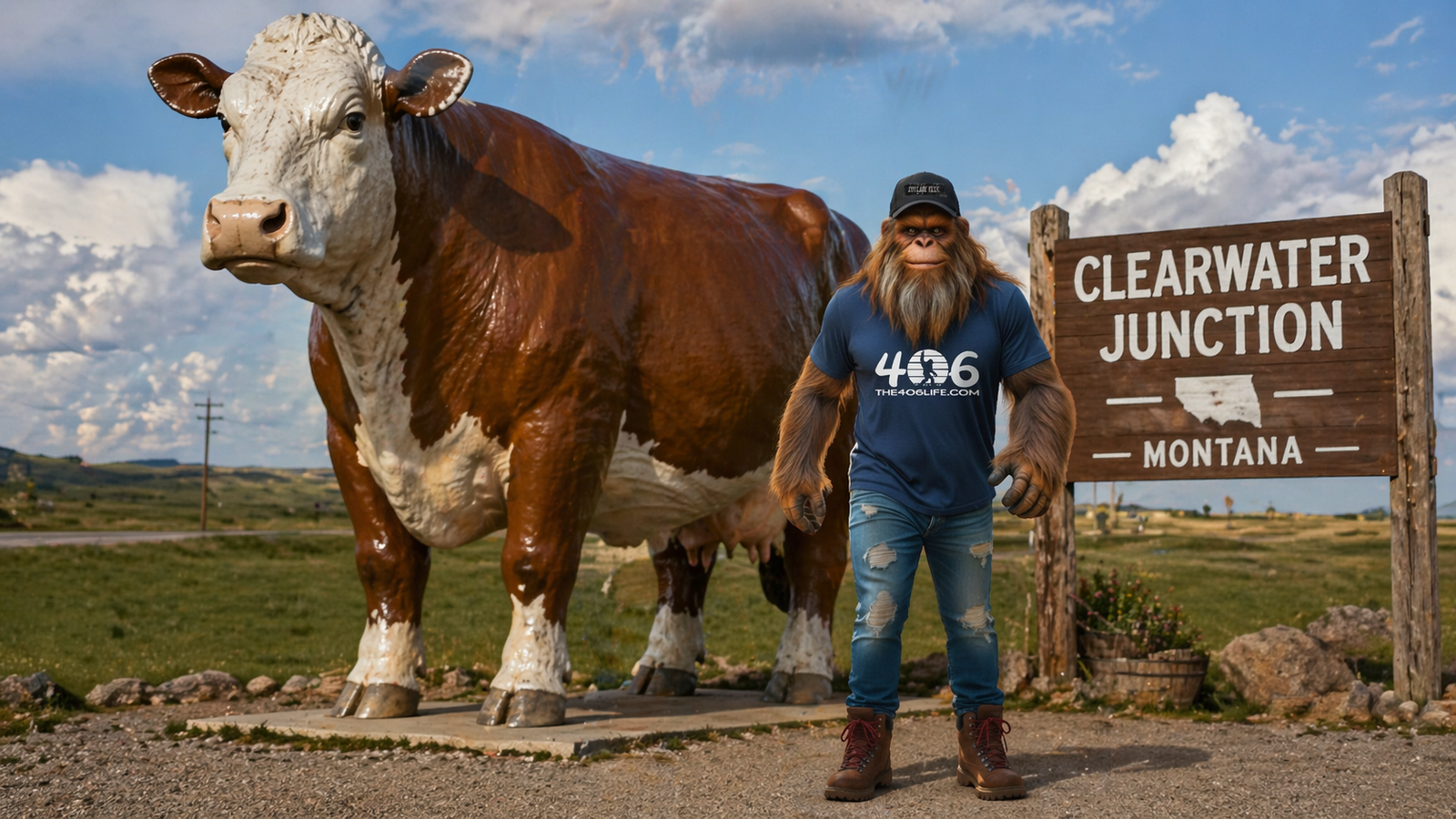
Montana, as told by a local Bigfoot · The 406 Life
Montana Weird Landmarks · Travel · Culture
Montana weird landmarks don’t require a guidebook — they require an open mind, a high-clearance vehicle, and a willingness to accept that your state is quietly, magnificently strange.
Folks, I’ve been living in Montana for longer than most of your family trees stretch back. I’ve watched towns rise, mines close, and one very confused herd of snow geese make a catastrophically bad landing decision. I’ve seen things that would scramble a field biologist’s notes. And yet, even by my standards — and I am a large, hairy, mostly-retired cryptid — this state continues to surprise me.
Because here’s what the brochures don’t tell you: Montana isn’t just big skies and trout streams. It’s also a 15-foot fiberglass cow, an underground city born from fire, boulders that ring like bells, and a 3,980-pound steer that toured 42 states powered by Prohibition whiskey mash. That last one is basically my autobiography, honestly.
So buckle up. Let’s take a tour of the Montana weird landmarks that don’t make it onto the postcard racks — but absolutely should.
I once made the mistake of stopping at the Clearwater Junction Cow for a photo. The owner came out, took one look at me, and said “That’s the biggest dang tourist I’ve ever seen.” I was wearing a hat. I thought it helped.
The Bovine Brotherhood: Montana’s Most Famous Fiberglass and Taxidermy
Montana has a thing for large bovines. I’m not judging — I respect a good bovine. But this state has elevated the celebration of cattle to a full-blown art form, and it’s worth meeting the main players.
The Clearwater Junction Cow — Montana’s Fiberglass Statue of Liberty
Out at the junction of Highway 200 and Highway 83, a 15-foot fiberglass cow has stood watch over the Seeley-Swan corridor for decades. Locals sometimes call her “Stoney,” and she’s become such an icon of Western Montana that artist Parker Beckley — who gave her a significant facelift in 2017 — reportedly refused to go “hyper-neon” with the redesign, calling that approach a “cardinal sin” against Montana tradition. Good call, Parker. Some things are sacred.
In 2021, the owner of the Clearwater Stop N Go commissioned further repairs after the ol’ girl had taken some wear — including, and I say this without further comment, 32 bullet holes. The restoration brought a fresh 70s-style paint job and reattached both a horn and a tail. She’s also, apparently, a landmark in the Fallout video game series, which means Stoney has achieved a level of cultural immortality I can only dream of.
Constructed with 3/8-inch-thick fiberglass to survive alpine winters, she’s engineered to last. Here’s a bit of scale to put her in perspective:
| Parameter | Stoney’s Stats | Real Cow Reference | Scale Factor |
|---|---|---|---|
| Height | 15 feet | 5 feet | 3.0x |
| Length (estimated) | 15 feet | 8 feet | 1.875x |
| Material | Fiberglass (3/8″) | Biological tissue | — |
| Theoretical weight | 14,625 lbs | 1,300 lbs | 11.25x |
| Quarter Pounders (theoretical) | 23,400 units | 2,080 units | 11.25x |
Steer Montana — The Whiskey-Fed World Record Holder
Over in Baker at the O’Fallon Historical Museum, a very large taxidermied Shorthorn steer sits in dignified retirement. Steer Montana — as the beast was known — was born in 1923 and raised by one Jack Guth, described generously as the “P.T. Barnum of Baker.” Guth fed the steer grain mash left over from his Prohibition-era whiskey still, which apparently works exceptionally well if your goal is an enormous steer rather than, say, legal compliance.
By the time of his death in 1938 at age 15, Steer Montana weighed 3,980 pounds, stood nearly six feet at the withers, and had toured 42 states and over 60 fairs and carnivals. Even in death, he kept touring — on a wheeled platform. The man never stopped working. I respect that deeply.
| Measurement | Value |
|---|---|
| Verified weight | 3,980 lbs |
| Height at withers | 5 feet 11 inches |
| Total length | 10 feet 4 inches |
| Girth | 9 feet 2 inches |
| Lifespan | 15 years, 4 months |
| Current location | O’Fallon Historical Museum, Baker |
The Cut Bank Penguin — Cold, Proud, and Occasionally Talking
Cut Bank, meanwhile, went an entirely different direction and chose a penguin. Specifically, a 27-foot, 10,000-pound concrete penguin named — and I’m paraphrasing local civic pride here — the mascot of the “Coldest Spot in the Nation.” Built by Ron Gustafson in 1989 and equipped with a motion-activated squawk box that announces the town’s frigid reputation, the penguin stands in Glacier Gateway Plaza as a monument to leaning into your weaknesses and making them your brand identity.
As observers have pointed out, Cut Bank is geographically closer to polar bear territory than penguin territory. Doesn’t matter. The penguin is there. Five tons of concrete says so.
The Underground & The Toxic
Montana’s Most Dramatic Below-Ground Stories
Above ground, Montana is breathtaking. Below ground, Montana gets downright cinematic. Two of the most striking weird landmarks in the state are defined entirely by what lies beneath the surface — and they couldn’t be more different from each other.
Havre Beneath the Streets — A City That Refused to Quit
In 1904, a massive fire destroyed about 60 businesses across four city blocks in Havre. A sensible town might have paused, mourned, and eventually rebuilt. Havre’s business owners simply moved underground and kept going.
That subterranean network — where commerce continued in connected basement levels and tunnels while the surface was being rebuilt above — is now one of Montana’s most genuinely fascinating tours. Since opening to the public in 1994, “Havre Beneath the Streets” has offered visitors a preserved window into early 20th-century frontier life, including a bordello, a barbershop, an opium den, a Chinese laundry, and a bakery. All of it operating, at various points in history, simultaneously and presumably noisily.
I toured Havre Beneath the Streets in 1994. The guide kept saying “imagine you’re a frontier businessman dodging the law.” I was already doing that. I found the whole experience very relatable.
| Subterranean Recreation | Historical Function | Notable Detail |
|---|---|---|
| Sporting Eagle Saloon | Turn-of-the-century honky-tonk | Cowboy gambling and frontier spirits |
| Wah Sing Laundry | Chinese immigrant business | Reflects Havre’s diverse demographics |
| Opium Den | Underground social club | One of three known historical dens in Havre |
| Tamale Jim’s | Ethnic restaurant/eatery | Part of reconstructed storefronts |
| Bordello | Red-light district operation | Preserved rooms showing social stratification |
The Berkeley Pit — Beautiful Disaster Turned Biological Frontier
In Butte, the legacy of the “Richest Hill on Earth” is mostly visible as a mile-and-a-half-long, 1,800-foot-deep lake of highly acidic, heavy-metal-laden toxic water. The Berkeley Pit was once one of the most productive open-pit copper mines in the world. Since mining stopped in 1982, the water has risen steadily and lethally — famously killing 10,000 snow geese that landed on it in a single event.
And yet — this is very Montana — the Pit has recently become a site of unexpected scientific excitement. Extremophile microbes, unique species of fungi and bacteria, thrive in the toxic slurry and are being studied for potential medical and industrial applications. Butte turned its most catastrophic industrial scar into a biological research frontier. Near the pit, statues of a stray dog called “Auditor” — who somehow survived the treacherous landscape — serve as a folk symbol of Butte’s own stubborn survival.
“Montana’s most toxic landmark might also be its most medically promising. That’s the most Montana sentence I’ve ever written.”— Montana Max, The 406 Life
Geology Gets Weird
Rocks That Ring, Mines That Radiate
Montana’s geology doesn’t play by normal rules, and frankly, neither do some of its most dedicated tourists. These next two landmarks occupy opposite ends of the scientific credibility spectrum, but both are undeniably real, undeniably Montana, and undeniably worth knowing about.
The Ringing Rocks of Whitehall — Montana’s Free Outdoor Concert
About 18 miles east of Butte near Whitehall, a BLM-managed site contains one of only seven known geological formations on Earth where boulders ring like bells when struck. The rocks are a specific mixture of basalt and granite magma that crystallized millions of years ago, and when you hit them with a hammer — which you can borrow from a rack at the base of the site — they emit a clear, musical chime.
Curiously, only about a third of the boulders in the pile actually sing. The rest are just rocks. Removing a boulder from the pile apparently causes it to lose its resonance, which is the most poetic geological fact I’ve ever encountered. Also: bring a high-clearance vehicle for the four-mile gravel road in. No entrance fee. Best visited April through October.
| Accessibility Detail | Info | Notes |
|---|---|---|
| Road type | 4-mile gravel/dirt | High-clearance vehicle necessary |
| Entrance fee | None (BLM managed) | Open year-round, weather permitting |
| Equipment | Hammer rack on-site | Bring your own if preferred |
| Best time to visit | April – October | Snow can make road impassable in winter |
I went to the Ringing Rocks in 2019 and tried to hum along. A geological surveyor asked me to stop. Apparently it was disturbing his readings. Some of us are just too resonant for science.
The Radon Health Mines — Where People Go to Glow
Between Boulder and Basin, several defunct gold and uranium mines — including the Free Enterprise and the Merry Widow Health Mine — have been repurposed as “radon health mines.” Visitors, many dealing with chronic conditions like arthritis, lupus, or asthma, spend hours at a time underground breathing low-level radioactive radon gas in the belief that it triggers an immune response.
Scientific consensus on the efficacy remains… mixed. However, these mines have operated for decades, some offering “Value Packages” with RV hookups, and have developed a dedicated community of annual visitors who swear by the results. Montana contains multitudes. This is one of them.
Art, Spirit & Sculpture
When Montana Weird Landmarks Get Artistic
Not all of Montana’s landmark curiosities are geological or agricultural. Some of them are the product of artists, visionaries, and one very determined Buddhist teacher with a childhood dream. These sites prove that Montana weird landmarks aren’t just accidental — some of them are entirely, beautifully intentional.
The Bleu Horses of Three Forks — 39 Impossibly Blue Metal Horses
Just north of Three Forks on Highway 287, a herd of 39 blue metal horse sculptures grazes on the side of Kamp Hill, and motorists routinely do a double-take at 65 miles per hour. Artist Jim Dolan funded and built the 15-month project as a “thank you” to the people of Montana for supporting his career over 40 years. The engineering details alone are worth the stop:
Movement
Wind-Responsive Heads
Twelve horses have heads mounted on ball bearings, so they actually move in the Montana wind, adding to the illusion of life.
Texture
4,000 Feet of Rope
Manes and tails are constructed from 4,000 feet of unraveled polyester rope, installed by employees at Reach, Inc., a supported workplace for individuals with developmental disabilities.
Anatomy
Elongated Legs
The legs are one-third longer than real horses, calibrated so the sculptures appear natural from a distance — a subtle trick of perspective built into the steel.
Color
Glossy Blue Roan
Dolan chose a glossy blue roan specifically because it looks extraordinary against winter snow. Which, in Montana, is most of the year.
Blackfoot Pathways: Sculpture in the Wild — Lincoln’s Cultural Reinvention
In Lincoln, a 26-acre sculpture park called “Blackfoot Pathways: Sculpture in the Wild” has transformed a former logging and mining town into an international art destination. Founded in 2014, the park features site-specific works from artists around the world, constructed from natural and industrial materials, including reimagined “Tee Pee Burners” — the tall conical structures that once characterized regional sawmills. The park draws over 30,000 visitors annually and sits right on the Continental Divide Trail corridor.
The Garden of One Thousand Buddhas — Serenity in Arlee
On the Flathead Indian Reservation near Arlee, one of Montana’s most quietly astonishing landmarks spreads across the Jocko Valley. The Garden of One Thousand Buddhas was established by Tulku Sang-ngag Rinpoche, who identified the valley — based on a childhood vision — as a lotus-flower-shaped site suitable for a peace center.
The garden is arranged in the shape of an eight-spoked Dharma wheel, centered on a 24-foot statue of Yum Chenmo, the Great Mother, surrounded by 1,000 hand-cast concrete Buddha statues and 1,000 stupas. Each is filled with sacred symbols, precious stones, and water from all the seas of the world. Over 18,000 visitors annually find their way here. Its location near medicinal hot springs and Glacier National Park places it on one of Montana’s most culturally layered travel corridors.
I spent an afternoon at the Garden of One Thousand Buddhas in 2018. It was the most peaceful I’ve felt since that summer I slept through all of August in a huckleberry thicket. Highly recommend both experiences.
History, Ghosts & Granite
Ghost Towns, Victorian Castles & Ancient Hunting Grounds
Montana’s weird landmarks aren’t exclusively strange in the conventional sense. Some of them are strange because of what they reveal about the layers of history compressed into this landscape — from ancient buffalo hunts to Gilded Age ambition to the eerie silence of abandoned boomtowns.
The Castle — Byron Roger Sherman’s Granite Monument to Himself
Perched on Knob Hill above White Sulphur Springs, the Castle is a 12-room Victorian mansion built in 1892 out of solid granite blocks — hand-cut and hauled by 16-ox teams from the Castle Mountains twelve miles away. Construction cost $36,000 in 1892 dollars. The interior featured Italian marble washbasins, Belgian rugs, and an early electrical system powered by a spring-fed pond and windmill-pumped water. Sherman used gravity and falling water to spin dynamos and give White Sulphur Springs its first electric lights, which admittedly only lasted a few hours per evening as the water level dropped.
The Castle is now a museum managed by the Meagher County Historical Association. Some scholars have noted a possible connection between Sherman’s mansion and the inspiration for Gatsby’s estate. Given the ambition on display, that tracks.
Garnet and Elkhorn — Time Capsules of the Boom-and-Bust West
Montana’s ghost towns deserve their own feature — and they’ll get one eventually — but Garnet and Elkhorn are impossible to leave off any list of the state’s landmark curiosities. Garnet, east of Missoula, preserves over 30 original gold rush structures including log cabins and a hotel, offering self-guided trails through the physical remnants of a town that once housed nearly 1,000 gold miners. Elkhorn near Boulder, a silver boom relic, still has its fraternity halls standing in eerie silence beside dilapidated residences. Both are historians’ dreams and photographers’ playgrounds.
Pompeys Pillar — The Only Physical Evidence Lewis and Clark Were Here
For all the Lewis and Clark historical markers scattered across Montana, Pompeys Pillar National Monument near Billings is singular: it contains the only remaining physical evidence of the expedition still visible on the trail. William Clark’s signature, carved into the 150-foot sandstone butte on July 25, 1806, is protected behind glass. The butte was named after Jean Baptiste “Pomp” Charbonneau, son of Sacagawea. Climb it, and you’ll see a river valley that has changed remarkably little in two hundred years.
Museums & Americana
Where Montana Keeps Its Weirdest Collections
Two museums on opposite ends of the state deserve special mention — not because they’re dusty and obligatory, but because they are, each in their own way, absolutely unhinged in the best possible sense.
The American Computer & Robotics Museum — Bozeman’s Best-Kept Secret
Founded in 1990 and regarded as the oldest continually operating museum of its kind in the world, Bozeman’s American Computer & Robotics Museum takes visitors on a chronological journey through 4,000 years of human innovation — from Babylonian cuneiform tablets to modern quantum computing. The collection includes an original Apple I signed by Steve Wozniak, Apollo Guidance Computer artifacts on loan from the National Air and Space Museum, an Enigma Machine, and a replica of the Antikythera Mechanism (circa 80 BCE). Harvard scientist Edward O. Wilson reportedly called it “inch for inch, the best museum in the world.” High praise for a place most Montanans couldn’t find without GPS.
The Miracle of America Museum — Polson’s Smithsonian of Stuff
In Polson, founder Gil Mangels has assembled over 340,000 artifacts across 35 buildings and five acres, creating what might fairly be called Montana’s most democratic museum. Kids can climb into military helicopters. Player pianos can be played. The motorcycle gallery alone — featuring over 70 rare antique bikes — draws riders from across the country. The philosophy here is simple: a rusty old tractor tells a story just as powerfully as a polished artifact. Montana agrees. So do I.
Go Find Your Own Montana Weird Landmark
Montana’s strangest places aren’t waiting to be discovered — they’re already out there, on gravel roads, in museum basements, and on the side of highways, waiting for you to show up. Max has done the reconnaissance. Now it’s your turn.Explore The 406 Life
Sources
- Montana Public Radio — The Clearwater Junction Cow Gets a Facelift
- Visit Montana — O’Fallon Historical Museum (Steer Montana)
- City of Havre — Havre Beneath the Streets
- Pit Watch — Berkeley Pit, Butte, Montana
- Bureau of Land Management — Ringing Rocks, Whitehall
- Merry Widow Health Mine — Radon Health Mines, Basin, MT
- Bleu Horses of Three Forks — Jim Dolan Artist
- Blackfoot Pathways: Sculpture in the Wild — Lincoln, MT
- Garden of One Thousand Buddhas — Arlee, MT
- National Park Service — Pompeys Pillar National Monument
- American Computer & Robotics Museum — Bozeman, MT
- Miracle of America Museum — Polson, MT
- Meagher County Historical Association — The Castle Museum
- Montana FWP — Garnet Ghost Town State Park
- City of Cut Bank — Penguin Landmark & Visitor Info
Montana, as honestly reported by a local Bigfoot · The 406 Life
Leave a Reply
You must be logged in to post a comment.