
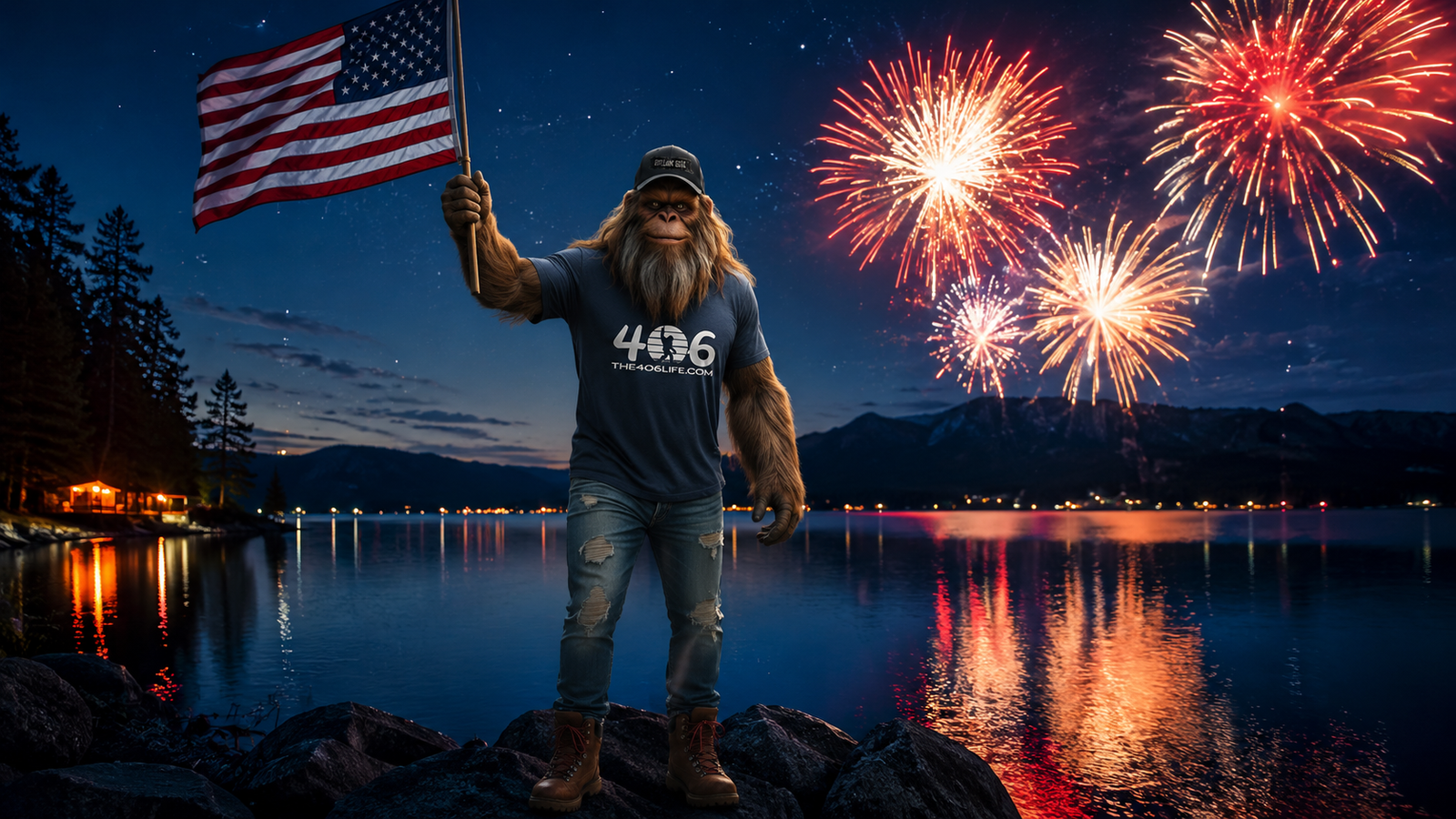
Montana’s Fourth of July: Where to Celebrate, Where to Hide
Two hundred and fifty years in. Here’s how Montana marks it — and where to go if the noise isn’t your thing.
Now I’ve been around a good while. Long enough to say that with a straight face and have folks believe it. And in all that time, I can’t recall a Fourth of July that carried quite this much weight.
Two hundred and fifty years. That’s how long this country’s been at it. The Semiquincentennial — which is a word I had to sit with for a minute, and I’ve had centuries to build my vocabulary. 2026 is the big one. A quarter-millennium of independence, and Montana’s going to mark it the only way it knows how: rodeos, fireworks over mountain lakes, parades through towns where half the crowd is related to the other half, and somewhere out in the backcountry, a campfire and a whole lot of quiet.
Here’s how to spend your Fourth in Montana — whether you’re looking for the noise or running from it.
A Fourth Worth Remembering
This isn’t just any summer holiday. The United States turns 250 years old in 2026 — and across Montana, the celebrations carry a little more deliberateness than usual. The parades feel more earned. The fireworks mean something different when you stop and do the math.
Montana itself has only been a state since 1889, so it missed the first 113 of those birthdays. But it’s been making up for lost time ever since. And this year, standing in a field somewhere watching fire light up a mountain sky, it’s worth taking a second to think about what you’re actually celebrating.
Where the Celebrations Are
Small Towns That Know How to Show Up
Ennis anchors the Madison Valley with its historic parade down Main Street and an NRA-sanctioned rodeo at the Ennis Rodeo Grounds. The valley doesn’t mess around.
Red Lodge pairs its mountain backdrop with the Home of Champions Rodeo — a Professional Rodeo Cowboys Association event with roots going back to the late 1890s. That’s not recent history. That’s nearly as old as statehood.
Bigfork runs rubber ducks down the Swan River before the floats even roll. Then a multi-day professional rodeo picks up right after the holiday. Only in Montana does a duck race count as opening ceremonies.
Whitefish pairs its Fourth with the Whitefish Arts Festival and a fireworks show over Whitefish Lake. Mountain town energy with a lakeside finish.
Belgrade throws a block party downtown on July 3rd — street festivities in the evening, fireworks to close it out. If you can’t make the Fourth itself, Belgrade’s third works fine.
Three Forks goes the patriotic pie route — red, white, and blue designs, community barbecue, pie-tasting contest. Don’t knock it until you’ve tried it.
Choteau stretches it across multiple days: rodeo, street dances, community picnics, and a parade. The kind of celebration that doesn’t rush itself.
Cooke City keeps it classic. Fireman’s Picnic, duck races, a community pancake breakfast the next morning, and the annual Beartooth Run. Under peaks that don’t care what day it is.
The Loudest Show in the State
Butte holds what is widely recognized as the largest fireworks display in Montana — and they fire it off on July 3rd, launched from the base of Big Butte near the illuminated mountain “M.” Because it’s the 3rd, it draws from across the region without competing with July 4th events elsewhere.
Good viewing spots include the Original Mineyard, Chester Steele Park, and the elevated parking at the Alice Mine. Fair warning: traffic on Main, Montana, and Excelsior Streets can lock up until midnight. If you’re near the Alice Mine, take Ryan Road to Oro Fino Gulch Road, then Browns Gulch Road south to Rocker to reach Interstate 15/90. Saves you an hour of sitting still wondering where you went wrong.
More Fireworks Worth Chasing
Livingston lights up after the Roundup Rodeo each night from July 1st through the 4th. The rodeo sells out months ahead, but the fireworks are viewable for free from G Street Park, Sacajawea Park, or the overlook at the top of Ridgeway Drive.
Great Falls launches its People’s Park display on the Fourth. Good vantage points include Elk’s-Riverside Park, Eagle Falls Golf Course, and Centene Stadium. The Great Falls Voyagers baseball game wraps up right before — post-game fireworks included. Two shows, one night.
Lakeside puts on an over-water show launched from Lakeside Harbor right on Flathead Lake. The bursts reflect off the water with the Mission Mountains as the backdrop. It’s the kind of thing that makes you stop talking mid-sentence.
East Helena’s Prickly Pear Community Fireworks Celebration has run annually since 1957, funded entirely by local businesses and community donations. That’s nearly seven decades of showing up without being asked twice.
One Town That Skips the Fireworks Entirely
Big Sky Resort made a deliberate call. No fireworks. Instead: the Big Sky Community Organization’s 5K Fun Run at Len Hill Park, scenic lift rides, zip-lining, and live music from the Tiny Band in the plaza. High alpine terrain and wildfire risk made the decision easy — and honestly, the programming holds up on its own.
Camping Near the Action
Reservation-based campgrounds near Montana’s big Fourth celebrations fill up fast. Months in advance, in most cases. Plan early or plan on scrambling.
Near Red Lodge
- Perry’s RV and Campgrounds — 2 miles out, along a creek, showers and laundry on-site
- Red Lodge KOA — 4 miles north, quick access to the Beartooth and Chief Joseph Scenic Byways
- Basin Campground — 8 miles west, 30 sites near Wild Bill Lake
- Parkside Campground — 12 miles south, sits at 8,000 feet along the Beartooth Highway with paved loops
- Greenough Lake Campground — 12 miles southwest, 18 sites with non-motorized boating access
Near Livingston
Pine Creek Campground — 13 miles south in Paradise Valley. Douglas fir and spruce cover, fishing access to the Yellowstone River, and a trail leading to Pine Creek Falls and Pine Creek Lake. Twenty-six sites total.
Near Whitefish
- Whitefish Lake State Park — 2.2 miles out, 23 sites with direct water access
- Mountain View Farmstead — 7.8 miles out, 32 dry camping sites that accommodate rigs up to 60 feet
- Glamping at Mountain Shadow Ranch — 8 miles out, 14 sites in pine forest on a working horse ranch
Near Ennis
West Fork Madison Campground — 15 miles south, tent-only. Narrow roads keep the RVs out. Eleven sites along the West Fork of the Madison River. The kind of campground that self-selects for the right crowd.
Where to Go If You Want Quiet
Fireworks are prohibited on all federal public lands — National Parks, National Forests, and BLM lands. That’s federal law, and staffed campgrounds enforce it. If you’ve got a dog that doesn’t do well with noise, a sensitivity to sound, or you’re a veteran who doesn’t need that particular reminder on a holiday, these spots are worth knowing.
Remote Campgrounds Built for Quiet
Cut Bank Campground (East Glacier) — 14 sites, no RVs. Deep in an eastern valley drainage that naturally muffles outside noise. Access to Medicine Grizzly Lake and Triple Divide Pass.
Lost Creek State Park (Anaconda) — 25 sites tucked into a narrow canyon under 1,200-foot limestone cliffs. Lost Creek Falls nearby. The geology does most of the noise-blocking for you.
Beavertail Hill State Park (Clinton) — 24 electric sites plus two tipi rentals. Sheltered by a thick canopy of cottonwood along the Clark Fork River. River floats, fly-fishing, and a nature trail.
Devil Creek Campground (Hungry Horse) — 13 well-spaced sites, 32 miles from the nearest town. Dense forest. Creek fishing on-site. The kind of remote that reminds you how big this state actually is.
Alta Campground (Darby) — Multiple sites along the West Fork of the Bitterroot River. The sound of moving water handles the rest.
Vigilante Campground (Helena) — Reached by 7 miles of winding gravel road. Trout Creek acts as a natural sound barrier. Off-grid camping with creek access.
Red Shale Campground (Ashland) — 14 sites across the forest-prairie borderlands of the Custer Gallatin National Forest. Wind through pines, star-gazing, prairie hiking. Eastern Montana quiet — which is a different category altogether.
Something Entirely Different: The Arlee Celebration
If rodeos and fireworks aren’t your thing, the Confederated Salish and Kootenai Tribes host the annual Arlee Celebration — also known as the Esyapqeyni Powwow — at the Arlee Powwow Grounds, 20 miles north of Missoula on Highway 93.
The 2026 gathering marks the 126th year of this celebration. It’s open to the public and centered on cultural preservation, traditional song, drum competitions, and dance. If you go, go respectfully. This isn’t a backdrop. It’s a living tradition that has outlasted a lot of things in this state — including most of the noise around it.
Virginia City and Bannack: History With a Show
Virginia City does the Fourth the old way. Noon parade, live theater at the Virginia City Opera House, Brewery Follies performances, and train rides on the historic Virginia & Truckee Railroad. Community-funded fireworks at dusk. Reserved balcony seating with views of the display is available at the Fourth Ward School and the Mackay Mansion.
Bannack State Park — site of Montana’s first major gold discovery in 1862 — hosts live historical music on the Fourth.
Worth noting clearly: Bannack Days, the full ghost-town re-enactment with gunfights, wagon rides, and gold panning, runs the third weekend of July — July 18 through 19, 2026. Not the holiday weekend itself. Don’t drive out there on the Fourth expecting the full show.
Fire Restrictions: Read This Before You Go
July is peak wildfire season in Montana. Restrictions can change fast based on weather, and violations carry real consequences.
Stage 1 Restrictions limit open campfires to designated metal fire rings in developed campgrounds only.
Stage 2 Restrictions ban all campfires entirely — developed sites and backcountry both.
Gas and LPG stoves with an on/off valve remain legal under both stages, provided you’re using them in a three-foot cleared area. Internal combustion engines are prohibited from 1:00 PM to 1:00 AM daily under Stage 2.
Check current fire restrictions and air quality advisories through the Montana DEQ and state fire maps before you set up camp. Smoke from regional wildfires can impact visibility and air quality across the state during July, even far from the fire itself.
FAQ: Montana Fourth of July
Whether you’re in a lawn chair watching fire burst over Flathead Lake or hunkered down in a canyon somewhere that doesn’t know what a firework sounds like — Montana’s got a spot for you on the 250th. Pick yours before somebody else does. Campgrounds fill. Rodeos sell out. And the quiet places don’t stay quiet long once word gets out.
Wanna keep up with Montana Max and the wild ride that is The 406 Life? Follow us on Instagram for daily snapshots of Big Sky livin’, and join our Facebook crew—both the main page and the group—for local biz shoutouts, behind-the-scenes shenanigans, and real-deal Montana grit. Whether you’re scrollin’ from the mountains or missin’ ‘em from afar, we’ve got a seat ’round the digital campfire waitin’ for ya.
And don’t forget to roam through our blog, where Montana Max dishes out tales from the trail, cultural deep-dives, and a whole lotta backwoods wisdom.
Leave a Reply
You must be logged in to post a comment.