
Montana Max · Culture & Commentary
Montana vs. The Internet’s Montana
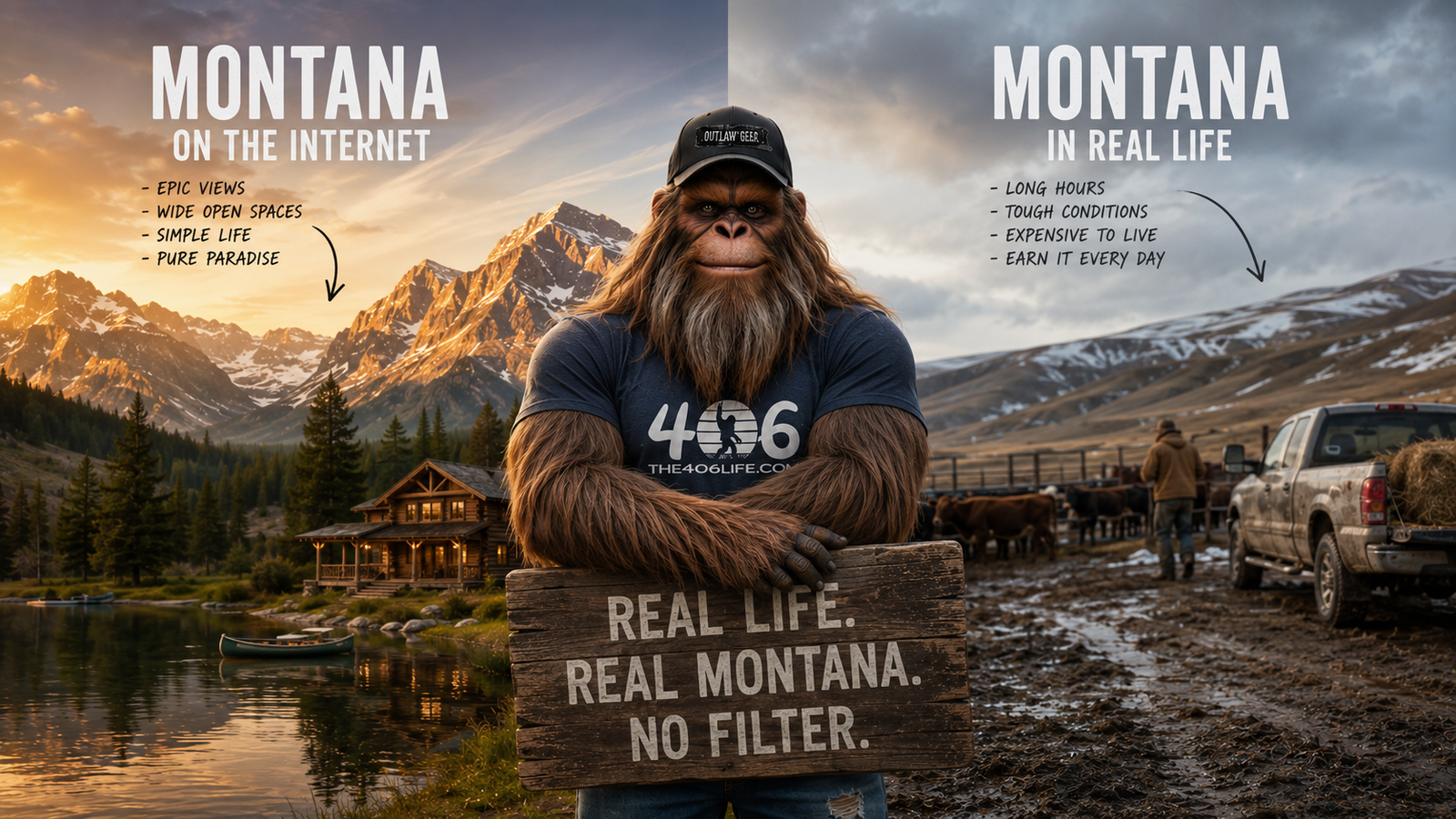
What they’re selling and what’s actually here aren’t the same thing. Not even close.
Now I’ve been watchin’ Montana get talked about on the internet for a while now. Long enough to notice something worth sayin’ out loud. The Montana people scroll past on their phones? It ain’t quite the place I’ve been livin’ in for… well, longer than I’m gonna admit.
The internet’s got a version of Montana that’s all golden light and open range and nobody around for miles. A place where you buy a little piece of land cheap, breathe the clean air, ride a horse, and basically become a Dutton. No traffic. No crowds. No complications. Just you, the mountains, and a cup of strong coffee on a porch somewhere.
That sounds real nice. It’s also about half true, wrapped around a whole lot of wishful thinking.
Here’s what Montana actually looks like from where I’m standing — which, for the record, is a ridge with a solid view and no cell service.
The “Empty Wilderness” Myth
The number people love to throw around is this: Montana is the fourth-largest state in the country and ranks somewhere in the low forties for population. About 7.5 people per square mile. So the internet calls it empty, wide open, and free.
And yeah, parts of it are genuinely empty. I’m talkin’ Garfield County, out in the east — about 0.3 people per square mile. That’s real. Petroleum County, Prairie County, Treasure County — same story. Eastern Montana is as lonesome as it sounds, and if that’s what you’re after, it’s out there.
But here’s what the Instagram posts don’t tell you: a large share of Montana’s people and jobs cluster in a handful of western hubs — Billings, Missoula, Bozeman, Kalispell, Great Falls, Helena, Butte. You start drivin’ toward those valleys and the “empty wilderness” thing gets complicated fast.
And that stunning, photogenic land everybody’s movin’ here for? A large share of it is federal. National forests, wilderness areas, Bureau of Land Management ground — it can never be developed. You can visit it. You can’t buy it and build on it. Which is a detail that surprises more than a few folks who show up with big plans.
The Yellowstone Effect — Real, But Not What You Think
You can’t talk about Montana’s online image without talkin’ about Yellowstone — the Paramount Network show with Kevin Costner, the Dutton ranch, the belt buckles, and the dramatic family feuds with mountain backdrops. That show turned Montana into a lifestyle brand for millions of people who’d never set foot here.
The numbers back that up, at least partway. A University of Montana study credited the show with drawing roughly 2.1 million visitors in 2021 alone, generating somewhere between $730 and $750 million in combined visitor and production spending for the state — the study body and the university’s own headline differed slightly on that number. Either way, that’s real money, and the researchers called it eye-opening.
But here’s where it gets complicated. That same study was funded in part by Paramount — the studio that makes the show. And economists who’ve looked at Montana’s actual population boom point to something less cinematic: COVID, remote work, and retirement. Boise is booming on the same timeline, and there’s no Dutton family set in Idaho.
Montana novelist Russell Rowland put it plainly in a Mountain Journal interview: “With so many people moving here because they’ve been seduced by all the hype, we have a real stark contrast between people who love this place in theory and people who love it because it is part of who they are.”
And rancher-writer Darby Minow Smith, who knows actual ranch work from the inside, laid out exactly where the show loses the plot: you can’t quickly tame a wild mustang, you don’t need gloves to pull a calf, and the Broken Rock Reservation in the show? Doesn’t exist. The show is about Montana. It is not for Montanans.
One Bozeman business owner summed it up for the Washington Post: “They’re not showing the hard days when it’s below zero and the calves are frozen.”
The Cowboy Culture Myth
The internet loves a cowboy. And Montana’s got ’em — real working ranchers who do real, unglamorous, skill-heavy work in conditions most people wouldn’t last a week in. That part’s true. Agriculture is woven into this state’s identity, and nobody’s denying that.
What’s less true is the idea that you’ll roll into any Montana town and find yourself surrounded by the real deal. What you’re more likely to find in Bozeman on a Tuesday is someone in Patagonia gear with a cold brew and a laptop open to a Zoom call. The cowboy hat on the guy at the bar might belong to a lawyer. The boots might have never seen a fence line. Real ranch hands aren’t usually the ones posting about Montana on social media, because they’re too busy working to care what social media thinks about Montana.
Agriculture, mining, and logging represent a relatively small share of Montana jobs compared to what the image suggests. Healthcare, retail, government, and tourism are what actually keep the lights on. The cowboy is real. The cowboy economy is a smaller piece of the picture than the aesthetic implies — and the cowboy hat has become, in a lot of cases, more costume than credential.
The Montana the Internet Never Shows You
Here’s something that bothers me more than the cowboy thing. The Montana being sold online is almost entirely western Montana. Glacier. The Flathead Valley. Bozeman. Missoula. Whitefish. That corridor of mountain towns and national park access that photographs beautifully and fills up every summer.
Eastern Montana is a different place entirely — and that’s not an exaggeration.
Out east you’ve got the high plains rolling out flat and wide in a way that genuinely messes with your sense of scale. The Missouri River Breaks — one of the most dramatic and least visited landscapes in the country. Small towns where the grain elevator is still the tallest structure around and families have worked that ground for generations. It is quiet out there in a way that’s completely different from the mountain quiet people come searching for. Wider. Older feeling. Less interested in being discovered.
Garfield County sits at about 0.3 people per square mile. Petroleum County, Prairie County, and Treasure County tell the same story. You drive east on Highway 2 or cut south through the Breaks and you will find a Montana that has never once appeared on a Pinterest board — and isn’t looking to.
The people out there — ranchers, farmers, folks who have worked that ground their whole lives — are watching the western part of the state change fast and feeling something about it that rarely gets asked about or written up. Because the cameras aren’t pointed at them. They’re pointed at Going-to-the-Sun Road.
Montana is not one place. It never has been. Any version of this state that only shows you the western mountains while the rest goes unseen is, at best, an incomplete picture.
The Golden-Hour Aesthetic vs. Actual Montana Weather
Here’s what the Instagram version of Montana looks like: warm golden light, fog lifting off a valley, wildflowers, a lone cabin, and not a single other person in frame.
Here’s what the Instagram version of Montana doesn’t look like: January.
Montana holds the contiguous U.S. cold record: negative seventy degrees Fahrenheit. That happened at Rogers Pass on January 20th, 1954. In January 1916, the town of Browning saw a temperature drop of a hundred degrees in twenty-four hours — from 44 above to 56 below. A U.S. record that still stands. In January 2024, a negative seventy-four degree wind chill was recorded at Judith Peak.
And summers? Wildfire smoke. The American Lung Association’s 2026 “State of the Air” report ranked Missoula 26th worst in the country for short-term particle pollution — much of it wildfire smoke that settles into western valleys and doesn’t move for days. The “clear blue sky” aesthetic assumes you’re here on the right day. That’s not always the day you get.
Montana Weather — By the Numbers
- –70°F — All-time contiguous U.S. cold record, Rogers Pass, January 1954
- 100°F drop in 24 hours — Browning, January 1916. Still a U.S. record.
- –74°F wind chill — Judith Peak, January 2024
- Missoula ranked 26th worst in the U.S. for short-term particle pollution per the American Lung Association’s 2026 “State of the Air” report — largely wildfire smoke
The “Cheap Land, Easy Life” Myth
This one might be the most outdated idea circulatin’ online right now. The “Montana is affordable” story made sense once. It doesn’t anymore.
Montana has become one of the nation’s least affordable housing markets relative to local incomes. The median home sales price rose roughly ninety percent between 2018 and 2023 — while median household incomes rose about twenty-eight percent. By 2024, the statewide typical home value sat around $467,000 to $470,000. In Bozeman, a single-family home hit a record $810,000. In Whitefish, prices doubled toward one million dollars.
Realtor.com gave Montana a D on its 2025 affordability report card — the lowest affordability score in the country.
Teachers, nurses, firefighters, and the people who actually keep Montana towns running are being priced out of those same towns. Roughly forty-five to forty-six percent of renters are cost-burdened. The state passed a significant housing reform package in 2023 — dubbed the “Montana Miracle” — and expanded it in 2025, with the Montana Supreme Court upholding the laws in March 2026. Relief is coming, but slowly.
The remote-work wave that drove a lot of this peaked around 2021, when net in-migration hit about 21,000 people. By 2023 it had cooled to around 10,000. By 2025, Montana’s population growth had slowed to one of its lowest rates in twenty-five years. But the prices those newcomers drove up? They didn’t come back down with them.
The Gap, Side by Side
| The Internet Says… | The Reality Is… |
|---|---|
| Wide open empty wilderness | A large share of jobs & people concentrated in a handful of western cities; eastern Montana is genuinely empty |
| Cheap land, affordable living | One of the nation’s least affordable housing markets relative to local incomes; median prices up ~90% since 2018 |
| Cowboy culture everywhere | Ag jobs <10% of economy; Bozeman runs on tech, healthcare, and tourism |
| Yellowstone the show = Yellowstone the state | Show was partially funded by the studio that profits from Montana tourism |
| Golden-hour skies, no crowds | –70°F winters, wildfire smoke summers, and 13.7M visitors in 2024 |
| Montana = mountains, Glacier, Bozeman, Whitefish | Eastern Montana is vast high plains, Missouri River Breaks, and small towns that never asked to be discovered |
| A place to escape to | A real place where real people live, work, and can no longer afford rent |
The Touron Problem — What Actually Goes Viral
Here’s a thing worth knowin’: the Montana content that actually goes viral online isn’t the serene wilderness fantasy. It’s people doing spectacularly dumb things around bison at Yellowstone.
There’s an account called “Tourons of Yellowstone” — a name that blends “tourist” and “moron” — and it is wildly popular for good reason. It’s full of people approaching bison for photos, ignoring every posted warning, and finding out that bison can run three times faster than a human and genuinely do not care about your vacation plans.
Real incidents fuel it constantly. In 2025 alone, an 83-year-old woman was gored on the Storm Point Trail. A 47-year-old Florida man was gored. An Idaho man named Clarence Yoder was cited for kicking a bison. The National Park Service notes that bison have injured more people in Yellowstone than any other animal. They weigh up to 2,000 pounds. They are not props.
This is the collision between the online fantasy and the actual Montana landscape — and it happens every summer, on schedule, for our collective entertainment and occasional horror.
The Overtourism Reality Nobody Posts
Montana had a record 13.7 million nonresident visitors in 2024, per the University of Montana’s ITRR. That’s the highest visitor count ever recorded for the state. They spent five billion dollars. Glacier National Park drew 3.2 million people — its fourth year above three million and second-highest total on record. Yellowstone hosted 4.7 million.
The Glacier Country region alone — Flathead Valley, Glacier Park, that corridor — captured roughly a third of all traveler expenditures in the state. One area. One third of everything.
To manage the crush on Going-to-the-Sun Road, Glacier ran a vehicle reservation system from 2021 through 2025. In December 2025, officials announced they’d shelve it for summer 2026 — a decision that made some locals nervous and others relieved. Watch how that goes.
In Whitefish, population around 8,500, the city had to hire a dedicated enforcement officer just to crack down on illegal short-term rentals. The reason a city official gave was blunt: “We don’t want our neighborhoods to be full of hotels. We want them to be full of neighbors.”
The Instagram aesthetic sells emptiness. The reality is that the most photogenic spots are increasingly crowded, reservation-gated, or smoke-hazed in August. You can still find the quiet Montana. You just have to work a little harder for it than the algorithm suggests.
What Montana Actually Is
Montana is about 85 percent white. It has seven Native American reservations — Blackfeet, Crow, Flathead (Confederated Salish and Kootenai Tribes), Fort Belknap, Fort Peck, Northern Cheyenne, and Rocky Boy’s — plus the federally recognized Little Shell Chippewa, recognized in 2019. The Native presence here is not a historical footnote. It’s the present.
Montana wages sit at about seventy-two percent of the national average, per Bureau of Economic Analysis data. Tourism supports roughly one in every fifteen Montana workers — but those are mostly modest-wage hospitality jobs. The childcare system meets about forty-four to forty-six percent of demand. Many counties have no licensed childcare at all. Most Montana counties carry some form of medical underserved designation, and rural residents in the state’s most remote corners can face hundreds of road miles to reach specialized care.
That’s not the Montana that gets thirty thousand likes on a Sunday morning. But it’s the Montana that the people who live here deal with every single day.
There’s a phrase that floats around this state — “The Last Best Place.” It came from a 1988 literary anthology, and before long it became a marketing slogan. A Las Vegas businessman even tried to trademark it for his resort. After years of legal fights involving two U.S. senators, the Patent and Trademark Office permanently denied the trademark in 2012. You can’t own Montana’s identity, even if plenty of people keep trying.
Here’s the thing about that phrase, though. The people who move here chasing the idea of Montana and the people who were already here — who built the schools and dug the wells and buried their people in the churchyards — they’re not experiencing the same place. And that gap is widening every year.
Montana doesn’t change for you. It never has. If you come here expecting the version you saw online, you’re going to spend a lot of time confused. If you come here ready to meet the actual place? Well. That’s a different trip altogether.
FAQ: Montana vs. The Internet’s Montana
Is Montana really as empty and wide open as it looks online?
Parts of it genuinely are — eastern Montana counties have less than one person per square mile. But a large share of the state’s jobs and people cluster in a handful of western cities. And a significant portion of that scenic open land is federally managed — meaning you can visit it, but you can’t buy it.
Did the Yellowstone TV show actually change Montana?
It shaped the image, and it drew real visitors and real money — a University of Montana study credited it with 2.1 million 2021 visitors and $730 million in spending. But economists point to COVID, remote work, and retirement as the actual drivers of Montana’s population shift. The show also received partial funding from Paramount, which profits from Montana tourism. Local writers are largely skeptical of the show’s accuracy and its effects on the state’s identity.
Is Montana affordable to move to?
Not anymore. Montana has become one of the nation’s least affordable housing markets relative to local incomes. Median home prices rose roughly ninety percent between 2018 and 2023. A statewide housing reform effort is underway, but relief takes time.
How crowded does Glacier National Park actually get?
Glacier drew 3.2 million visitors in 2024 — its fourth straight year above three million and second-highest total on record. The park ran a vehicle reservation system on Going-to-the-Sun Road from 2021 through 2025 to manage the volume. Check current conditions and access requirements before you go.
What does Montana actually look like in winter?
Cold. Montana holds the contiguous U.S. cold record at negative seventy degrees Fahrenheit. Winter is long, roads get dangerous, and the golden-hour aesthetic is nowhere in sight. It’s worth experiencing once. Come prepared or don’t come at all.
Is eastern Montana worth visiting?
Absolutely — and it’s a completely different experience from western Montana. The Missouri River Breaks, the high plains, and the small towns of eastern Montana offer genuine solitude and dramatic landscape without the crowds. It’s the part of the state that rarely makes the algorithm but rewards the people who find it.
Is Montana really cowboy country?
Real ranching exists here and always has. But the working rancher population is a relatively small share of the overall economy. Healthcare, government, retail, and tourism employ far more Montanans than agriculture. The cowboy identity is real — it’s just more complicated than the image suggests.
Is Montana diverse?
The state is approximately eighty-five percent white. About six percent of Montana’s population is American Indian or Alaska Native — the largest minority group — with seven reservations and the recently federally recognized Little Shell Chippewa Tribe. That Native presence is central to the state’s present, not just its past, even if the internet’s version of Montana rarely shows it.
Sources
The Yellowstone Show & Montana’s Image- Mountain Journal — “Why ‘Yellowstone’ Became a Dirty Word to so Many Montanans”
- Mountain Journal — Russell Rowland interview: “Why ‘Yellowstone’ The TV Show Ain’t The Real Montana”
- University of Montana — BBER/ITRR Study: Yellowstone Series Economic Impact
- Washington Post — “‘Yellowstone’ is fueling Montana’s tourism boom”
- NPR / The Indicator — “Why ‘Yellowstone’… is drawing people to Montana”
- NBC Montana — “‘Yellowstone’ series brings visitors, millions of dollars to Montana”
- Spokesman-Review — “The Duttons are fake, but the ‘Yellowstone’ tourism boom is very real”
- State Court Report — “Montana’s Housing Crisis Fix Survives Constitutional Challenge”
- Montana Budget & Policy Center — Rental Affordability in Montana (April 2025)
- Reason Foundation — “The ‘Montana Miracle’ continues”
- Daily Montanan — “Wages up, housing still out of reach”
- NBC News — “The remote workers have left, but the housing havoc remains”
- Bozeman Real Estate Group — “Montana’s Population Growth Slows to 25-Year Low”
- Daily Montanan — “Tourists spent nearly $5 billion in Montana last year”
- Daily Montanan — “Gallatin, Flathead counties see highest nonresident visitor spending”
- Spokesman-Review — “Glacier, Yellowstone notch second-highest visitation”
- Flathead Beacon — “Glacier Park Considers Shelving Reservation Pilot”
- NPS Glacier — Glacier Vehicle Reservations 2026
- Montana Free Press — “Whitefish takes aim at illegal short-term rentals”
- The Cool Down — “Onlooker captures video of tourists’ reckless actions near bison”
- American Lung Association — “State of the Air” 2026 Report (Missoula particle pollution ranking)
- University of Montana — “Montana Winters Aren’t for Wimps”
- KRTV — “How cold did it get in Montana?”
- Missoula Current — “Where are the jobs? Why are wages so low?”
- World Population Review — Montana Population & Demographics
- Wikipedia — “The Last Best Place” (trademark history)
- Bozeman Real Estate Group — “Is Instagram Ruining Montana?”
Montana Max, over and out.
Wanna keep up with Montana Max and the wild ride that is The 406 Life? Follow us on Instagram for daily snapshots of Big Sky livin’, and join our Facebook crew—both the main page and the group—for local biz shoutouts, behind-the-scenes shenanigans, and real-deal Montana grit. Whether you’re scrollin’ from the mountains or missin’ ‘em from afar, we’ve got a seat ’round the digital campfire waitin’ for ya.
And don’t forget to roam through our blog, where Montana Max dishes out tales from the trail, cultural deep-dives, and a whole lotta backwoods wisdom.
Montana Max
Leave a Reply
You must be logged in to post a comment.