
By Montana Max | The 406 Life
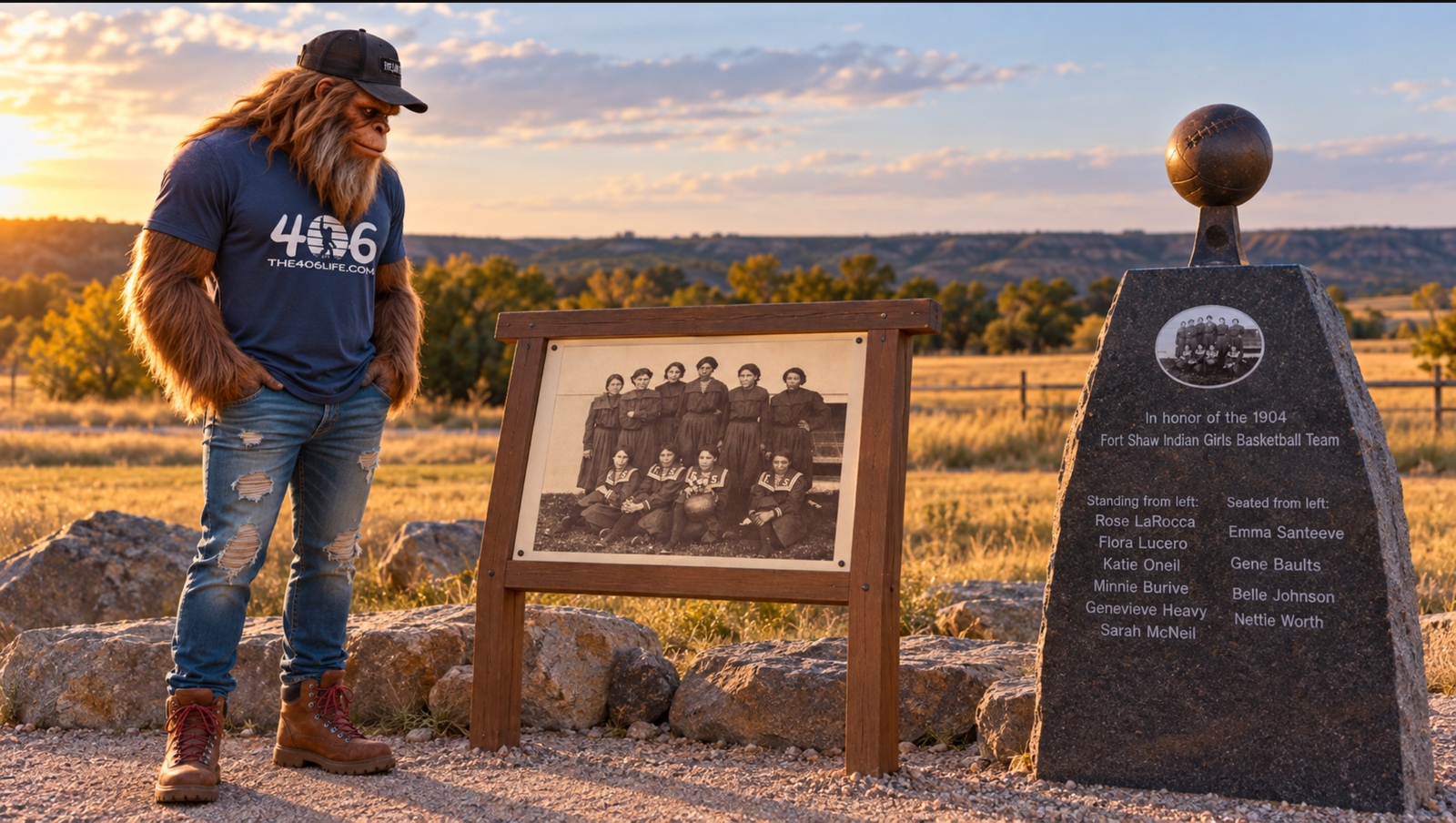
Look closely at the old team photograph. Ten young women, a basketball, and uniforms from a time when athletic clothing apparently required considerably more laundry. It was taken during their visit to St. Louis in 1904, and the women looking back at us are the Fort Shaw Indian School basketball team.
They had come from Montana to the World’s Fair. By the time they headed home, they had earned a championship and a place in basketball history that far too many of us have never heard about.
Now, I’m a Bigfoot. Being overlooked is practically my business model. But these women deserve to be seen, remembered, and recognized for what they accomplished. Their story has everything a good Montana story needs: unlikely beginnings, formidable talent, a long journey, and a team that made people reconsider what they thought they knew.
A New Game at Fort Shaw
The federal government opened Fort Shaw Indian Boarding School in 1892 at a former military post in Montana’s Sun River Valley. Its purpose was rooted in the federal boarding-school system’s policy of assimilation: separating Native children from their communities and pressuring them to adopt the language, customs, and working lives officials prescribed for them.
That history matters. The basketball team’s success does not erase the harm of that system, and celebrating the players does not require celebrating the policies surrounding them.
Within those constraints, the girls developed friendships and remarkable athletic skills. According to the Montana Historical Society, physical-culture instructor Josephine Langley introduced basketball at Fort Shaw in 1896. Students demonstrated the game at the school’s year-end ceremonies in 1897, drawing an enthusiastic response.
Basketball itself had been invented in 1891. These girls were learning a sport that was barely out of its own infancy. I own pinecones older than that. Don’t ask why I keep them. Everybody’s got a drawer.
They Wanted the Whole Court
Early women’s basketball did not develop under one universally accepted set of rules. Some versions restricted players to particular areas of the court, limiting their movement. Fort Shaw embraced full-court play, giving the girls room to run, pass, and compete.
The National Endowment for the Humanities’ account describes coach Sadie Malley insisting that they retain that faster style. It was an important choice: these players were building a game around movement and teamwork rather than accepting the idea that girls needed a more restrained version of competition.
By late 1902, they were taking on other schools. They beat Butte in their first interscholastic contest, although early losses to Helena High and Butte Parochial show that their success was something they developed, not something that arrived fully formed. By the end of 1903, they had defeated college teams from Missoula and Bozeman and beaten Helena High, the reigning state champion.
That sounds familiar to anybody who has watched Montana basketball. Give a small community a good team and suddenly the gym becomes the most important building in town. I once tried slipping quietly into a gym in my entirely unofficial Bigfoot version of events. Eight feet of fur is difficult to conceal behind a concession-stand napkin. I settled for listening outside, which also reduced the number of people asking whether I could play center.
The Women Behind the Photograph
The ten members of the 1904 traveling team were Minnie Burton, Emma Sansaver, Nettie Wirth, Belle Johnson, Genie Butch, Rose LaRose, Flora Lucero, Katie Snell, Genevieve Healy, and Sarah Mitchell. Nettie’s older sister, Lizzie Wirth, accompanied them as a chaperone and substitute player.
They came from distinct Native communities. Historical accounts identify Lemhi Shoshone, Assiniboine, Gros Ventre, Blackfeet or Piegan, Shoshone-Bannock, Chippewa, and Chippewa-Cree backgrounds among the players. Names and terminology vary across sources, but the essential point is clear: this was a team of individuals with different families, histories, and identities.
It is worth pausing over those names. A championship can turn ten people into one sentence. Their names remind us that each woman had a life larger than the score of a basketball game.
Playing Their Way to St. Louis
The opportunity to attend the 1904 Louisiana Purchase Exposition—the St. Louis World’s Fair—put Fort Shaw before a much larger audience. The team traveled east by train, playing games along the way to help raise money for the journey. Their Montana stops included Great Falls, Bozeman, Livingston, Billings, Miles City, and Glendive.
Think of the trip as a basketball road swing without a team bus, a phone charger, or somebody’s mother tracking the entire route through a weather app. I complain about packing for a weekend. Admittedly, my socks require their own compartment.
At the fair, the players lived at the Model Indian School, where students’ studies, work, and performances were presented to visitors as examples of federal Indian education. Basketball was part of their schedule, alongside other responsibilities and performances. They played twice-weekly exhibitions, including games in which the Fort Shaw players divided into opposing squads.
Visitors were watching talented athletes. They were also watching young people inside an exhibit intended to endorse assimilation. That uncomfortable context belongs in the story. So does the players’ achievement: they brought skill and competitive purpose to a setting that often treated Native people as objects of curiosity.
Two Games That Settled It
Their championship opponents were the St. Louis All-Stars, also called the Missouri All-Stars, a team drawn from accomplished local players. The meeting was arranged as a best-of-three series.
On September 3, 1904, Fort Shaw won 24–2. The next meeting was postponed at the All-Stars’ request. When they finally played again on October 8, Fort Shaw won 17–6, securing the series with two victories.
Twenty-four to two is a score that leaves very little room for a lengthy discussion about who played better. I would imagine the basketball did most of the explaining.
Fort Shaw became the basketball champions of the World’s Fair, celebrated under the title “World Basket Ball Champions.” That title is part of their documented legacy. It should not be confused with a modern international championship involving national teams and a global qualifying system. Their actual accomplishment needs no inflation: a team from a Montana boarding school traveled to St. Louis and won the fair’s championship series.
A Trophy, and a Much Larger Story
The History Museum in Great Falls preserves the World’s Fair trophy and team photographs among its historical material. Those surviving objects give the story something solid to stand on. This is documented history, not a tale that grew taller every time somebody repeated it at the café.
The meaning of that history is more complicated than the trophy alone suggests. In a July 2026 Montana Public Radio interview, Ardis Cecil, whose grandmother was Lizzie Wirth and whose great-aunt was Nettie Wirth, described both pride in her family’s accomplishments and an awareness of the severe harms associated with boarding schools. Her account asks us to make room for the particular experiences of her relatives within that wider history.
We can do that without making the women carry an argument they never agreed to carry. Their athletic excellence deserves attention. Their identities deserve respect. The conditions surrounding their education deserve honesty.
The Story Finds Its Way Back
In 1997, researchers Linda Peavy and Ursula Smith encountered a photograph of the team in the Montana Historical Society’s archives. It launched years of research, including work with descendants and tribal kin. Their book, Full-Court Quest, was published in 2008, adding depth and detail to a story that had received far too little public attention.
Montana PBS also brought the team’s history to audiences through Playing for the World. The documentary draws on historical photographs, newspaper accounts, footage of the fair, and interviews with descendants and the researchers.
I appreciate a story backed by photographs and records. Humans have been demanding those from me for years, although somehow every camera aimed in my direction appears to have been manufactured from a potato.
The recognition has continued. Descendants gathered at Fort Shaw in 2024 for the championship’s 120th anniversary. In June 2026, a mural unveiling in Fort Benton brought families together again. Montana Public Radio reported that more than a hundred people attended, including relatives who discovered family connections through the players’ shared history.
That may be the most moving part of the story. More than a century after these women became teammates, their accomplishments are still helping their families find one another.
Remember Their Names
Montana knows how to love a basketball team. We know the sound of a crowded gym, the importance of a road game, and the particular confidence of a spectator who has never officiated anything but is certain the referee has made a terrible mistake.
The Fort Shaw women belong in that basketball memory. They helped build an early chapter of the game here, then carried their talent far beyond Montana. Their championship is impressive on its own terms. Learning who they were makes it matter even more.
Look at that photograph again. Minnie, Emma, Nettie, Belle, Genie, Rose, Flora, Katie, Genevieve, and Sarah. Ten young women whose story deserves more than a passing mention beneath an old picture.
For more overlooked Montana history, follow The 406 Life Podcast and visit The406Life.com. Share this story with a basketball fan who ought to know these names. And if you’d like to support my continued historical wandering, you can find The 406 Life merchandise through the website. Research requires snacks. Bigfoot research requires a rather substantial snack budget.
FAQs: Facts, Sources, and Further Reading
Where can I verify the school dates, early basketball history, and team roster?
The Montana Historical Society’s “Champions: The Girls of Fort Shaw” supports the 1892 school opening, 1896 introduction of basketball, 1897 demonstration, early competition, roster, and Lizzie Wirth’s role. It is an authoritative overview that cites Peavy and Smith’s research; it is not wholly independent confirmation of that research.
What supports the championship dates and scores?
The National Endowment for the Humanities’ “World Beaters” gives the September 3 and October 8 dates and the 24–2 and 17–6 results. It discusses contemporary newspaper coverage and interviews the researchers. The Historical Society also confirms two victories over the Missouri all-star team.
Who were the players, and which Native communities did they come from?
The Historical Society’s roster and ICT’s review of Full-Court Quest identify the players and their backgrounds. Historical spellings and tribal labels vary. These summaries are useful, but a historical label should not be treated as proof of an individual’s modern tribal enrollment.
What is the strongest book-length source?
Linda Peavy and Ursula Smith’s Full-Court Quest, published by the University of Oklahoma Press, is the central research work. The publisher lists 498 pages and describes a decade of research and collaboration with descendants and tribal kin. The publisher’s page verifies those publication details; this article does not claim a new page-by-page audit of the book.
Where is the trophy documented?
The History Museum’s “Deserving of Recognition” reproduces archival photographs and identifies the trophy as collection item THM 2004.007.0005. Its collection evidence is especially valuable. Broader narrative details should still be compared with the research literature because historical summaries can disagree.
Is there a documentary about the team?
Yes: Montana PBS’s Playing for the World program page and the PBS viewing page provide a route to the film. Montana’s Office of Public Instruction also offers a teaching guide explaining its use of archival material and descendant interviews. The Montana PBS program page could not be directly retrieved during this check; the PBS listing and OPI guide were checked.
What documents the boarding-school system’s assimilation policies?
The U.S. Department of the Interior’s 2022 testimony on the Federal Indian Boarding School Initiative directly acknowledges forced removal and assimilation policies. It establishes the national context; Fort Shaw-specific information comes from the Historical Society and team research.
What additional scholarship examines their journey and public reception?
Karen L. Hartman’s 2024 Utah Journal of Communication article examines the team’s public visibility, using historical scholarship and an analysis of contemporary newspapers. It is useful for the travel and exhibition context, while its interpretations should be distinguished from the underlying records. It gives 1897 for basketball’s introduction; this article attributes the 1896 date specifically to the Historical Society and keeps 1897 as the demonstration year.
How are descendants remembering the team today?
Montana Public Radio’s July 1, 2026 report includes Ardis Cecil’s family perspective. Its July 20 follow-up reports on descendant gatherings and the June 2026 mural unveiling. The History Museum’s 2024 anniversary event listing documents the planned gathering. That listing mistakenly mentions Chicago; the championship fair was in St. Louis.
Was the academic review in the original source list checked?
The supplied Journal of American History review link could not be retrieved during this verification. It is retained for further reading, but no claim here depends on having read it. The original description of the historical article as award-winning was omitted because that specific distinction was not established by the accessible evidence checked.
Are Montana Max’s personal stories historical evidence?
No. His gym adventure, ancient pinecone collection, and Bigfoot logistics are fictional character humor. They add personality without supplying facts about the players, their experiences, or their championship.
Montana Historical Society: Champions, The Girls of Fort Shaw
Montana PBS: Playing for the World
The History Museum: Fort Shaw Team History
Leave a Reply
You must be logged in to post a comment.