
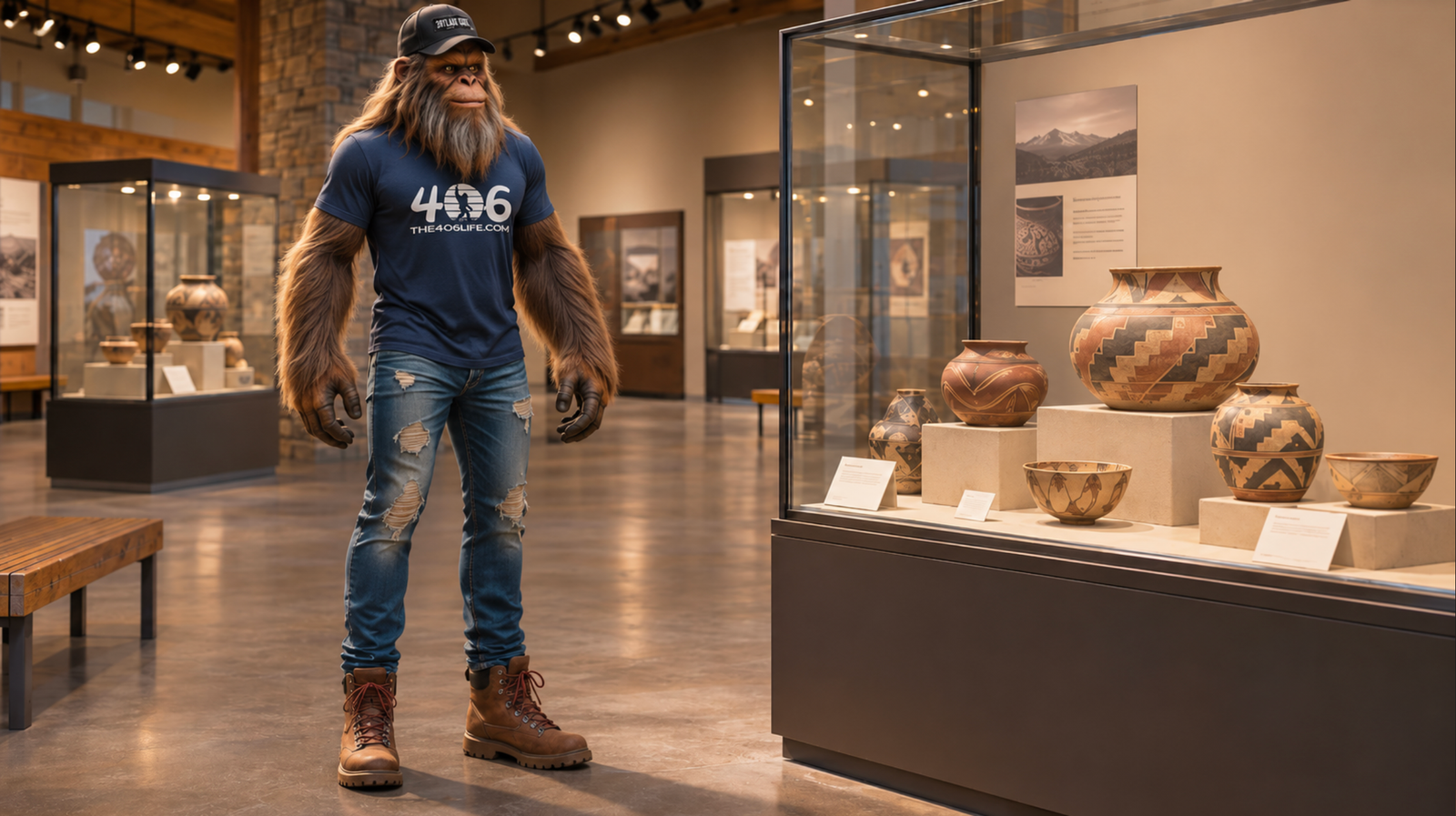
How a resourceful teacher, a basement studio, and Montana clay helped change American ceramics.
In 1946, Frances Senska arrived at Montana State College in Bozeman to teach art and establish a ceramics program. She had a master’s degree, years of artistic training, and experience teaching, but when it came to pottery, there was one rather interesting detail: she’d taken only two ceramics classes.
Now, I’ve wandered around Montana long enough to know that we’re a resourceful bunch. Give a Montanan a problem, a handful of tools, and enough stubborn determination, and there’s a reasonable chance something useful will come out of it. There is also a chance of a spectacular mess, but that’s generally how the learning happens.
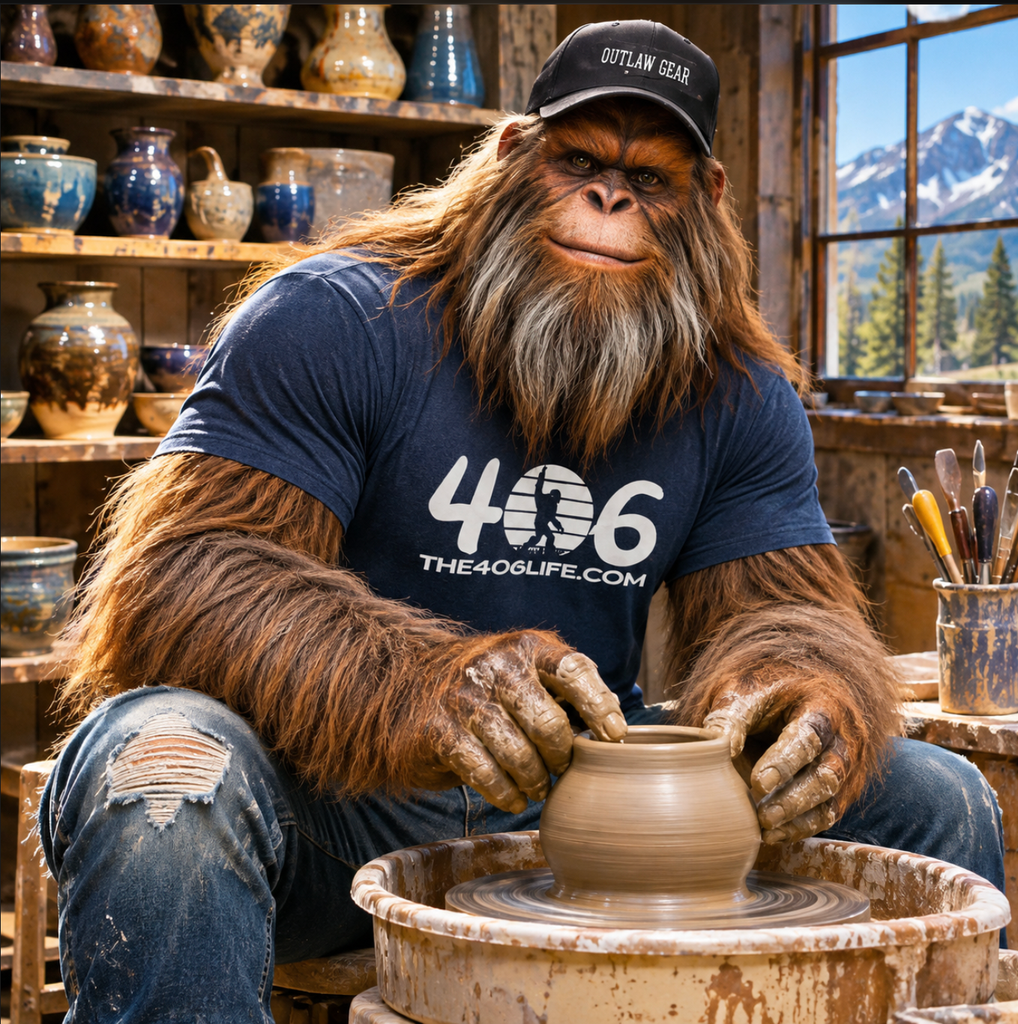
Frances Senska apparently understood this philosophy better than most. Rather than wait for an elaborate studio or pretend she knew everything about ceramics, she rolled up her sleeves and started building a program alongside her students. They purchased foot-powered pottery wheels, constructed a kiln, gathered clay from the Montana countryside, and figured out how to turn the materials beneath their feet into something beautiful.
What began in a basement at Montana State would help shape an extraordinary chapter in American art history. Among Senska’s students were Peter Voulkos and Rudy Autio, two artists who would become internationally recognized for transforming the possibilities of ceramics. Senska also helped establish the artistic community surrounding Helena’s Archie Bray Foundation, which would become a destination for ceramic artists from around the world.
For a woman who started with two pottery classes and a basement studio, that’s a mighty impressive legacy. But to understand how Frances Senska helped change ceramics in Montana, we need to travel a long way from Bozeman, back to where her story began.
From Cameroon to the American West
Frances Maude Senska was born in 1914 in Batanga, in what is now Cameroon, where her parents worked as missionaries. Her father was a physician as well as a skilled cabinetmaker and woodworker, and he taught his daughter how to use tools and work with her hands. But some of the most lasting lessons of her childhood came from watching the people around her create the objects they needed for everyday life.
In the community where she grew up, making things wasn’t necessarily divided into separate categories of art, industry, and household necessity. People worked with locally available materials, developing the knowledge and skill to create practical objects that could also be beautiful. Wood became tools and furniture. Clay became vessels. The person who needed something might also be the person who made it.
That experience left a deep impression on Senska. She came to appreciate the relationship between the maker, the material, and the finished object, an idea that would eventually become central to both her pottery and her teaching.
I can appreciate that kind of thinking. I’ve spent a fair amount of time in the Montana timber, and I’ve noticed that humans have a remarkable talent for hauling manufactured gadgets into the woods to accomplish jobs that could sometimes be handled with a stick. Granted, my sticks tend to be considerably larger than yours, but the principle is the same.
When Senska returned to the United States, she continued her education in Iowa, eventually earning bachelor’s and master’s degrees from the University of Iowa. Her studies covered several artistic disciplines, but ceramics had not yet become her specialty. That discovery would come during World War II, in a place far removed from both the African community of her childhood and the Montana mountains where she would eventually make her home.
The Navy and the Discovery of Clay
During World War II, Senska served in the WAVES, the women’s branch of the United States Naval Reserve. Her military service took her to San Francisco, where she began exploring ceramics through evening classes.
One early course involved casting porcelain objects using molds, a process that didn’t particularly capture her imagination. But another class, taught by ceramic artist Edith Heath, introduced her to the possibilities of working directly with clay.
This was something different. Clay offered Senska the opportunity to take part in nearly every stage of making an object, from preparing the material to shaping, decorating, glazing, and firing it. Instead of handing a design to someone else to manufacture, she could follow an idea all the way from raw material to finished piece.
For someone who had grown up watching skilled craftspeople create useful objects with their own hands, the appeal was immediate. Pottery brought together her interest in materials, craftsmanship, independence, and everyday usefulness.
Senska continued learning from influential artists and teachers, including Maija Grotell and Marguerite Wildenhain. Her artistic education also exposed her to modern design ideas that emphasized experimentation, problem-solving, and understanding materials rather than simply following established formulas.
These experiences helped shape an approach to teaching that would become one of her greatest contributions to American ceramics. She wasn’t interested in producing students who could perfectly imitate their instructor. She wanted people who understood their materials well enough to develop ideas of their own.
That distinction would become especially important when she arrived in Montana.
A Basement, $300, and a Lot of Montana Dirt
When Senska joined Montana State College in 1946, the school’s art program was relatively small and operated within the home economics department. Ceramics was hardly an established specialty, and the facilities available to her were modest.
Her first studio was an old storeroom in the basement of Herrick Hall. With approximately $300 in departmental funds, Senska and her students began putting together the equipment they needed. They purchased foot-operated pottery wheels and designed and constructed an electric kiln.
But the equipment was only part of the challenge. They also needed clay, and Senska wasn’t particularly interested in having students simply open a package of prepared material and start making pots.
Instead, she took them into the Montana countryside to find it.
Students gathered clay from hillsides, brought it back to the studio, and learned how to prepare it for use. They experimented with local materials for glazes, discovered how different clays behaved, and worked through the entire process of turning raw earth into finished pottery.
Imagine signing up for a college ceramics class and discovering that your first assignment might involve going outside with a shovel. Some students probably expected to spend their time making handsome bowls and decorative vases. Instead, they learned that pottery begins long before anyone sits down at a wheel.
And that’s what made Senska’s approach so valuable.
Her students weren’t simply learning how to shape clay. They were learning where it came from, how it behaved, what could go wrong, and how to solve problems when the results didn’t match their expectations. If a piece cracked, a glaze behaved strangely, or a firing produced something unexpected, the experience became part of the education.
I’ve always thought there’s something particularly Montana about that approach. Around here, being able to figure things out with whatever you’ve got available isn’t just a useful skill. Sometimes it’s the difference between finishing a job and spending the next three days waiting for a part to arrive from somewhere with considerably better shipping options.
Senska’s classroom embraced that same resourcefulness, but it also offered something less obvious: the freedom to experiment without being expected to arrive at exactly the same result as everyone else.
The Teacher Who Didn’t Need All the Answers
Senska’s teaching philosophy was unusual in an era when many craft traditions emphasized apprenticeship and imitation. Students were often expected to study a master’s techniques and reproduce established forms before developing their own styles.
Senska believed there was another way.
She wanted her students to understand the materials, master the necessary skills, and then decide for themselves what to create. Her classroom encouraged curiosity and independent thinking, with the understanding that a student might eventually produce work very different from anything the teacher herself would make.
She also continued learning throughout her career. Rather than treating her position as proof that she had mastered every aspect of ceramics, she approached the work as an ongoing process of discovery.
This didn’t mean technique was unimportant. Quite the opposite. Students needed to understand clay, tools, glazes, and firing well enough to make informed decisions. But technical knowledge was supposed to expand their possibilities, not confine them to one approved style.
That kind of teaching requires confidence. It’s one thing to show somebody how to make a pot that looks exactly like yours. It’s another to help them develop the skills and courage to make something you might never have imagined.
And in Senska’s classroom, a couple of students were about to demonstrate just how far that freedom could go.
Peter Voulkos, Rudy Autio, and a New Direction for American Ceramics
Among the students who passed through Senska’s Montana State classroom were Peter Voulkos and Rudy Autio. Their names may not be familiar to everyone outside the art world, but their influence on twentieth-century American ceramics was enormous.
Voulkos would become famous for challenging traditional expectations of pottery. Rather than treating clay primarily as a material for neat, functional vessels, he pushed it toward bold, expressive sculpture. His work helped redefine what ceramic art could be, opening possibilities that extended far beyond the familiar world of bowls, pitchers, and plates.
Autio also became a celebrated ceramic sculptor, developing a distinctive artistic style and contributing to the growing recognition of clay as a serious medium for contemporary art.
Both artists benefited from Senska’s encouragement to experiment and develop their own ideas. She gave them a foundation in materials and technique without insisting that their finished work resemble hers.
And apparently, at least one of them found creative ways to spend time outside the classroom.
In a 1979 profile published by Studio Potter, Senska recalled that Voulkos sometimes disappeared from class and returned carrying a sack of clay, claiming he’d been prospecting for materials. Senska suspected he’d actually been fishing.
Now there’s a student I can appreciate. Montana offers plenty of opportunities for serious field research, particularly when the research happens to involve a fishing pole.
The more important part of that story is what happened after these students left Senska’s classroom. They carried their knowledge and experimental spirit into a larger artistic community that was beginning to take shape in Helena.
And that brings us to one of Montana’s most remarkable contributions to the international art world.
How a Helena Brickyard Became an International Art Center
In the early 1950s, Helena businessman Archie Bray Sr. had an idea for his brickmaking property. He envisioned a place where artists working with clay could gather, experiment, share knowledge, and develop their craft.
That vision became the Archie Bray Foundation for the Ceramic Arts, established in 1951 on the grounds of the Western Clay Manufacturing Company.
The setting was an unusual but remarkably practical choice. A working brickyard already had an established relationship with clay, kilns, and the technical processes involved in firing ceramic materials. What it needed was an artistic community willing to explore what else those resources could make possible.
Senska and her longtime companion, fellow Montana State artist Jessie Wilber, were part of the group that helped bring the foundation into existence. Voulkos and Autio also became central figures in its early development, eventually serving as the foundation’s first resident potters.
The Bray offered something that was difficult for many young artists to find: a place where they could continue working seriously with clay, learn from one another, and pursue their own artistic directions.
It was a natural extension of the cooperative approach Senska had encouraged in Bozeman. Rather than treating artistic success as a competition in which one person had to outshine everyone else, the emerging Montana ceramics community valued the exchange of ideas and techniques.
That spirit helped the Archie Bray Foundation grow into an internationally respected center for ceramic art. Artists from around the world have traveled to Helena to work, experiment, and participate in a creative tradition that began on the grounds of a Montana brickyard.
Think about that for a moment. When people talk about important centers of American art, they usually mention places like New York, Chicago, or Los Angeles. Yet a brickyard in Helena, Montana, became one of the places where modern ceramics found new directions.
I have nothing against the big cities, provided I don’t have to spend much time in them. But I do enjoy the idea that something with worldwide influence grew out of a Montana operation where people were already making things from dirt.
Frances Senska Made Pots, Not Excuses
For all the recognition Senska received as a teacher and influential artist, her own pottery remained closely connected to the practical philosophy she had developed throughout her life.
She made functional earthenware and stoneware, including bowls, jars, pitchers, and covered vessels. Her pieces were meant to be used, handled, and appreciated as part of everyday life rather than admired only from a distance.
Senska often preferred darker clay bodies, and her decorative designs drew inspiration from nature, travel, and the visual traditions she had encountered during her childhood in Africa. She continued experimenting with local Montana clays and glaze materials, maintaining a direct relationship with the earth from which her pottery was made.
She also had a wonderfully straightforward way of describing her work.
For a 2001 exhibition at Helena’s Holter Museum of Art, Senska’s artist statement consisted of just three words: “I make pots.”
No elaborate explanation of her artistic philosophy. No attempt to make a useful bowl sound like an unsolvable philosophical mystery. Just a simple description of what she did.
I find that refreshing. Humans have a remarkable ability to complicate perfectly understandable things, particularly when someone hands them a microphone or asks for an artist statement.
But Senska’s simplicity shouldn’t be mistaken for a lack of sophistication. Her work reflected decades of accumulated knowledge about clay, form, firing, decoration, and the relationship between an object and the person who uses it.
She understood that a beautifully made pot didn’t need to abandon its usefulness to become art. The craftsmanship, proportions, surface, and function were all part of the same creative decision.
That belief connected the mature artist working in her Bozeman studio with the young girl who had watched skilled craftspeople make everyday objects in Cameroon.
The Montana Earth Became Part of Her Art
One of the most distinctive aspects of Senska’s work was her lasting interest in local materials. While many ceramic artists relied on commercially prepared clay and glazes, she continued investigating what Montana’s own geology could offer.
She gathered clay and other materials from locations around the state, testing their properties and exploring how they could be incorporated into her work. Her research and experiments became part of a larger understanding of the relationship between ceramics and the natural environment.
This wasn’t simply an exercise in saving money or avoiding commercial supplies. It reflected a deeper belief that knowing where materials came from could change the way an artist understood and worked with them.
There is something wonderful about the idea that a piece of Montana pottery might contain actual Montana earth. The landscape isn’t merely represented in the finished object through a painted mountain or a decorative design. It becomes part of the object itself.
A hillside provides the clay. The artist transforms it through skill and heat. Eventually, that same material might become a bowl sitting on someone’s kitchen table, holding soup or a generous serving of ice cream.
For the record, I would probably need a serving bowl. Regular human portions have never been particularly practical for a Bigfoot.
Senska’s example continues to influence interest in locally sourced clay, including contemporary research and artistic work at Montana State University. Her approach reminds us that understanding a material can be just as important as mastering the tools used to shape it.
Jessie Wilber and the Community Behind the Art
Although Senska’s name is closely associated with Montana ceramics, her accomplishments were also part of a remarkable partnership with Jessie Wilber.
Wilber was already teaching art at Montana State College when Senska arrived in 1946. The two became colleagues, artistic collaborators, and lifelong companions, sharing a commitment to education, creativity, and making art more accessible to Montana communities.
Together with artists and educators including Bob DeWeese, they helped strengthen the college’s art program and contributed to a growing network of artists across the state.
Their influence extended well beyond the classroom. Senska and Wilber supported the Montana Institute of the Arts, encouraged community art programs, and helped establish opportunities for people outside universities to experience and create art. They also designed their own home and studios, bringing their creative interests into the spaces where they lived and worked.
In 1988, both women received the Montana Governor’s Award for Distinguished Achievement in the Arts, recognizing their extraordinary contributions to the state’s cultural life.
Their partnership is an important part of this story because artistic history often focuses on individual genius. We remember the famous sculptor, the celebrated painter, or the visionary teacher, sometimes overlooking the relationships and communities that helped make their achievements possible.
Senska’s career offers a different picture. Her students learned from her and from one another. Her colleagues shared ideas and supported new opportunities. The Archie Bray Foundation developed through cooperation among artists, educators, and people willing to invest in the possibilities of clay.
The result was something much larger than any one person’s accomplishments.
And perhaps that’s one of the reasons the influence of this Montana art community has lasted so long.
A Legacy That Still Shapes Montana
Frances Senska retired from teaching at Montana State in 1973, but she didn’t retire from making art. She continued working in her Bozeman studio, creating pottery and maintaining the curiosity that had guided her throughout her career.
She died in 2009 at the age of 95, leaving behind an extraordinary legacy as an artist, educator, and community builder.
Her influence can still be seen in Montana’s ceramics programs, in the work of artists who followed the paths she helped open, and in the continuing international reputation of the Archie Bray Foundation.
In July 2026, the Montana Historical Society announced that Senska had been selected as one of ten future honorees for the Gallery of Outstanding Montanans. The recognition places her among people whose contributions reached beyond their own communities and helped shape the state’s history.
It’s a fitting honor for someone whose work began so modestly in Montana.
And yet, when I think about Frances Senska, I don’t picture awards, galleries, or international recognition first. I picture that basement at Montana State College, where a teacher and her students were figuring out how to make pottery with limited equipment and materials gathered from the surrounding countryside.
They probably had no idea how far their work would reach.
What Frances Senska Really Taught Montana
It’s easy to describe Frances Senska’s legacy in terms of ceramics. She helped establish an important university program, influenced major American artists, supported the creation of an internationally recognized foundation, and produced beautiful pottery throughout her life.
But there’s another lesson in her story, and I think it’s one worth remembering.
Senska didn’t wait until she had perfect facilities, unlimited resources, or complete mastery of every technique before getting started. She worked with what she had, learned what she needed to know, and encouraged others to do the same.
More importantly, she understood that a teacher’s greatest accomplishment isn’t necessarily producing students who make the same things. It’s helping them develop the knowledge, confidence, and imagination to create something entirely their own.
Montana is sometimes described as being far removed from the places where major cultural movements begin. Senska’s story is a reminder that important ideas don’t require a famous address. Sometimes they need a little room to grow, people willing to share what they know, and enough independence to try something different.
In 1946, that opportunity existed in a basement in Bozeman, with a modest budget, homemade equipment, and clay gathered from Montana hillsides.
Eighty years later, the results are still being felt.
I suspect Frances Senska would have been pleased to know that people are still learning, experimenting, and making things with their own hands. Although, judging by her approach to teaching, she’d probably be more interested in what they’re creating next than in hearing another speech about her accomplishments.
As for me, I’ve considered taking up pottery. There’s something appealing about making a useful object from the ground beneath your feet. But given the size of my hands, I suspect my first coffee mug would require its own shelf and possibly a structural engineer.
Still, Frances Senska taught us that you don’t have to know everything before you begin.
Maybe I’ll give it a try.
Sources and further reading
- Montana Historical Society: The Life and Work of Frances Senska
- Montana State University: Frances Senska
- Studio Potter: Frances Senska, 1979 Profile
- Smithsonian Archives of American Art: Frances Senska Oral History
- Montana State University: International Wild Clay Research Project
- Montana Historical Society: 2026 Gallery of Outstanding Montanans Selections
I’m Montana Max, and this is The 406 Life, where we uncover the people, places, and stories that make Montana unlike anywhere else. If you enjoyed discovering Frances Senska’s remarkable legacy, share this story, follow The 406 Life Podcast, and explore more Montana history at The406Life.com. You can also check out our Montana-inspired merchandise and help keep these stories coming.
Leave a Reply
You must be logged in to post a comment.