
The Montana Crucible: How Helena Forged the World’s Elite Mountain Commandos (1942–1944)
The Strategic Choice: Why Helena?
Helena, Montana, wasn’t picked by accident. In 1942, Allied war planners were frantic about the possibility of Nazi Germany developing atomic weapons using heavy water from Norwegian hydro plants. To stop them, Lord Mountbatten and his crew—including the famously eccentric Geoffrey Pyke—dreamed up Operation Plough. The plan? Drop elite troops into Norway in the dead of winter, have them destroy key hydro plants, and slip out before the Germans even knew what hit ‘em.
But where could you possibly train men for such a mission? Nowhere in Europe was safe from Axis spies or bombers. The U.S. Rockies had mountains, but Helena was different:
- Geography: Helena’s Continental Divide has peaks near 9,000 feet, sharp cliffs, and a mix of open valleys and dense forest—a near-perfect twin to Norway’s forbidding landscape.
- Weather: Long, hard winters with sub-zero temps and heavy snowpack. Soldiers would be forced to acclimate to Arctic misery—just like Norway.
- Isolation: Fort William Henry Harrison sat in a flat-bottomed valley, perfect for parachute jumps. The remote location made secrecy possible.
- Terrain Diversity: The area offered everything from flat drop zones to vertical granite cliffs for climbing, all within a stone’s throw.
This was no small detail—the U.S. Army needed a spot that could throw every challenge at its troops, so when the time came, there’d be no surprises. (See: Montana Military Museum and U.S. Army Center of Military History)
The First Special Service Force: America and Canada’s Wildest Team-Up
The FSSF—later mythologized as the “Devil’s Brigade”—was a one-of-a-kind experiment in international military cooperation. Officially activated on July 9, 1942, at Fort Harrison, it was made up of equal parts U.S. and Canadian volunteers. This was unprecedented—every rank, from the top brass to the greenest private, had both nations side by side.
Why the mix?
- The planners wanted the broadest possible set of outdoor skills.
- Americans brought improvisation, frontier spirit, and raw physical toughness.
- Canadians brought high-altitude training, discipline, and, for many, real combat experience from early WWII campaigns.
Recruitment: Not Your Average Draftee
The FSSF wasn’t scraping the bottom of the barrel—they wanted specialists:
- Lumberjacks & Rangers: Already tough, already at home in rough, cold woods.
- Hunters & Game Wardens: Good with rifles, trackers by nature, could spot a squirrel at 200 yards.
- Prospectors & Skiers: Used to isolation, bad food, and moving fast over snow.
- Professional Skiers: Brought on as ringers for the winter phases.
Recruitment posters didn’t say, “Join up and see Paris.” They said: “If you know how to survive alone in the cold and the wild, we want you.” (See: First Special Service Force Association)
Training That’d Break a Grizzly (But Built a Brigade)
If you thought Army boot camp was rough, the FSSF at Fort Harrison would chew you up and spit you out. Their three-phase program built physical, mental, and tactical skills for every hellish scenario Norway—or any battlefield—could throw at ‘em.
Phase 1: Paratrooper Panic
- Start: August 1942.
- Everyone, from riflemen to cooks, had to become qualified paratroopers. Jumping wasn’t just about getting into battle—it was about building trust. Shared fear and accomplishment erased any national rivalries.
- Problem: Fort Harrison didn’t even have jump towers at first. Soldiers did their very first jumps out of C-47s, over the Helena valley. Talk about trial by fire.
- Weapon Training:
- Recruits became experts not just in American weapons, but German and Italian arms as well.
- Required to break down and fire captured weapons under stress.
- Explosives:
- Training used up twice the Army’s usual allotment of dynamite. Sometimes, civilian Helena buildings bore the brunt of a “learning experience.”
Phase 2: Small Unit Savvy
- Oct–Nov 1942:
- Focused on tactics for fighting as independent squads.
- “Back way” drills: Men navigated dense Montana brush, simulating what they’d face in Norway and Italy.
- Physical Conditioning:
- Standard: 60-mile marches over rugged hills, done in under 24 hours, carrying full gear.
- Training happened in all conditions—rain, snow, blazing sun—ensuring there was no “good weather” soldier.
Phase 3: Alpine Agony
- Winter-Spring 1943:
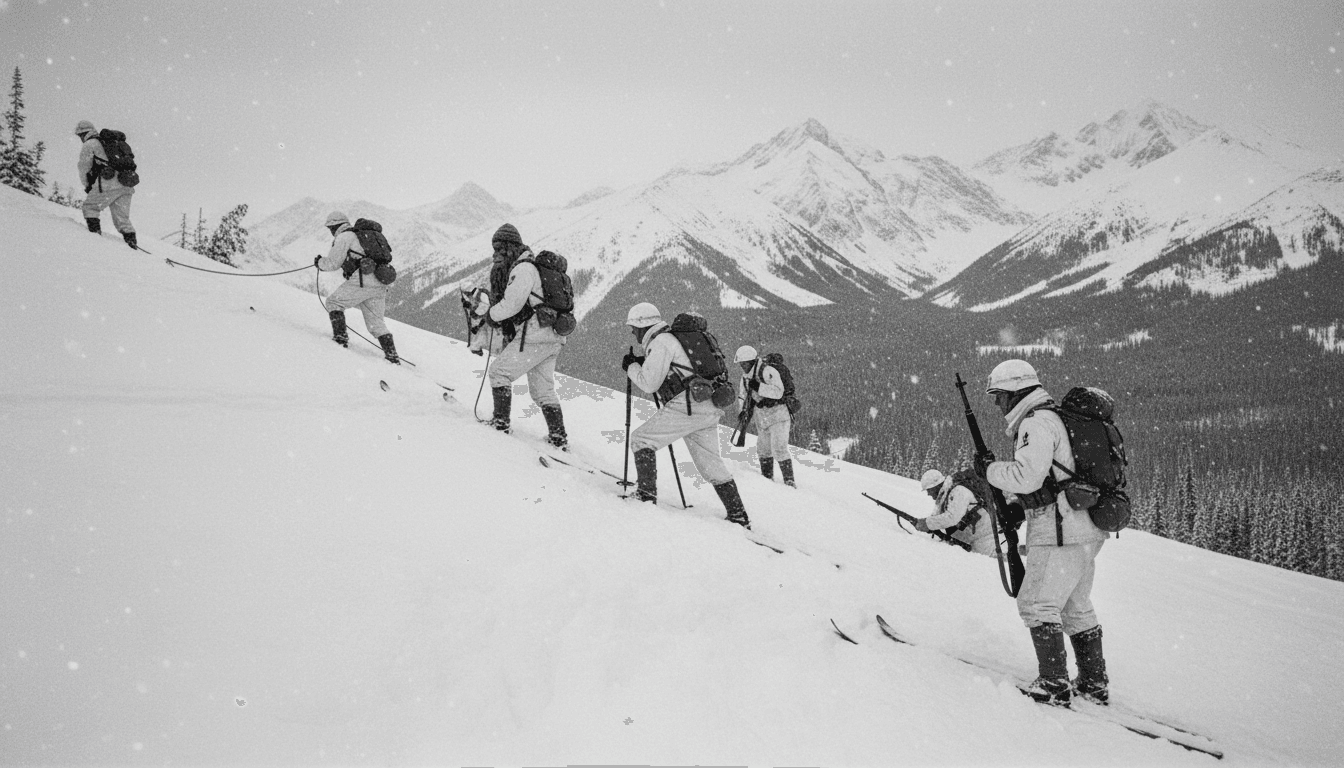
- Norwegian Army ski instructors brought in for cross-country skiing, snowshoeing, and arctic survival.
- Mountaineering on local landmarks (Mt. Helena, Blue Cloud, Sheep Mountain) built rope and climbing skills.
- Soldiers practiced moving silently at night, hauling mortars up cliffs in the dark, prepping for assaults like Monte la Defensa.
Hand-to-Hand Combat: O’Neill’s Edge
Pat O’Neill, ex-Shanghai cop, taught brutal, real-world techniques—no fancy wrestling, just methods to end fights fast.
- Signature Move: “O’Neill Cover” (cross-arm guard) protected vital areas, letting fighters quickly counterattack.
- V-42 Knife: The FSSF’s own custom blade, designed for lethal efficiency. Training blended knife and hand-to-hand strikes for maximum impact.
(For details, see: Canadian Special Operations Regiment)
Camp Rimini: The War Dogs of the Divide
Helena’s war story wasn’t just about men—dogs played a crucial role, too.
Camp Rimini, a few miles west of town, trained 800+ sled and pack dogs and 150+ handlers for high-altitude logistics:
- Summer training: Dog teams pulled stripped-down car chassis over Montana’s hills to build strength.
- Winter: Mushers and dogs learned to run supply sleds, carry heavy gear, and even fire mounted machine guns!
- Innovation: Parachute harnesses were designed so dogs could drop into remote areas with their human teammates.
After Norway:
- When Operation Plough got axed, Rimini’s dogs were shipped off to Greenland, Baffin Island, and Newfoundland for search-and-rescue.
- These teams recovered crashed pilots and equipment from the Arctic—no machine could do what these teams accomplished.
(See: Camp Rimini Sled Dog Memorial)
The “Devil’s Brigade” in Helena: Town and Troops Collide
Helena, a mining town with a reputation for hard living, was wary at first. Rumors spread about the new arrivals—folks called ‘em criminals, troublemakers, or worse. But soon, reality set in:
- Local Businesses: Saturday nights, Forcemen and locals mingled at the Gold Bar, The Corner, and the Log Cabin Night Club. Sometimes it ended in a brawl, but more often in laughter and tall tales.
- Economic Boost:
- Soldiers sometimes pawned their paratrooper wings for $5 loans—money always repaid.
- Romance:
- 200 Helena women married members of the Brigade, tying the town and the Force together forever.
- Parade Farewell:
- On April 6, 1943, Helena gave the Brigade a full parade. Local pride replaced suspicion. Soldiers, families, and townsfolk marched together down Main Street.
(See: U.S. Army Center of Military History)
From Helena to Heroics: Monte la Defensa & Beyond
All this sweat and suffering in Helena led to one of the most legendary assaults of WWII: Monte la Defensa, Italy, December 1943.
- The Mission:
- 500-foot cliffs, German defenses considered “unscalable.”
- At night, FSSF used climbing skills honed in Montana to ascend the cliffs and take the summit.
- Surprised the Germans, seized the objective by dawn.
- Results:
- Success, but at a price: 511 casualties just on Monte la Defensa—many from frostbite and trenchfoot, which even Montana’s training couldn’t prevent in the Italian cold.
- FSSF’s relentless raids at Anzio earned them the nickname “Black Devils”—they painted their faces black and slipped through enemy lines nightly, terrifying the Germans.
- Not just tactical wins: the FSSF’s work allowed larger Allied units to break out and take Rome.
(See: Congressional Gold Medal for the FSSF)
The Legacy: Modern Special Ops Owe It All to the 406
The FSSF was disbanded in December 1944, but its legacy never died:
- DNA of Modern SOF:
- The U.S. Army Green Berets and Canadian Special Operations Regiment both trace their roots to Helena.
- Symbols:
- Red arrowhead patch, crossed arrows—both part of today’s special forces heraldry.
- Recognition:
- In 2013, surviving FSSF members were awarded the Congressional Gold Medal for inventing modern elite warfare.
- Montana Military Museum:
- Fort Harrison is still active, and its museum is packed with FSSF artifacts, from V-42 knives to M29 Weasel carriers.
(See: Montana Military Museum)
FAQs
Q: Can you visit Fort Harrison and the Montana Military Museum?
A: Yes! The museum’s got a stunning collection of original FSSF and Camp Rimini gear—check their website for hours.
Q: Are there still FSSF veterans alive?
A: Only a handful, but their stories live on in books, documentaries, and at the annual First Special Service Force reunions.
Q: Did Camp Rimini’s dog teams keep working after WWII?
A: Yep! They helped out with postwar rescue missions and inspired Montana’s current dog-sled races and winter mushing clubs.
Q: Was the “Devil’s Brigade” really unbeatable?
A: In 251 days of combat, they never failed a single mission, despite suffering 134% casualties (meaning many replacements also saw combat). Their reputation struck fear into Axis forces.
Q: Where can I read or watch more?
A: Try The Devil’s Brigade book, the 1968 movie, and the CBC documentary.
Leave a Reply
You must be logged in to post a comment.