
The 406 Life • Montana Heritage
Montana’s Hidden Grief: Honoring Those Who Never Returned
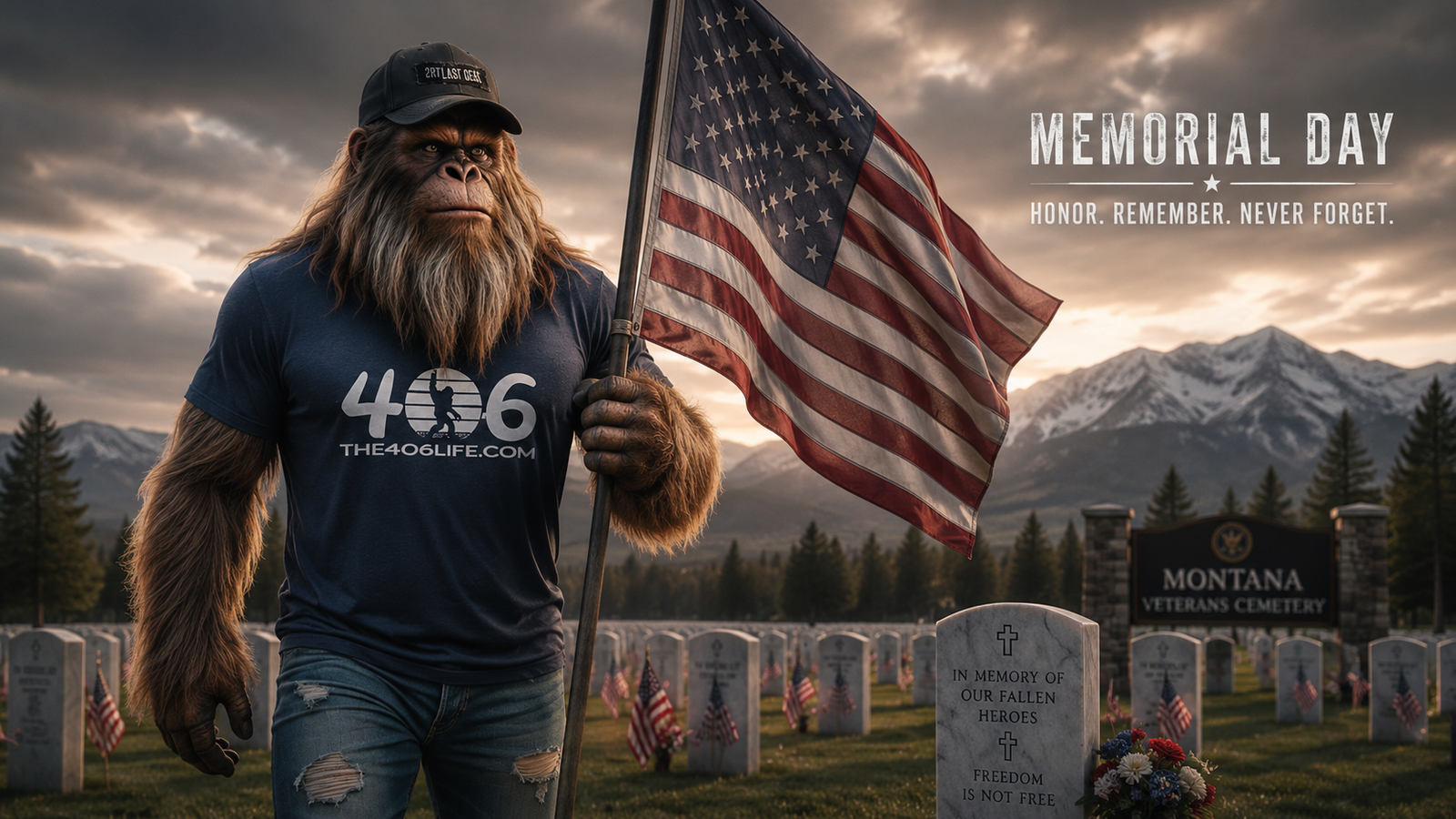
I’ve stood quiet in a lot of places across this state. River valleys at dawn. Ridgelines nobody drives past. And every last Monday in May, I notice something shift out there… a stillness that don’t have much to do with weather.
Memorial Day in Montana ain’t a long weekend. Not really. Sure, the campgrounds fill up and the boat launches get busy — that’s just the calendar doing what it does. But underneath all that, there’s something heavier. Something earned. Because this state sends more of its people to serve than almost anywhere else in the country, and it remembers the ones who don’t come back.
If you want to understand Montana, pay attention to how it grieves. That’ll tell you more than a postcard ever could.
Montana’s Military Footprint Is No Small Thing
The numbers here are worth sittin’ with for a minute. Montana ranks third in the nation for patriotism, according to civic studies that track things like voter turnout, volunteerism, and the ratio of civilians to veterans. That last one is where Montana really stands out.
That’s approximately 85,871 veterans living in Montana today. More than 40% of them are 65 or older, which means a big chunk of this community is aging — and a good portion of them are doing it in rural areas far from the services they need.
Because of that, local organizations like the American Legion, the Veterans of Foreign Wars, and the Veterans Navigation Network end up doing a lot of the heavy lifting. They’re not just planning ceremonies — they’re running the support networks that hold things together between holidays.
I’ve watched those organizations work. Quietly, mostly. No fanfare. Just folks showing up for each other the way Montana folks tend to do — without making a big production of it.
How Memorial Day Came to Be
It started after the Civil War — the bloodiest conflict this country ever fought. Back then, folks called it Decoration Day. The idea was simple: go out in spring, when flowers were blooming, and lay them on the graves of the people who died in the war.
In 1868, Major General John A. Logan issued a formal order designating May 30 as the day to do it. May 30 wasn’t chosen because anything particular happened that day. It was chosen because flowers would be in bloom across the whole country.
Over time, the tradition grew to include all American service members lost in any conflict — not just the Civil War. Then in 1971, Congress moved the holiday to the final Monday in May to create a three-day weekend. A lot of veteran groups pushed back on that. They argued — and still argue — that shifting the date traded solemnity for convenience.
The distinction between military holidays matters, and it’s worth knowing:
- Armed Forces Day (third Saturday in May) — honors those currently serving
- Memorial Day (final Monday in May) — honors those who died in service
- Veterans Day (November 11) — honors all who served, living or dead
Three different days. Three different purposes. Worth keeping straight.
Montana’s Military Legacy Runs Deep
The reason Memorial Day carries so much weight in Montana isn’t abstract. It’s specific. It’s tied to real units, real campaigns, and real costs paid by people from these towns and valleys.
The Devil’s Brigade — Trained Right Here in Helena
During World War II, one of the most elite commando units ever assembled — the First Special Service Force, known as the “Devil’s Brigade” — trained at Fort William Henry Harrison near Helena. It was a joint American-Canadian unit, handpicked for its toughness. Outdoorsmen, hunters, lumberjacks. The kind of people who already knew how to move in cold terrain and rough country.
They were trained in parachute jumps, ski warfare, mountain climbing, and close-combat operations. Their most famous action came in December 1943, when they cleared Nazi positions off the steep, icy cliffs of Monte la Difensa in Italy — a position that had already broken other Allied units.
First Special Service Force — By the Numbers
251 days of active combat across Italy and southern France
2,314 total casualties — equal to 134% of original combat strength
77% casualty rate during the Italian mountain campaign
They left cards on fallen German soldiers. Red spearhead insignia. The message on the back translated to: “The worst is yet to come.” That’s the kind of unit they were.
The 163rd Infantry — Montana’s Sons in the Pacific
Originally part of the Montana National Guard, the 163rd Infantry Regiment fought in the jungles of Papua New Guinea during World War II. At the Battle of Sanananda in January 1943, they became the first American unit to defeat Imperial Japanese forces in land combat.
They did it in hell. Constant rain. Standing water. Malaria, dysentery, snipers, and hidden bunkers. The jungle fought them as hard as the enemy did.
163rd Infantry at Sanananda
Company B entered with 187 soldiers — emerged with 21 able-bodied men
97 killed, 215 wounded; hundreds more evacuated due to disease
Over 230 Native American soldiers served in the regiment, representing eight tribal nations
Worth noting: Company B was formed in 1922 at Poplar, Montana, entirely with Native American soldiers from the Fort Peck Indian Reservation. Many served as code talkers — transmitting classified communications in their native languages. That contribution stayed classified for decades after the war ended.
I’ve been through those valleys on the Fort Peck reservation. Quiet country. The kind of quiet that’s been there a long time. Knowing what those men did — and how long the world kept it secret — well. That sits heavy.
Montana’s State Veterans Cemeteries
Montana operates four state veterans’ cemeteries, managed by the Montana Department of Military Affairs. The first — at Fort Harrison — opened in 1987. Since then, the program has expanded to cover the state’s far corners, because veterans live in all of them.
- Montana State Veterans Cemetery — Fort Harrison (western and central Montana)
- Western Montana State Veterans Cemetery — Missoula
- Eastern Montana State Veterans Cemetery — Miles City
- Northern Montana State Veterans Cemetery — Columbia Falls
Eligible veterans receive a plot, headstone, and perpetual care at no cost. Families submit discharge documentation and a death certificate. That’s it. The state handles the rest.
Decoration rules are strict — and they exist for good reason. Mowing equipment and uneven ground are a hazard for anything placed on a grave. Here’s what’s generally allowed and when:
- Artificial flowers — permitted November 16 through March 15, and five days before and after Memorial Day
- Potted plants — permitted seven days before and after Easter and Memorial Day
- U.S. flags — authorized on individual graves during Memorial Day weekend only
- No statues, glass, balloons, pinwheels, or shepherd’s hooks at any time
The Coin Tradition — What It Actually Means
If you’ve ever walked through a veterans’ cemetery and noticed coins sitting on headstones, that’s not random. It’s a tradition with specific meaning — rooted in history going all the way back to ancient Rome, and brought into modern use during the Vietnam War era, when political tensions made it hard for veterans to talk to Gold Star families without friction.
Leaving a coin said what words couldn’t — without starting an argument.
Cemetery staff collect those coins monthly. The money goes directly toward cemetery upkeep and covering burial costs for veterans who can’t afford them. Even in death, veterans look after each other.
Where Montana Gathers on Memorial Day 2026
Ceremonies happen across the state — in big cities and small towns alike. Here are some of the major observances planned for Memorial Day 2026.
Missoula — 100th Consecutive Wreath Ceremony
This one’s significant. Missoula’s wreath ceremonies mark their 100th consecutive year in 2026 — coordinated by American Legion Hellgate Post 27 and VFW Post 209. The day runs from a 7:00 AM sunrise service at the Western Montana State Veterans Cemetery all the way through a 4:00 PM closing at the Iraq-Afghanistan War Memorial on the University of Montana campus.
In between, ceremonies move through the Van Buren Street Bridge, the Missoula County Courthouse, Fort Missoula, and more than 20 individual military monuments. At noon, the historic Miss Montana aircraft flies over the cemetery for a parachute flag drop.
Great Falls — Montana Veterans Memorial
The Montana Veterans Memorial Association hosts its 21st annual ceremony on May 25, 2026, at the Memorial Plaza in Great Falls. The Great Falls Municipal Band and Great Falls Pipe Band provide music. The 341st Operations Support Squadron’s commander delivers the keynote, and a C-130 Hercules from the Montana Air National Guard’s 120th Airlift Wing performs a flyover.
Separately, the Great Falls Freedom Memorial — behind the Great Falls Library — hosts a service at 11:00 AM to honor all local service members, including the six Great Falls residents lost on September 11, 2001.
Flathead Valley — Sequential Honors All Day
The United Veterans of the Flathead Valley and VFW Post 2252 run a full-day sequence of ceremonies across the valley, starting at 10:15 AM at Glacier Memorial Gardens and moving through Kalispell, Conrad, Fairview, and Columbia Falls — wrapping up at the Montana Veterans Home Cemetery by mid-afternoon.
Columbia Falls Freedom Post 72 also hosts a Walk to Honor — marching to the Flathead River to pay respects to those buried at sea.
Bozeman — Montana’s First Gold Star Monument
Sunset Hills Cemetery in Bozeman will unveil Montana’s first Gold Star Families Monument in 2026 — the 100th such monument in the nation. It honors Gold Star families: those who lost a loved one in active military service. If you’re near Bozeman, that’s worth making time for.
Smaller Communities
- East Helena — VFW Cory-Dullum Post 10010 community parade and picnic
- Libby — Happy’s Inn VETS Memorial Weekend fundraiser for Valor Equine Therapy Service
- Ferndale — Montana Legends Memorial Run motorcycle poker run for veteran support
- Whitefish — Songwriter’s show benefit concert for veteran counseling and transition programs
Montana don’t need a reason to show up for its own. But Memorial Day gives everybody the same moment to do it together. And in a state this spread out, that matters more than most people say out loud.
How to Observe Memorial Day the Right Way
You don’t have to attend a ceremony to mark the day with intention. Here are a few ways to do it right, wherever you are in Montana.
- Attend a local ceremony — most are open to the public and free
- Visit a veterans’ cemetery and leave a coin on a headstone
- Observe the National Moment of Silence at 3:00 PM local time
- Fly your flag at half-staff until noon, then full-staff for the rest of the day
- Thank a Gold Star family — quietly, genuinely, without making it about yourself
And if you’re heading into the hills this weekend — which is a fine thing to do — take a minute before you go. The trails will still be there. The moment is now.
FAQ: Memorial Day in Montana
What is the difference between Memorial Day and Veterans Day?
Memorial Day honors service members who died while serving in the U.S. military. Veterans Day honors all who have served, living or deceased. They are separate holidays with distinct purposes.
Where are Montana’s state veterans’ cemeteries located?
Montana operates four state veterans’ cemeteries: Fort Harrison (near Helena), Missoula, Miles City, and Columbia Falls. All four are managed by the Montana Department of Military Affairs.
Who is eligible to be buried in a Montana state veterans’ cemetery?
Eligible veterans receive burial benefits at no cost. Montana is one of few states that also permits National Guard and Reserve members who don’t meet standard federal active-duty requirements to be interred in state veterans’ cemeteries under the Burial Equity for Guards and Reserves Act.
What does leaving a coin on a headstone mean?
Each denomination carries a specific meaning: a penny means you visited, a nickel means you trained together, a dime means you served together, and a quarter means you were present when the veteran died. Collected coins go toward cemetery upkeep and indigent veteran burials.
What was the Devil’s Brigade and what does it have to do with Montana?
The First Special Service Force — nicknamed the “Devil’s Brigade” — was an elite joint American-Canadian commando unit that trained at Fort William Henry Harrison near Helena during World War II. They suffered 2,314 casualties in 251 days of combat, representing 134% of their original combat strength.
Are Memorial Day ceremonies in Montana open to the public?
Most are. Major ceremonies in Missoula, Great Falls, Billings, the Flathead Valley, and Bozeman welcome community members. Check with your local American Legion or VFW post for specific times and locations.
I’ve walked a long stretch of this state. And whatever day it is — Memorial Day or any other — there’s always some piece of ground out here that holds more than soil. It holds names. Some of ’em you know. A lot of ’em you don’t.
That’s worth a minute of your time. At least.
Wanna keep up with Montana Max and the wild ride that is The 406 Life? Follow us on Instagram for daily snapshots of Big Sky livin’, and join our Facebook crew—both the main page and the group—for local biz shoutouts, behind-the-scenes shenanigans, and real-deal Montana grit. Whether you’re scrollin’ from the mountains or missin’ ‘em from afar, we’ve got a seat ’round the digital campfire waitin’ for ya.
And don’t forget to roam through our blog, where Montana Max dishes out tales from the trail, cultural deep-dives, and a whole lotta backwoods wisdom.
Leave a Reply
You must be logged in to post a comment.