
Montana’s Wild Places Don’t Owe You a Selfie: How to Behave in Glacier, Yellowstone, and Beyond
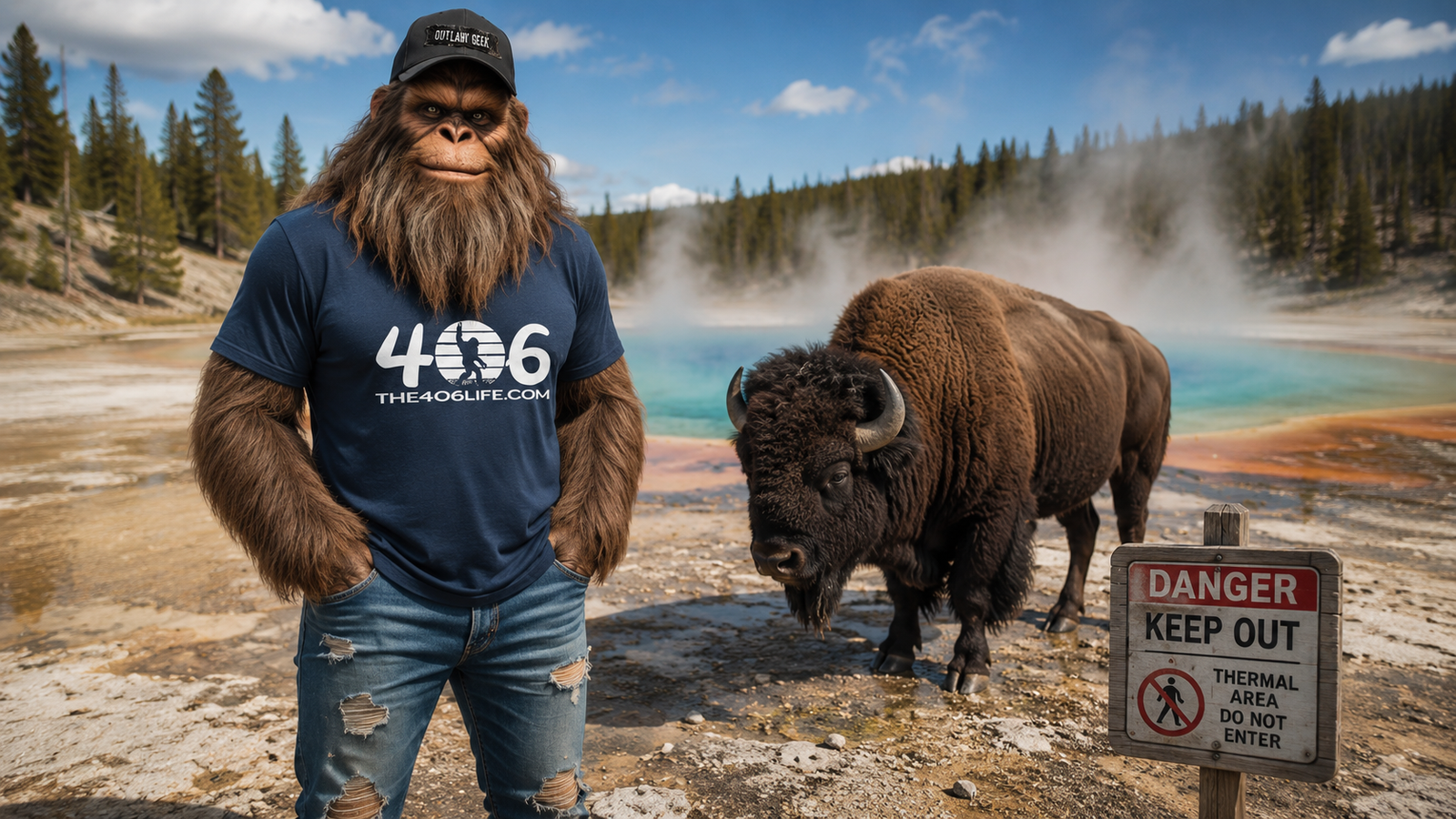
Now I’ve been sittin’ up in these mountains a long, long time. Long enough to remember when the only thing botherin’ the bison was the wind. These days? It’s tourists with iPads held over their heads, askin’ a two-thousand-pound animal if they can ride it.
I wish I was makin’ that one up. I’m not.
I’ve watched a fair share of folks wander into Montana’s parks thinkin’ the wildlife’s here for their Instagram and the ground’s just scenery. Neither one’s true. So let’s talk about how to actually behave out here — because the wild places in this state will teach you a lesson one way or another, and I’d rather you learn it from me than from a bison.
The Golden Rule: Distance Isn’t a Suggestion
Here’s the simple version, straight from the National Park Service, and it’s the same whether you’re in Glacier or Yellowstone:
- 100 yards from bears and wolves. That’s about the length of a football field.
- 25 yards from everything else — bison, elk, moose, deer, bighorn sheep, mountain goats.
Now if math ain’t your thing on vacation, here’s an easier test. Hold your thumb up at arm’s length. If your thumb don’t cover the whole animal, you’re too close. Simple as that.
And here’s the real test, the one I use: if the animal changes what it’s doing because you showed up — head comes up, it stops eating, it starts walkin’ toward you instead of away — you crossed the line a while back. Animals don’t lie about how they feel. People do that. Animals just leave, or they don’t, and if they don’t, you’re in trouble.
Bison: The Most Underestimated Animal in America
Folks see a bison standing there in a meadow, chewin’ grass, lookin’ about as dangerous as a parked car, and they think, “well, that’s just a big cow.”
It is not just a big cow.
A bison can run 35 miles an hour — that’s about three times faster than you. It weighs up to 2,000 pounds. And here’s the part that should scare you straight: researchers looked at injury reports from Yellowstone between 2000 and 2015 and found that when people got hurt by bison, the average distance between the person and the animal beforehand was about 11 feet. Eleven feet. That’s closer than most living rooms.
Since 1980, bison have injured more people in Yellowstone than any other animal — more than bears, more than anything. It’s usually one or two injuries a year on average, though some years have been worse than others — 2015 saw five — almost always because somebody decided eleven feet was close enough for a good photo. Deaths, by comparison, are rare: only two in the park’s entire history, and none since 1983.
I’ve seen the videos. A man walkin’ up to a bison jam holdin’ an iPad over his head like he’s filmin’ a nature documentary instead of standin’ in one. Skiers gettin’ within twenty feet of a bull bison on a webcam. And — I promise you I’m not inventin’ this — somebody asked a bison, out loud, if they could ride it.
That bison did not answer. Bison rarely do. They just put their head down and answer with their whole body, and that’s when somebody ends up gored.
It happened to an 83-year-old woman on the Storm Point Trail — lifted clean off the ground by the horns. A 47-year-old man at Lake Village. A 30-year-old man at the Upper Geyser Basin, after a crowd of people pressed in too close for photos. None of these folks were doing anything most people wouldn’t think to do. They just got too close to something that looked calm and wasn’t.
And it’s still happening. Just this past Friday, June 26, 2026, a 12-year-old visitor was injured by a bison near Mud Volcano, just north of Fishing Bridge, around 9:15 in the morning. Park officials haven’t released details on how close the encounter got or how bad the injuries were — the kid was taken to a hospital and the whole thing’s still under investigation. But the park’s response was the same as always: bison have hurt more people in Yellowstone than any other animal, and the 25-yard rule doesn’t take the day off just because you’re on vacation.
Yellowstone’s Thermal Features: Pretty, Colorful, and Trying to Kill You
Now Yellowstone’s got more than ten thousand hydrothermal features — geysers, hot springs, mud pots — and more than half the active geysers on the planet. They’re some of the most beautiful things you’ll ever lay eyes on. They are also, and I want to be real clear about this, capable of killing you in under a minute.
Here’s why. What looks like solid ground around those pools is actually a thin crust — sometimes thin as a skim of ice on a pond — sittin’ right on top of water that can be near boilin’, sometimes hotter, and in some spots acidic enough to dissolve things. Not “irritate your skin” acidic. Dissolve. Things.
At least 22 people have died from falling into Yellowstone’s thermal features since the park opened in 1872 — that works out to about one death every six or seven years on average, but each one happens the same way: a wrong step where a wrong step shouldn’t be possible. The first was a seven-year-old boy in 1890.
In 2016, a young man named Colin Scott left the boardwalk at Norris Geyser Basin with his sister, lookin’ for a place to soak — what folks call “hot potting.” He knelt down to check the water temperature, slipped, and fell into a pool that was both scalding and highly acidic. By the next day, there wasn’t enough of him left to recover. The day before that happened, six other people had been cited for walking off the boardwalk at Grand Prismatic Spring. Six. In one day. At the same park where a man had just died doin’ the same thing.
In 2022, a 70-year-old man went into the Abyss Pool at West Thumb. They found a shoe and part of a foot weeks later.
And in 2025, a man got five days in federal jail for walking straight across Mammoth Hot Springs’ fragile features — Canary Spring, Mound Terrace, Palette Hot Spring. Prosecutors said his footprints damaged formations that took nature thousands of years to build, and that he’d come about as close as a person can to turnin’ himself into soup.
The boardwalk ain’t there to keep the view nice for photographs. It’s the only thing standin’ between you and a hole that doesn’t forgive mistakes.
Now I don’t want to scare you into never leavin’ your car. Yellowstone pulled in nearly 4.75 million visits last year. Glacier saw over 3.2 million. Against numbers like that, these deaths are rare — genuinely rare. Across the entire National Park System, only about nine people died from wildlife encounters between 2007 and 2023, out of nearly five billion visits. You’re a lot more likely to drown, crash a car, or take a bad fall in a national park than you are to get killed by an animal or a hot spring. But “rare” don’t mean “impossible,” and every one of these stories started with somebody thinkin’ the odds didn’t apply to them.
Glacier: Where the Bears Don’t Care About Your Hiking Schedule
Glacier’s got somewhere around 300 grizzly bears wanderin’ its slopes — part of the largest grizzly population left in the lower 48. That’s not a reason to stay home. It’s a reason to carry bear spray where you can actually reach it, on your hip or your chest, not buried at the bottom of your pack where it’ll do you exactly no good.
In May of 2026, a 33-year-old man from Florida was killed in what officials believe was a surprise encounter on the Mount Brown trail near Sperry. It was the first bear fatality inside Glacier since 1998 — a 28-year gap. Since the park opened back in 1910, eleven people have died in bear encounters there, and most of those happened in one rough stretch between 1967 and 1998. Call it roughly one death per decade overall, which tells you these things are rare. It also tells you they’re real, and they happen fastest when nobody saw it coming.
That’s the whole point of makin’ noise on the trail, hikin’ in groups, and not running through brushy, blind-corner terrain. No grizzly attack has ever been recorded on a group of four or more people. Bears don’t want trouble with a crowd. Give ’em the chance to know you’re there, and most times, they’ll just go about their business — same as I do, mostly.
I’ve watched grizzlies chase mountain goats clean across the boardwalk at Hidden Lake Overlook, not ten feet from a line of stunned hikers takin’ pictures. Even in the open, even on a trail full of people, wildlife moves a whole lot faster than your reaction time. That boardwalk don’t make you safe. It just makes you comfortable. Big difference.
The Babies Aren’t Yours to Save
Now this one gets me every time, because it comes from a good place and ends up bein’ a death sentence.
In 2016, a father and son found a newborn bison calf near Lamar Buffalo Ranch. Figured it looked cold. Loaded it into their SUV. Drove it to a ranger station, thinkin’ they were heroes.
The herd wouldn’t take it back. Rangers tried and tried. The calf kept walking up to cars and people instead of bison, because that’s what it had learned to do in those first critical minutes. They had to put it down. The man got fined $235 and had to pay $500 to a wildlife fund — a real bargain compared to what that calf paid.
It happened again in 2023. Different man, same story, same ending. A newborn elk got the same treatment that same year — picked up, driven off, never recovered.
Here’s what I need you to understand: a wild animal that’s been touched by human hands often gets rejected by its own herd. Their mothers can smell it. You’re not rescuing anything by puttin’ your hands on a baby animal. You’re orphaning it twice — once from its mother, and once from its whole future.
If you see somethin’ that looks abandoned or hurt, you call a ranger. You don’t become one yourself.
The Ground Remembers Longer Than You Think
This last part don’t get near enough attention, and it’s the one that bugs me most, bein’ as I’ve watched it happen slow, over decades, right under my own feet.
Up at Logan Pass in Glacier, there’s a stretch of alpine meadow that’s home to more than thirty rare arctic-alpine plants — some found almost nowhere else on Earth. Before the boardwalk went in, foot traffic had worn the natural trail down so bad that switchbacks were getting cut, and in places the trail had widened out to twelve feet across, just from people walkin’ wherever they pleased.
So they studied it. Researchers actually trampled a test patch of that meadow on purpose, back in 1967, just to see how long it’d take to come back. You know what they found? Walked on fifteen times a week, it took 19 to 25 years to recover. Walked on fifty times a week — which is closer to what a busy trail sees — it took 25 to 30 years.
Thirty years. That’s not a season. That’s not even close to a season. That’s most of a person’s working life, just to grow back grass and wildflowers that a few thousand careless footsteps wiped out.
Once they built the boardwalk, the difference showed up fast. Only about 2 percent of people stepped off the boardwalk, compared to 19 percent who used to wander off the old natural trail. That’s the whole reason that walkway exists. It’s not there to make your hike easier. It’s there because they did the math on how long this place takes to heal, and decided you weren’t worth the wait.
So stay on it. Every time. The view’s just as good from where you’re supposed to stand.
How to Actually Be Good Out Here
I’ve watched this state for longer than I care to admit, and the pattern’s always the same. The folks who have the best time are the ones who treat Montana like they’re visitin’ someone’s house, not like they bought the place.
So here’s the short version, no fine print:
- Keep your distance — 100 yards from bears and wolves, 25 yards from everything else. If the animal notices you, you’re already too close.
- Stay on the boardwalk, stay on the trail. Every time. No exceptions for a “better angle.”
- Never touch, feed, or “rescue” wildlife — especially babies. A good photo from far away beats a dead calf every time.
- Carry bear spray where you can reach it if you’re in Glacier country, and make some noise on the trail.
- Pack out what you bring in, camp away from water, and leave the rocks and wildflowers right where you found ’em.
This place will hand you the best afternoon of your life if you let it. Sunrise over a ridge, fog liftin’ off a valley, a bison herd movin’ slow across an open field at a distance that keeps everybody breathin’. But it don’t bend the rules for anybody, and it sure don’t care how many followers you’ve got.
You don’t find Montana. You either fit into it, or you don’t.
Behave like you fit.
FAQ: Wildlife and Terrain Safety in Montana’s Parks
How far away do I need to stay from bears in Montana?
At least 100 yards — about the length of a football field — whether you’re in Glacier, Yellowstone, or anywhere else bears roam.
Are bison really dangerous if they look calm?
Yes. Bison have injured more Yellowstone visitors than any other animal since 1980 — usually one or two people a year — and most of those injuries happened when people were standing roughly 10 to 15 feet away. Deaths are much rarer: only two in the park’s history, and none since 1983.
What happens if I step off a boardwalk in a thermal area?
You risk serious burns or death from scalding, sometimes acidic water hidden under a thin crust. At least 22 people have died this way in Yellowstone’s 150-year history — about one every six or seven years — but it only takes one wrong step.
Why can’t I touch a baby animal that looks abandoned?
Human contact can cause a mother to reject the calf, and the animal often becomes habituated to people instead of its herd — frequently leading to euthanization. Call a ranger instead.
How long does it take damaged alpine terrain to recover?
Research at Glacier’s Logan Pass found trampled alpine meadow took 19 to 30 years to fully recover, depending on how often it was walked on.
Montana Max, over and out.
Wanna keep up with Montana Max and the wild ride that is The 406 Life? Follow us on Instagram for daily snapshots of Big Sky livin’, and join our Facebook crew—both the main page and the group—for local biz shoutouts, behind-the-scenes shenanigans, and real-deal Montana grit. Whether you’re scrollin’ from the mountains or missin’ ‘em from afar, we’ve got a seat ’round the digital campfire waitin’ for ya.
And don’t forget to roam through our blog, where Montana Max dishes out tales from the trail, cultural deep-dives, and a whole lotta backwoods wisdom.
Leave a Reply
You must be logged in to post a comment.