
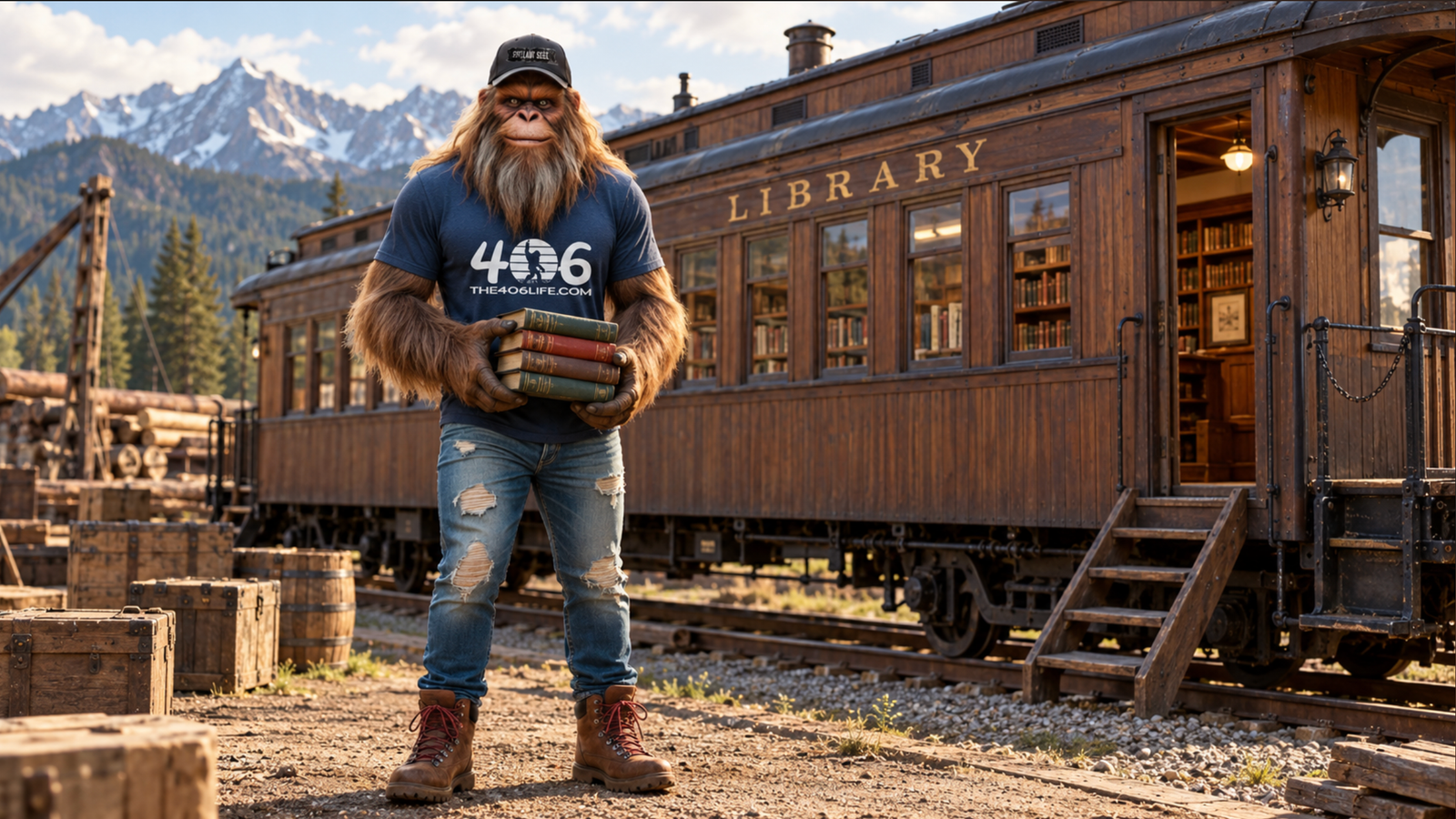
In the early 1920s, deep in the timber country of western Montana, something rather unusual began making its way along the logging railroads. It wasn’t carrying lumber, mining equipment, or supplies for the men working in the remote camps. Instead, this particular railroad car was filled with books, newspapers, magazines, comfortable chairs, and a warm stove. It even had living quarters for the man responsible for keeping the whole operation running.
It was called the Lumberman’s Library, and it was one of the more remarkable ideas to come out of Montana’s logging industry.
Now, I’ve spent a considerable amount of time wandering through Montana’s forests, usually doing my best to avoid the very people who were cutting them down. And while I’ve seen some interesting things over the years, I have to admit that a traveling library for lumberjacks is a pretty clever invention. Apparently, somebody figured out that a fellow could swing an axe all day and still enjoy a good book when he got home.
What makes the story especially interesting is that the library wasn’t merely a nice idea that looked good on paper. According to contemporary newspaper reporting, thousands of books were borrowed by the men who visited it. Workers even contributed their own money to help purchase reading material, and on winter evenings, the little railroad car became a gathering place where men could escape the isolation of camp life for a while.
The story begins with a determined librarian named Ruth Worden, a skeptical lumber company manager named Kenneth Ross, and an unexpected discovery about the men working in Montana’s timber camps. And nearly a century after its busiest years, the actual railroad car has survived. You can still find it at the Historical Museum at Fort Missoula.
A Woman With an Idea and a Lumber Boss Who Wasn’t Interested
By 1919, the Anaconda Copper Mining Company was deeply involved in more than just mining copper. Its lumber department operated an enormous timber business in western Montana, supplying wood for mining operations and other industrial needs. The company’s sawmill at Bonner, east of Missoula, was a major part of that operation, while hundreds of men worked in logging camps scattered throughout the surrounding mountains.
Life at those camps was considerably different from life in town. The men spent their days doing physically demanding work, and when evening came, their entertainment options were limited. Historian Robert G. Dundas, who documented the Lumberman’s Library in a 2003 issue of Tall Timber Short Lines, described workers passing their free time playing cards, visiting with one another, maintaining equipment, or simply resting. The men at the Bonner mill had access to some organized social activities, but workers stationed farther into the woods didn’t necessarily have those same opportunities.
Ruth Worden, the Missoula County librarian, saw an opportunity to change that.
According to an account published in The Missoulian on December 19, 1926, Worden and the Missoula city librarian approached Kenneth Ross during a visit to a company logging camp in the Ninemile area west of Missoula in 1919. Ross was the general manager of the Anaconda Copper Mining Company’s lumber department, and Worden wanted to know whether he would be interested in providing books for his employees. The library would furnish them without charge and arrange for additional selections as needed.
Ross wasn’t particularly impressed with the proposal. In his recollections published several years later, he admitted that he expected the books to create extra responsibility without accomplishing very much. Nevertheless, he knew Worden and agreed to let the logging camp clerk take charge of a shipment if the clerk was willing.
That might have been the end of the experiment if Ruth Worden had been the sort of woman who accepted a reluctant yes and quietly disappeared. Fortunately for Montana’s logging camps, she wasn’t.
Not long afterward, she approached Ross again, this time about furnishing books to the sawmill workers at Bonner. He agreed to let the company storekeeper handle a collection, but Worden returned with another concern. The store wasn’t particularly convenient for men who wanted books in the evening, and the collection needed someone responsible for keeping the books organized and regularly exchanged.
Ross eventually arranged for a room in the local hotel and hired a young woman to manage the books. Judging from his later recollections, he was mostly relieved to have the responsibility taken off his hands.
I’ve known a few humans like Mr. Ross. They aren’t necessarily opposed to a good idea. They just don’t want it landing on their desk, particularly when they’re already busy running a lumber company. I suspect Ruth Worden understood that perfectly well. She simply kept working on the problem until there was a solution.
And before long, the reports coming back from the libraries began to change his mind.
An Unexpected Appetite for Books
At the end of the Bonner library’s first year, Ross received a report indicating that more than 4,000 books had been read. He also learned that the collection at the logging camp was receiving considerable attention. Those figures, which come from Ross’s recollections in the 1926 newspaper account, surprised a man who had initially doubted that the workers would have much interest in reading.
It wasn’t simply the circulation numbers that impressed him. Ross believed the availability of books was having a positive influence on the workers, although that was his interpretation rather than something we can independently measure today. Whatever his broader conclusions, the practical evidence was difficult to ignore: the men were using the libraries, and the collections were worth expanding.
Meanwhile, the company had something that made a much more ambitious plan possible. Its logging operations were connected by railroad tracks, allowing timber, equipment, and supplies to move between camps and the Bonner mill. If those tracks could carry everything else the operation required, there was no obvious reason they couldn’t carry books.
Ross eventually arranged for a railroad car to be converted into a traveling library. The Historical Museum at Fort Missoula dates its construction to approximately 1921, and the finished car became known as the Lumberman’s Library. Instead of expecting workers to travel to a permanent library, the company could move the library between camps, putting reading material within reach of men who otherwise had limited access to it.
It was a wonderfully practical Montana solution to a Montana problem. The workers were scattered through the mountains, the company already had the railroad, and a determined librarian had demonstrated that there was demand for books. Rather than build a permanent library at every camp, they put one on wheels and took it where it was needed.
I do have one small complaint about the arrangement. Nobody seems to have considered including a section for large, hairy creatures who prefer wilderness literature. But then, library cards have always been a little difficult for those of us who don’t have a permanent mailing address.
A Reading Room in the Middle of Timber Country
The Lumberman’s Library was much more than a railroad car with books stacked inside. Historical photographs and contemporary descriptions show that considerable thought went into making it a comfortable, functional reading room. The exterior was painted gray and carried a sign identifying it with the Missoula County Free Library. Inside, bookshelves lined portions of the walls, and a long table surrounded by armchairs gave workers somewhere to sit and read.
The car had lighting and a stove for heat, important comforts during western Montana’s winters. Newspapers and magazines were kept within easy reach, and a Victrola record player added another form of entertainment. The arrangement was practical but welcoming, offering a very different environment from the equipment, bunkhouses, and work areas that otherwise defined much of life in a logging camp.
One end of the railroad car was reserved for the librarian. A partition separated his living quarters from the main reading room, allowing him to sleep aboard and travel with the collection as it moved between camps. The books were managed using ordinary library procedures, complete with pockets and borrowing cards to record who had checked out each volume and when it was returned.
According to Ross’s account, the car was generally moved to another logging camp about every two weeks. The company already maintained the rail connections, so the library could follow the same transportation system that served the timber operation. Workers who might have lived many miles from the nearest town suddenly had regular access to books, newspapers, magazines, and someone who could help them find additional reading material.
The design also gave the library another important purpose. Men didn’t necessarily have to borrow something and leave. They could sit at the table, browse the shelves, read the newspaper, listen to music, or spend part of the evening in a warm room away from the ordinary surroundings of camp life.
In a place where entertainment and access to outside information were limited, that was no small thing. And as the library’s popularity grew, it became clear that the idea had struck a chord with the workers it was intended to serve.
The Lumberjacks Who Couldn’t Get Enough Reading Material
By December 1926, the traveling library was stationed at the Anaconda company’s Greenough headquarters logging camp in the Blackfoot River drainage. Its librarian was James Dwyer, and a detailed article published that month in The Missoulian provides one of the best surviving descriptions of how the operation worked.
Dwyer reported that during a seven-month period, the library had received 5,010 visits and recorded 3,195 book loans. Those figures were preserved in the newspaper account and later documented by historian Robert G. Dundas. Although the original circulation records haven’t been independently examined for this article, the contemporary reporting gives us a good indication of how extensively the service was being used.
The newspaper described a collection of approximately 1,400 cataloged volumes, with roughly 300 to 350 books generally in circulation at any given time. Some had been donated, while others were purchased using money contributed by the lumbermen themselves. According to the report, those contributions amounted to approximately $400, which Ruth Worden used to help expand the collection.
That last detail deserves a little attention. The workers weren’t simply accepting an occasional shipment of books because somebody thought it would be good for them. They were helping finance the collection. Whatever individual reasons they had for reading, enough of them valued the service to contribute toward keeping it supplied.
Sundays were particularly busy. Dwyer reported that the library typically received between 10 and 25 visitors on Sundays, with the number sometimes reaching 60 during the winter when the camps were fully staffed. Men borrowed books to take back to more distant camps, while others checked out volumes to read in their bunks during the week.
The 1926 newspaper account also described the library becoming crowded on winter evenings. Even before all the seasonal workers had arrived, small groups were spending time there between supper and bedtime, reading newspapers and magazines or enjoying the warmth and company. What had begun as an experiment in circulating books was also becoming a social gathering place for men living and working in isolated surroundings.
Now, I’ll admit that I can see the appeal. After a full day in the woods during a Montana winter, a heated room, a comfortable chair, and something interesting to read probably sounded pretty inviting. Personally, I’m more comfortable beneath a big spruce tree, but I understand that most humans prefer their evening reading without pine needles falling into the pages.
What the Men Were Reading Might Surprise You
One of the more revealing parts of the 1926 newspaper account concerns the books themselves. Western adventures were popular, with Zane Grey and James Oliver Curwood among the authors favored by the workers. Considering the setting and the era, that probably won’t surprise anyone. Even men who spent their days in the woods apparently enjoyed reading about other people’s adventures.
But the library’s collection offered considerably more than Western fiction. Dwyer requested a copy of Forty Years on the Frontier, the memoir of Montana pioneer Granville Stuart, from the main library. Ruth Worden also described receiving requests from workers who were studying particular subjects and needed information that wasn’t readily available in camp.
One of her examples involved a man seeking information for a water-power invention patent. In another instance, the library supplied plays and books about drama to a young college student. These accounts don’t tell us what ultimately became of the people involved, but they illustrate the variety of interests the traveling library was serving.
I find those examples especially interesting because they challenge an assumption that seems to have followed working people through a good deal of history. Someone sees a fellow carrying an axe, operating machinery, or working long hours outdoors and decides that his interests probably begin and end with the work in front of him. Yet here were men requesting technical information, reading Montana history, and studying subjects that had little to do with cutting timber.
A person can enjoy a Western novel and still be curious about engineering. He can spend his day hauling logs and his evening reading about the wider world. There isn’t anything contradictory about that, although some people apparently needed a railroad car full of books to figure it out.
The reporting also gives us a glimpse of how the library helped information travel beyond the car itself. Workers sometimes borrowed several books at once, carrying them to outlying camps where they would spend the following week. The books might have remained in the reading room for only a short time before continuing farther into the mountains in somebody’s arms.
I rather like that image. The railroad carried the library through timber country, and the readers carried its contents the rest of the way.
A Little Railroad Car With a Big Following
The surviving historical reporting suggests that the Lumberman’s Library reached its busiest recorded period in the late 1920s. According to a notice published in the lumber industry journal West Coast Lumberman in 1938, as cited by Dundas, the library recorded 9,617 visits and 7,894 book loans in 1927. Those totals have not been independently checked against the original industry publication, but they remain among the most frequently cited figures associated with the library’s history.
Even allowing for the limitations of the surviving records, the scale of the operation is impressive. This was not a permanent public library in a growing city. It was a railroad car moving between logging camps, carrying a rotating collection of books and relying on a combination of public-library resources, company transportation, and the work of its traveling librarian.
It also represented an unusual partnership. Ruth Worden and the county library provided the expertise to select, manage, and circulate books. Ross and the lumber company supplied the car and the means to move it. The workers contributed to the collection and made regular use of the service.
There’s a lesson in that arrangement that still feels relevant today. Getting something useful into a rural community doesn’t always require inventing a complicated new system. Sometimes it means recognizing what’s already available and finding a better way to use it. In this case, the company had railroad tracks, the library had books, and the workers had an appetite for reading.
Put those pieces together and you had a library that could travel through the mountains.
Of course, I’d like to believe the idea would have been just as successful if they’d added a small selection of books on Bigfoot. But given the quality of the photographic evidence people were producing back then, I suspect the nonfiction section would’ve been a little thin.
Changing Times and the End of the Traveling Library
Like many innovations that once solved a very particular problem, the Lumberman’s Library eventually found itself serving a changing world.
By the early 1940s, the car was stationed at the company’s Woodworth logging operation in the Blackfoot River drainage. A December 1941 article in West Coast Lumberman, referenced in Dundas’s research, described librarian Al Henderson managing a collection that circulated approximately 300 books per month.
That was below the levels reported during the library’s busiest years. The industry reporting attributed the decline partly to the increasing popularity of radio, improved roads, and greater access to automobiles. Those explanations are reasonable, although they reflect the interpretation offered by the historical source rather than a complete accounting of every reason the library’s use changed.
What is clear is that life in western Montana was becoming less isolated in some important ways. Better transportation gave workers more opportunities to reach town, while radio brought news and entertainment into homes and camps without requiring a trip to a library car. The conditions that had made the traveling library especially useful in the early 1920s were gradually changing.
The Anaconda Copper Mining Company ended its railroad logging operations in 1949, but the library car continued serving camps for several more years. Its traveling-library career finally ended in the late 1950s, after more than three decades of bringing reading material into Montana’s timber country.
That might have been the end of the story. Old railroad equipment has a way of disappearing once it no longer serves its original purpose, especially when keeping it requires space, money, and maintenance. But the Lumberman’s Library was fortunate enough to find another use, and that second chapter turned out to be rather appropriate.
A Second Life Among the Trees
After its retirement from library service, the railroad car was moved to the Lubrecht Experimental Forest northeast of Missoula, where it became known as Cabin 15. Its railroad running gear was removed, and the structure was placed on supports rather than tracks. Over time, alterations changed both its appearance and its function, transforming the former traveling library into a stationary building used for lodging and other purposes.
The setting was different, but there was still a strong connection to the world the car had originally served. Lubrecht was associated with the University of Montana’s forestry program, and the old library car became part of a place devoted to studying and working with forests.
One of the most interesting details in Dundas’s research comes from Hank Goetz, who remembered the car from the spring of 1960, when he was a University of Montana forestry student. According to his recollection, much of the original interior arrangement remained, including the bookshelves and long reading table. Forestry reference books occupied the shelves, and students sat at the same table that had once served the lumberjacks.
Think about that for a moment. The railroad car was no longer carrying books between remote logging camps, but decades after its construction, people were still sitting inside it and reading. Its purpose had changed, its surroundings had changed, and the people using it were different, yet the old library continued to serve as a place for learning.
I’ve always thought old buildings and equipment are most interesting when they manage to keep some connection to their original purpose. Montana is full of abandoned structures whose histories have nearly disappeared, and plenty of useful old things have been hauled away or dismantled because nobody saw a reason to keep them.
Fortunately, that didn’t happen to the Lumberman’s Library.
The car eventually spent time being used for storage, and its appearance changed considerably over the years. But the structure survived long enough for its historical significance to be recognized and for preservation efforts to give it another chapter.
The Railroad Library That Survived
Today, the original Lumberman’s Library car is preserved at the Historical Museum at Fort Missoula. The museum identifies it as the railroad car that once traveled among the Anaconda Copper Mining Company’s logging camps and houses an exhibit explaining its history.
The building has been altered over the decades, so visitors shouldn’t expect to see a perfectly untouched 1920s interior or exterior. But the surviving structure is genuine, and the museum’s documentation connects it with historical photographs showing how it looked during its years of service.
Those photographs are particularly valuable. One shows the interior reading room at the Greenough headquarters logging camp in late 1926, with men seated around the long table and bookshelves lining the walls. Another shows James Dwyer in his compartment at one end of the car, while later photographs document the library during the years when Al Henderson was serving as librarian.
There are exterior photographs, too, including images from the 1920s that show the railroad car as it appeared during its working life. Together, they provide a rare opportunity to connect a surviving historic structure with the people who actually used it.
And for someone like me, that’s one of the best parts of researching Montana history. Sometimes all we have are descriptions, memories, or fragments of old newspaper articles. But occasionally, we get lucky enough to find the real thing, complete with photographs that help bring its past into focus.
As a creature whose own photographic history consists mostly of blurry shapes moving suspiciously fast between trees, I have to admit that I envy the documentation this railroad car received.
The museum’s published material does contain conflicting dates for when the car was brought to Fort Missoula, so I won’t pretend that part of the timeline is settled. What matters to this story is that the structure survived its years as a traveling library, its later use at Lubrecht, and the many changes that might otherwise have erased its history.
For a modest railroad car that once carried books into logging camps, that’s a pretty remarkable journey.
What the Lumberman’s Library Tells Us About Montana
Montana history is full of stories about the enormous things people built and the extraordinary challenges they faced. We have mines that changed entire communities, dams that transformed rivers, railroads that crossed mountain ranges, and towns that grew almost overnight before slowly fading away.
Those stories matter, and I enjoy digging into them as much as anybody. But every now and then, a smaller piece of history tells us something especially meaningful about the people who lived here.
The Lumberman’s Library is one of those stories.
It wasn’t a grand public building with impressive stonework or a wealthy benefactor whose name was carved above the entrance. It was a railroad car that traveled between logging camps because a librarian believed the men working there deserved access to books. Ruth Worden recognized a need, Kenneth Ross eventually helped find a practical solution, and the workers demonstrated through their use of the collection that the effort was worthwhile.
What I find most interesting isn’t simply the novelty of putting a library on railroad tracks. It’s what the library reveals about the men who used it. These were workers whose lives were shaped by physical labor and the demands of a remote industry, yet they made time to read, study, and explore subjects that interested them. Some wanted Western adventures, others sought technical information, and still others used the books to stay connected with the wider world.
And the library offered something beyond information. For men spending long stretches of time away from established communities, it provided a place to gather, visit, and enjoy a little comfort after work. In that sense, it served a purpose that public libraries continue to fulfill today, especially in communities where opportunities for connection can be limited.
There’s also something distinctly Montana about the way the problem was solved. When the people who needed books were scattered through the mountains, somebody decided to put the books on a train and take them there. It was practical, resourceful, and probably a whole lot more effective than expecting every lumberjack to make a special trip into Missoula.
Nearly a century after the library’s busiest years, the old railroad car is still here to remind us that curiosity doesn’t belong to any particular occupation, income level, or place on a map. A person doesn’t have to live in a big city, attend a university, or have a fancy office to enjoy learning something new.
Sometimes all it takes is a good book and a chance to read it.
I think Ruth Worden understood that better than most. And I suspect Kenneth Ross came to appreciate it, too, even if it took a few thousand borrowed books to convince him.
So the next time you find yourself wandering through Fort Missoula, take a little time to learn about that old library car. Imagine it traveling through western Montana’s timber country, bringing its collection of books to men who might otherwise have had little opportunity to visit a library. Picture the reading room on a winter evening, with the stove providing warmth and the shelves offering a chance to explore something beyond the day’s work.
It’s a small piece of Montana history, but it tells a mighty good story.
And if somebody ever decides to start another traveling library in the mountains, I’ll be happy to offer a few suggestions for the collection. A good Montana history book would be appreciated, along with something on wilderness preservation and perhaps a decent mystery.
Preferably one where the mysterious creature gets to keep his privacy.
Keep Exploring Montana With Max
Montana has a whole lot of fascinating history tucked away in its small towns, old buildings, mountain valleys, and occasionally even its railroad cars. If you enjoyed this story, share it with somebody who loves books, railroads, logging history, or the unusual people and places that make the Treasure State special.
You can discover more forgotten history, remarkable Montanans, and stories from across the state at The 406 Life. Be sure to follow The 406 Life podcast for more adventures with Montana Max, and if you’re enjoying the show, leave a five-star rating and share it with a friend. You can also browse our The 406 Life merchandise while you’re visiting the website.
Got a little-known Montana story you think I ought to investigate? Send it our way. There’s a lot of history hiding out there, and I’m always interested in finding more of it.
Believe me, I know a thing or two about hiding.
— Montana Max
Sources and Further Reading
1. Historical Museum at Fort Missoula — Lumberman’s Library Car
Official museum history of the railroad car, its construction, use in logging camps, preservation, and historical photographs.
2. Robert G. Dundas — The Lumberman’s Library: An Account of ACM’s Rolling Reading Room
Published in Tall Timber Short Lines, Fall/Winter 2003, pages 30–36. This illustrated historical study contains the most detailed accessible account of the library’s early operation, its later years, archival photographs, and a measured floor plan.
Read the historical article (PDF)
3. The Missoulian — December 19, 1926
Contemporary newspaper reporting about the library car, its use by logging workers, and the recollections of Kenneth Ross, Ruth Worden, and librarian James Dwyer. Substantial portions are preserved in Dundas’s 2003 research. The original newspaper issue has not been independently examined for this article.
Read the newspaper material reproduced in Dundas’s study
4. Bonner Milltown History — History of Bonner
Local historical research covering the Bonner sawmill, Kenneth Ross, the company town, and Ruth Worden’s role in establishing library access for workers.
5. Bonner Milltown History — The Sawmills
Historical background on the timber industry at Bonner, the development of railroad logging, and the Anaconda Copper Mining Company’s lumber operations.
Explore Bonner’s Sawmill History
6. West Coast Lumberman — 1938 and December 1941 Reports
Historical lumber industry reporting cited by Robert G. Dundas. The 1938 notice provides the reported 1927 circulation totals, while the December 1941 article describes the library’s later operation under librarian Al Henderson. The original issues have not been independently examined.
Find references in the Dundas historical study
7. Historical Museum at Fort Missoula — Visitor Information
Official museum website for current visitor information and inquiries about the preserved library car.
Historical Museum at Fort Missoula
Historical research note: Some of the early accounts and exact circulation statistics reproduced in later histories originated with the same December 1926 newspaper reporting. They should not be mistaken for separate independent confirmations. The museum also publishes conflicting dates for the car’s arrival at Fort Missoula, so that relocation year has intentionally been omitted.
More Montana Stories Worth Exploring
Enjoyed the story of Montana’s traveling library? There’s plenty more unusual history hiding across the Treasure State. Here are a few more adventures worth taking with Montana Max.
The Iron Riders: Montana’s Bicycle Soldiers
Long before the Lumberman’s Library arrived at Fort Missoula, soldiers from the 25th Infantry set out on an extraordinary bicycle expedition across the American West in 1897. Discover the unusual military experiment that put Montana on two wheels.
Journey into western Montana’s Blackfoot Valley, where a story of logging, land, and conservation shows how the region’s past continues to shape its future.
Fort Peck Dam: Montana’s Boomtown Giant
Travel back to the Great Depression, when thousands of workers descended on northeastern Montana to build an enormous dam and the boomtowns that surrounded it.
What Happened to Granite Ghost Town?
Discover the rise and fall of a remarkable Montana silver-mining community, where fortunes were made, an entire town took shape, and the good times didn’t last forever.
Leave a Reply
You must be logged in to post a comment.