
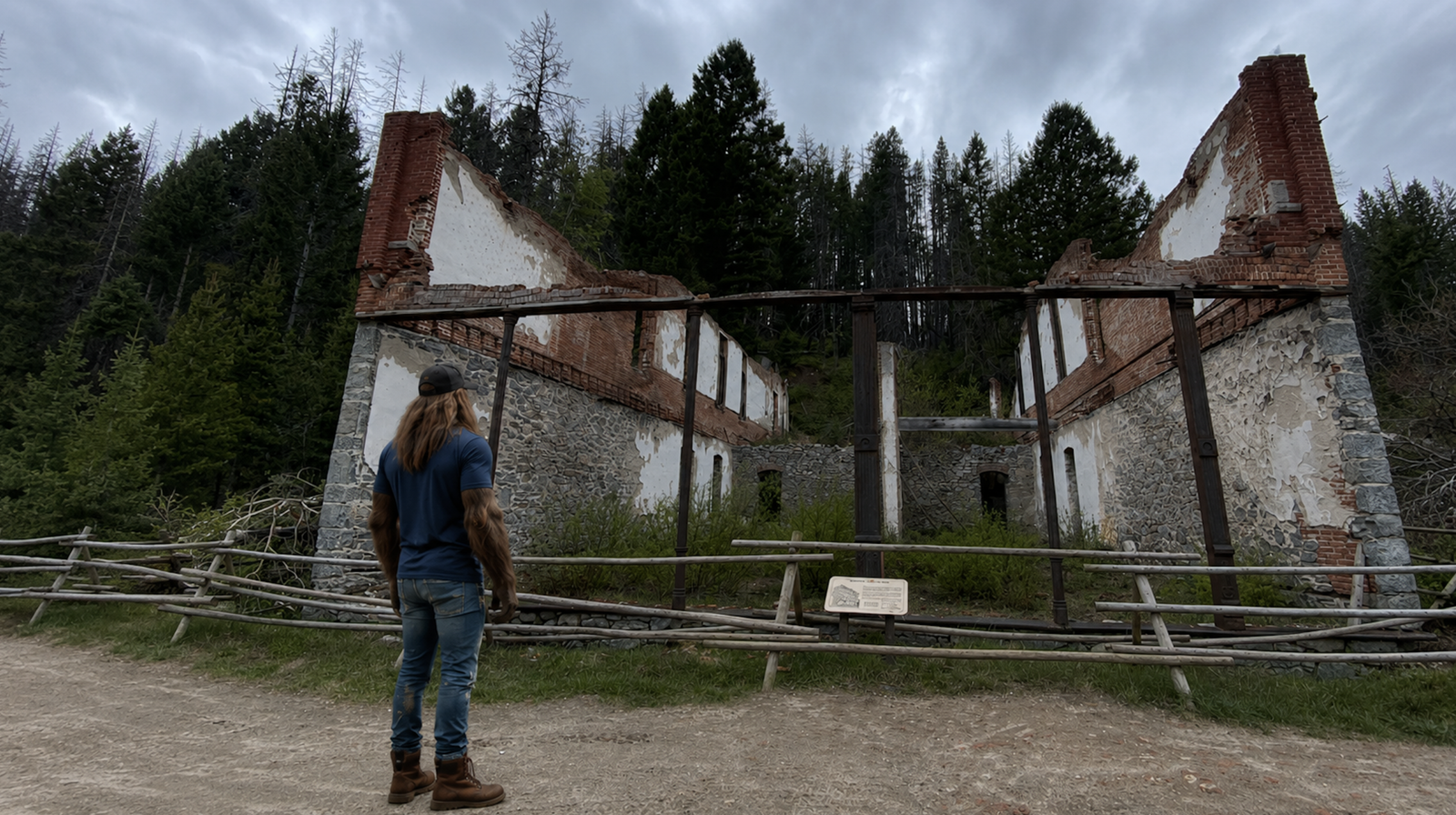
If you’ve ever driven around Montana and thought, “You know what this mountain needs? Eighteen saloons, four churches, a roller-skating rink, and enough silver fever to make rational people completely lose their minds,” well… congratulations. That already happened.
A few miles above Philipsburg sits Granite Ghost Town, one of the coolest reminders that Montana’s history was built by a mixture of grit, luck, stubbornness, and men who probably should’ve slept more and speculated less.
And Granite has one of the wildest origin stories in the state.
According to Montana Fish, Wildlife & Parks, the mine might never have become what it did if a telegram from investors back east had arrived on time. The backers had apparently decided the venture was a bust and wanted operations shut down. But because the message was delayed, the miners kept working. Then came the kind of ending every desperate crew dreams about: the last blast on the last shift hit a bonanza. That strike eventually yielded about $40 million in silver.
Now listen. If you’re a miner on your “last shift” and your final blast suddenly changes history, that’s either the best day of your career or the exact moment you start believing mountains have opinions.
Granite soon became a booming silver camp. Not a sleepy little outpost. A real-deal Montana boomtown.
At its height, Granite had around 3,000 residents. That’s a lot of people to cram up on a mountain chasing shiny rocks and financial optimism. And this wasn’t just some cluster of rough cabins and wishful thinking. The town had 18 saloons, four churches, banks, a hospital, homes, a ballpark, and a roller-skating rink. It even had a three-story Miners’ Union Hall that reportedly boasted the finest dance floor in the Northwest.
That right there is what I love about old Montana towns. They didn’t just mine. They went all in. If there was money in the ground, folks weren’t content with a shovel and a cot. No, no. They wanted entertainment, community, business, and apparently enough places to get into trouble that a person could rotate saloons all week and still not repeat himself.
For a while, Granite represented the dream. Montana was full of those dreams in the late 1800s—towns rising fast on mineral wealth, people pouring in, fortunes being made, fortunes being lost, and everybody convinced the good times would last just a little longer.
Spoiler alert: they usually did not.
Granite’s trouble came with the broader collapse of silver prices. The repeal of the Sherman Silver Purchase Act in 1893 hammered mining communities across the West. Explore Philipsburg notes that Granite shrank from 3,000 people to just 140 within a year. That is not a slowdown. That is a full-blown historical faceplant.
Montana FWP says the mine shut down in the silver panic of 1893 and the camp was deserted for three years. It never returned to what it had once been.
And that, friends, is the ghost-town pattern in one brutal little package: boom, swagger, money, confidence, collapse, silence.
Today, Granite Ghost Town is part state park, part history lesson, part time machine with no roof. What remains is enough to spark your imagination without over-polishing the past. Montana FWP says the site preserves the Granite Mine Superintendent’s House and the ruins of the Miners’ Union Hall, both important links to the town’s past. Walk the trails and you can still picture what once stood there—the stores, homes, mining works, and all the noise that used to bounce off those hills.
And let me tell you, ghost towns hit different when you stand in them.
A photo can show you an old building. A history book can give you names and dates. But standing on that mountain, looking at what’s left, you start to feel the scale of what people tried to build up there. Granite wasn’t just a mine. It was a whole community hanging its future on silver.
That’s the part of Montana history I think we forget sometimes. These places weren’t born romantic. They were born noisy. Messy. Hopeful. Competitive. Full of ordinary people trying to make a life in a very unforgiving place.
Some came to get rich. Some came to work. Some came to sell to the people trying to get rich. And some probably came because they heard there were already 17 saloons and saw a real business opportunity in opening number 18.
Honestly, that part tracks.
Granite also tells a bigger Montana story—the one about how quickly fortunes can change here. One delayed telegram helps launch a mining legend. A national economic shift helps kill it. In between, thousands of people build a town high on a mountain and act like that is a perfectly normal long-term plan.
You’ve got to admire the nerve.
If you’re visiting the Philipsburg area, Granite Ghost Town is absolutely worth the side trip. But take the warnings seriously. Montana FWP describes the road as steep, narrow, and winding, with a significant elevation gain, and notes that a high-clearance vehicle is necessary. It’s not accessible by RV or bus, and the park operates seasonally through September 30. In other words, this is not the place to drive a low little city car up a mountain while pretending confidence is a substitute for clearance.
It is, however, the perfect place to bring your curiosity.
You’ll get the scenery, the history, the eerie beauty, and that strange Montana feeling that the past is never really that far away. It’s still there in the timberline, in the foundations, in the wind moving through what’s left of a once-booming camp.
Granite may be a ghost town now, but it still has a pulse if you know how to listen.
And maybe that’s why places like this stick with us. They remind us that Montana isn’t just pretty. It’s layered. Every mountain seems to have a story. Every old town has a chapter people forgot to finish. Granite’s chapter just happens to include silver fever, spectacular ambition, and one terrible delay in nineteenth-century communications that turned into a legendary stroke of luck.
Not bad for a place that technically died.
If you find yourself near Philipsburg, go see Granite. Walk it slow. Read the signs. Imagine the noise. Imagine the hope. Imagine the final blast that changed everything.
And if you hear something big and hairy stomping around up there, relax.
That’s just me doing historical research.
SOURCES:
The historical information in this article was researched using the following sources:
Montana Fish, Wildlife & Parks — Granite Ghost Town State Park
Official state park history, including the discovery of the Granite Mine, the delayed telegram story, the estimated $40 million silver bonanza, Granite’s population, surviving structures, and current visitor information.
https://fwp.mt.gov/stateparks/granite-ghost-town
Philipsburg Chamber of Commerce — Ghost Towns
Local historical information about Granite’s population decline following the 1893 silver crash, as well as details about the town’s saloons, churches, hospital, banks, ballpark, roller-skating rink, and Miners’ Union Hall.
https://philipsburgmt.com/ghost-towns
Montana Historical Society — Montana’s Gold and Silver Boom, 1862–1893
Background and historical context on Montana’s gold and silver mining era and the economic forces that shaped mining communities across the state.
https://mhs.mt.gov/education/StoriesOfTheLand/Part2/Chapter6/
Historical accounts can vary in wording and detail. The 406 Life uses reputable state, historical, and local sources and distinguishes documented history from Montana Max’s clearly fictional commentary and stories.
Leave a Reply
You must be logged in to post a comment.