
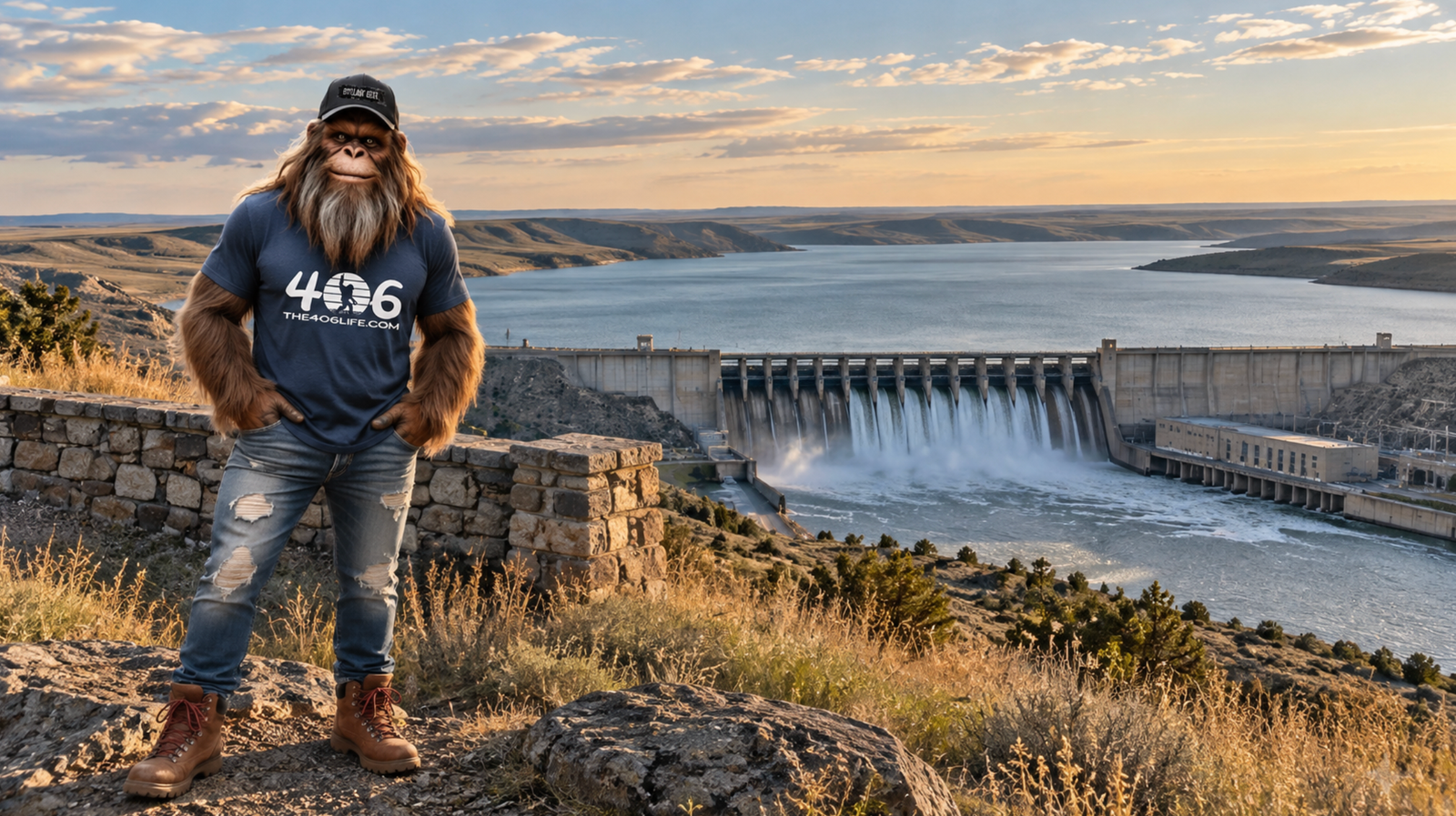
There are places in Montana where history happened slowly.
A town grew. A railroad came through. Somebody struck ore. Families put down roots.
Fort Peck was not one of those places.
In 1933, the United States government approved construction of an enormous dam across the Missouri River in northeast Montana. The country was deep in the Great Depression, jobs were scarce, and word that somebody was hiring carried a lot farther than any advertisement ever needed to.
People came.
And kept coming.
According to the U.S. Army Corps of Engineers, more than 40,000 people eventually came into the Fort Peck area looking for work. By 1936, roughly 10,500 people were directly tied to construction at its peak. Around the project sprang a collection of makeshift communities with names like New Deal, Square Deal, Wheeler, Delano Heights and Park Grove.
People often call them the 18 boomtowns of Fort Peck.
And because history enjoys making things inconvenient, even that number needs an asterisk.
The Corps commonly identifies 18 or “more than 18” boomtowns. Other researchers find as many as 21, depending on whether a cluster of homes, businesses or entertainment establishments counted as its own community.
Either way, this wasn’t just a construction site.
For a few strange years, it was practically its own civilization.
And I imagine the prairie was as confused about the whole thing as everybody else.
I’ve spent a lot of time avoiding humans. Suddenly there were tens of thousands of you.
Very inconsiderate.
Fort Peck Was a Dam. It Was Also a Job.
Before we get to the boomtowns, there’s one historical detail worth straightening out.
You’ll sometimes see Fort Peck described as a WPA project.
The original records tell a slightly different story.
The Corps says the project was funded in 1933 with money from the National Industrial Recovery Act that was channeled through the Public Works Administration, or PWA. National Park Service documentation also identifies the Public Works Administration as the agency that authorized the Corps to begin construction.
That doesn’t make it any less New Deal.
It just means history has departments, acronyms and paperwork.
Apparently even the Great Depression had administrative confusion.
President Franklin D. Roosevelt visited the site in August 1934. Speaking to the crowd, he noted that the workers had come from many states and called the project national in scope.
That tells you something about what Fort Peck meant at the time.
A job in northeast Montana could pull somebody halfway across the country.
The Government Built a Town. Then Reality Showed Up.
The Corps knew it needed housing.
It planned Fort Peck as an organized government town, complete with residences, dormitories and community facilities.
There was only one problem.
The workforce that actually arrived didn’t match the workforce planners expected.
The Corps originally planned mainly around single workers and a limited number of families. But Montana hiring preferences favored married men with dependents, and within a relatively short period a large portion of the workforce consisted of family men.
There wasn’t enough government housing for them.
So families did what people tend to do when nobody has bothered to make enough room for them.
They made room themselves.
Workers rented patches of nearby land.
They built small houses.
They moved buildings in.
They put up shacks made from inexpensive lumber and tar paper.
Local landowners subdivided property.
And communities appeared.
Wheeler.
New Deal.
Square Deal.
Delano Heights.
Park Grove.
Wilson.
Midway.
And others whose exact status historians are still sorting out nearly ninety years later.
The official town of Fort Peck was carefully designed.
Outside it?
Things got considerably more Montana.
Fifty Cents an Hour Could Change a Family’s Life
The Corps’ historical account says common laborers could work 34 hours a week at fifty cents an hour.
That doesn’t sound like much now.
In Depression-era Montana, it could mean survival.
People tolerated rough living conditions because the paycheck mattered.
Some boomtown homes had no running water.
Roads could amount to little more than tracks through the dirt.
Electricity was not guaranteed.
Water was hauled.
Families improvised.
Montana PBS preserved memories from people who actually lived through the Fort Peck years. Ivy Stebleton, who grew up in one of the tar-paper homes, remembered winter conditions so cold that water froze indoors.
That’s a different picture of a New Deal construction camp than the heroic black-and-white photograph most people imagine.
It wasn’t only men moving earth and concrete.
It was children waking up cold.
Women keeping households running.
People doing laundry for money.
Stores opening.
Schools being organized.
Meals being cooked.
Families trying to turn temporary shelter into something that felt like home. The Montana Historical Society’s Fort Peck oral histories preserve accounts involving women’s employment, medical care, family life, recreation, barracks and the daily work of building the dam.
That’s the part of Fort Peck I think gets lost when we only talk about engineering.
Humans built the dam.
But while they were doing it, they also built a community around themselves because they had to.
The Wild West Story Was Only Half the Story
Now here’s where Fort Peck gets a little messy.
The boomtowns developed a reputation.
Bars.
Gambling.
Dance halls.
Brothels.
Places with names that did not exactly scream municipal planning committee.
The Corps’ own historical account acknowledges the rougher side of boomtown life.
Then Margaret Bourke-White arrived.
She had been sent west on assignment for a brand-new magazine called LIFE.
She photographed the enormous Fort Peck construction project.
But she also photographed the people.
The bars.
The workers.
The homes.
The everyday life surrounding the project.
Her photograph of the Fort Peck spillway became the cover of LIFE’s first issue, published November 23, 1936.
Montana was literally on Issue Number One.
Not New York.
Not Hollywood.
Not Washington.
Fort Peck.
But the pictures also caused friction.
Local critics believed the boomtown coverage leaned too heavily on drinking and nightlife and didn’t show enough of the schools, families, churches and ordinary community life happening at the same time. Later historical research has described that debate as part of the Fort Peck story itself.
And I think that’s probably the fairest way to look at it.
Both Fort Pecks existed.
There were rowdy towns.
There were also families.
There were bars.
There were schools.
There was desperation.
There was opportunity.
There were people making questionable decisions at midnight.
And there were people getting up before daylight to go earn fifty cents an hour.
If you’ve lived in Montana long enough, you already understand that two contradictory things can be true about the same town.
Sometimes the contradictions are living next door to each other.
The Movie Theater That Never Slept
One piece of that era is still standing.
The Fort Peck Theatre opened in November 1934.
During the dam years, movies ran around the clock to accommodate workers whose shifts ran at every hour of the day. Historical records put the theater’s seating at roughly 1,200 people.
Think about that.
A remote construction town in northeast Montana had enough workers moving through different shifts to justify movies 24 hours a day.
Apparently there’s only so much dam a person can build before he needs a two-hour break and a bag of popcorn.
The theater remains one of the surviving pieces of the original Fort Peck townsite.
Most of the boomtowns weren’t nearly so lucky.
Then There Was the Dam Itself
The human story can make you forget that the physical project was absurdly large.
The finished Fort Peck Dam stretches 21,026 feet, more than four miles, across the Missouri River valley. Its maximum height is roughly 250 feet, and construction used more than 125 million cubic yards of fill.
Workers built rail infrastructure.
They built vessels on site.
They dug massive diversion tunnels.
Dredges pumped enormous quantities of earth and water into the growing embankment.
The Corps’ project history describes an operation that eventually included 60 miles of rail track and an extensive fleet of equipment and vessels built right there at Fort Peck.
This wasn’t a group of men with wheelbarrows.
This was industrial construction on a scale Montana had never seen.
And then, on September 22, 1938, part of it moved.
The Slide of 1938
Construction was nearing the dam’s final height.
At about 1:15 in the afternoon, the upstream portion near one end of the dam began to fail.
A huge mass of earth shifted toward the reservoir.
Tracks moved.
Equipment went with it.
Men went with it.
Dam-safety records say 180 men were working in the area. Thirty-four were injured.
Eight died.
Six of those men were never recovered.
There isn’t a Max joke here.
There shouldn’t be.
The engineers investigated the failure, changed the design and rebuilt the damaged section. The project continued, and the dam entered operation in 1940.
The Corps later created a memorial recognizing workers who died during construction.
Fort Peck is an engineering story.
But it is also a labor story.
And labor stories include the people who didn’t make it home.
Then the Boomtowns Disappeared
Construction work wound down.
The reason those temporary communities existed began to disappear.
So did the communities.
Some buildings were moved.
Some were salvaged.
Others vanished.
Today, you can drive through this part of Montana without realizing that tens of thousands of people once crowded around this stretch of the Missouri looking for work and building lives that might last only as long as the next paycheck.
That’s one of the strangest things about Montana history.
We’re very good at leaving almost no evidence that something enormous happened.
A few foundations.
An old road.
A surviving building.
Maybe a name.
Then grass.
Give Montana enough time and it’ll cover your whole civilization with prairie and act like it never met you.
Fort Peck Never Really Became Small Again
The crowds left.
The dam didn’t.
Fort Peck Dam has been operating since 1940. The reservoir stretches roughly 134 miles, and the Corps continues managing the project for purposes that include flood-risk reduction, hydropower, water supply, recreation, fish and wildlife, water quality and navigation.
Today people come for fishing.
Boating.
Camping.
Wildlife.
Dinosaurs.
The theater.
The lake.
And sometimes they come just to look at the dam.
But if you stand there long enough, the really interesting part isn’t the concrete or the earth.
It’s imagining what surrounded it.
Thousands of workers.
Families making homes out of whatever they could find.
Kids going to makeshift schools.
Movies running through the night.
Bars doing brisk business.
A famous photographer wandering around with a camera.
A new magazine about to publish its first issue.
And an enormous piece of Montana prairie temporarily turned into one of the busiest places in the state.
I would’ve hated the crowds.
But I would’ve watched every bit of it.
From a respectful distance.
Obviously.
If You Visit Fort Peck Today
Fort Peck is worth seeing because the history still makes more sense when you understand the scale of the place.
The Fort Peck Interpretive Center and surrounding public recreation areas provide opportunities to learn about construction history, paleontology, wildlife and Fort Peck Lake.
Hours, tours and access can change seasonally, so check the U.S. Army Corps of Engineers’ current Fort Peck information before making the drive.
And while you’re standing there, take a second to remember that this wasn’t built by some anonymous machine called “the government.”
It was built by people.
People who needed jobs.
People who dragged their families across Montana.
People who lived in tar-paper houses.
People who worked around the clock.
People who sometimes paid a terrible price.
That’s the part worth remembering.
And if there’s somebody in your life who loves Montana history, send this story their way. There are a lot more 406 stories hiding in plain sight.
You can find more of them, listen to The 406 Life Podcast, and follow Montana Max at The406Life.com.
And if you’d like to help keep a Bigfoot employed, check out The 406 Life merch. Apparently even cryptids have overhead.
FAQ
Why was Fort Peck Dam built?
The original project was tied to Missouri River navigation and broader water-management goals, while its approval during the Great Depression also created badly needed employment. Its purposes later expanded as part of the larger Missouri River system.
How many people worked on Fort Peck Dam?
USACE historical records put peak direct employment at roughly 10,500 workers in 1936. Exact figures vary slightly among Corps records, so “about 10,500” is more defensible than pretending the payroll count is perfectly settled.
Were there really 18 boomtowns around Fort Peck?
USACE commonly describes 18 or more than 18 boomtowns. Historical researchers have noted that counts can reach 21 depending on what is considered a separate community.
Was Fort Peck Dam a WPA project?
It was part of the broader New Deal, but original USACE and National Park Service records show its 1933 authorization and funding were handled through the Public Works Administration, or PWA, under the National Industrial Recovery Act.
What happened at Fort Peck Dam in 1938?
On September 22, 1938, part of the upstream embankment failed during construction. Thirty-four workers were injured and eight died; six of the victims were never recovered.
Was Fort Peck really on the first LIFE magazine cover?
Yes. Margaret Bourke-White’s photograph of the Fort Peck spillway appeared on the cover of the first issue of the relaunched LIFE magazine on November 23, 1936.
Sources & Further Reading
U.S. Army Corps of Engineers: Fort Peck Dam and Lake
U.S. Army Corps of Engineers: Historical Vignette, Fort Peck Dam
USACE Digital Library: Fort Peck Dam, 75 Years of Service
National Park Service: Fort Peck Dam National Register Documentation
Montana Historical Society: Archival and Fort Peck Oral History Collections
Montana PBS: Fort Peck Dam Documentary & History
Association of State Dam Safety Officials: Fort Peck 1938 Slide
National Gallery of Art: Margaret Bourke-White’s Fort Peck Dam Photograph
LIFE: First Cover Story, Building Fort Peck Dam
FDR’s 1934 Remarks at Fort Peck Dam
Also check out these articles:
The Montana Roads Nobody Tells You About
Montana’s Fossil Secrets
Montana vs. The Internet’s Montana
What You Don’t Know About the Gates of the Mountains
Leave a Reply
You must be logged in to post a comment.