
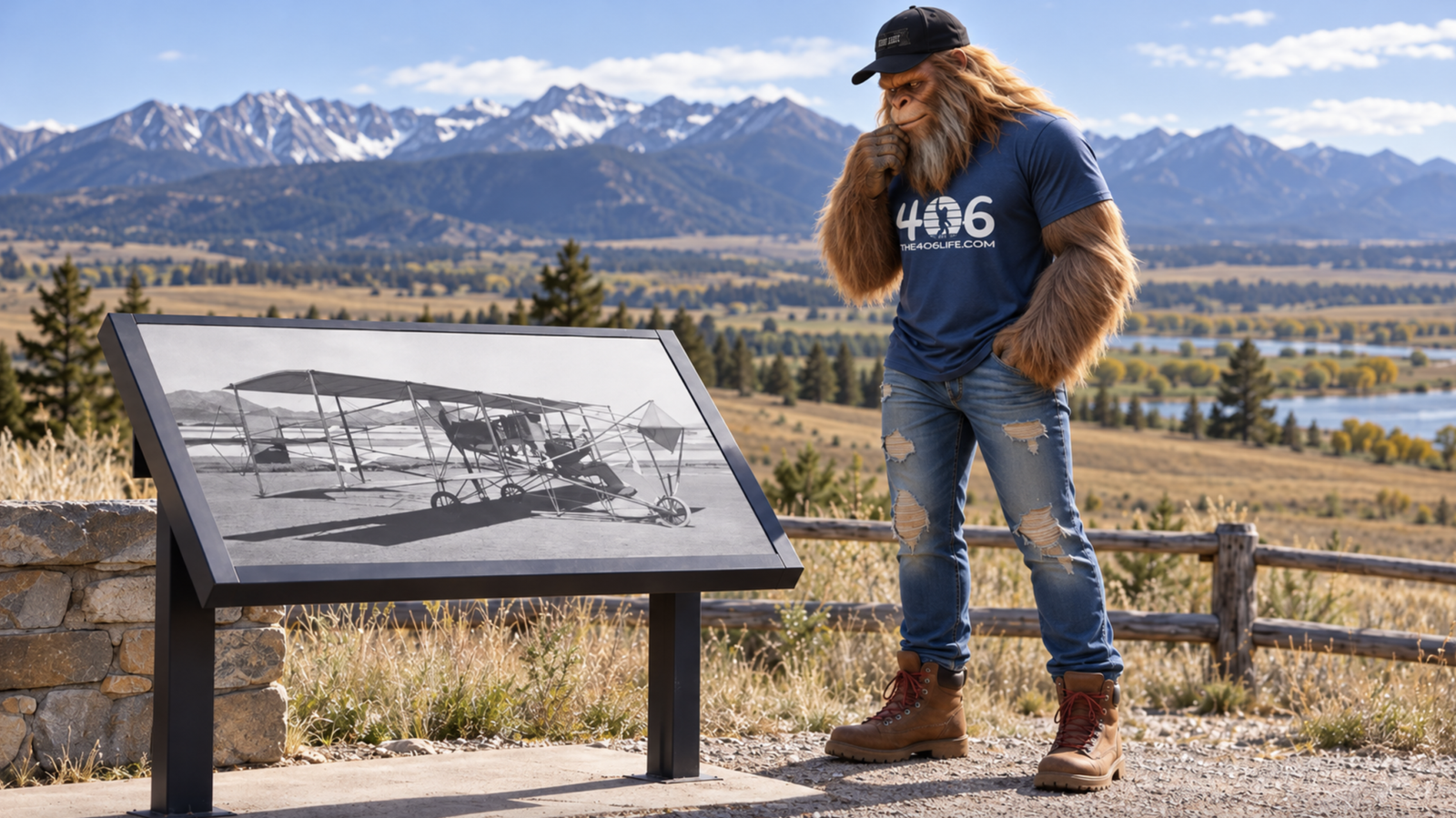
At just 19 years old, he conquered Montana’s Continental Divide in a fragile airplane, won $10,000, and became an aviation legend. Two days later, he was gone.
On September 30, 1911, a 19-year-old pilot climbed into an airplane made largely of wood, bamboo, wire, and fabric at the Montana State Fairgrounds in Helena. His destination was the other side of the Continental Divide, a mountain barrier that had already defeated an earlier attempt.
His name was Cromwell Dixon, and what he was about to do would earn him a place in aviation history.
He would fly across the Divide, land near the little community of Blossburg, and return to Helena that same afternoon. Waiting for him was a $10,000 prize and a crowd eager to celebrate a feat that had seemed nearly impossible.
Forty-eight hours later, Dixon would be dead.
I’ve spent a fair amount of time wandering around Montana’s mountains, and I can tell you that crossing the Continental Divide on foot is one thing. Doing it in a machine that looks like a strong breeze could scatter it across three counties is something else entirely.
But to understand why Dixon’s flight was such a big deal, you’ve got to remember what flying meant in 1911.
When Flying Was Still a Dangerous Experiment
Today, people board airplanes, complain about legroom, and get irritated when the beverage cart takes too long.
In 1911, people were still figuring out how to keep the darn things in the air.
The Wright brothers had made their historic powered flight at Kitty Hawk less than eight years earlier. Aviation was developing quickly, but airplanes remained primitive by modern standards. Pilots depended on lightweight structures, exposed controls, modest engines, and a healthy amount of courage.
There were no modern navigation instruments, weather radar, or dependable mountain-flying forecasts. An unexpected gust or mechanical problem could turn a promising flight into a disaster.
And that’s where Cromwell Dixon enters the picture.
Dixon was from Columbus, Ohio, and despite his age, he wasn’t some inexperienced kid who had wandered onto the fairgrounds and asked to borrow an airplane.
He had been fascinated by machinery and flight since childhood. Before becoming an airplane pilot, he had designed and flown dirigibles, those early lighter-than-air flying machines that helped pioneer aviation take shape.
He later learned to fly airplanes under the guidance of Glenn Curtiss, one of America’s leading aviation pioneers.
By the time Dixon arrived in Montana, he had already developed a reputation as a daring exhibition pilot.
And Montana had a challenge waiting for him.
Helena’s $10,000 Challenge
The Continental Divide west of Helena presented an irresistible opportunity for early aviation promoters.
If an airplane could cross the mountains, it would demonstrate just how far the new technology had come. It would also bring considerable attention to Helena and the Montana State Fair.
A $10,000 prize was offered for the accomplishment, an enormous amount of money in 1911.
Historical research identifies three contributors to the prize: Helena businessman Lewis Penwell, Great Northern Railway president Louis Hill, and John Ringling, the famous circus entrepreneur who had business interests in Montana.
That’s a rather interesting collection of sponsors. A businessman, a railroad executive, and a circus man all putting money behind an airplane stunt.
Apparently, Montana understood the value of a good spectacle long before anybody invented social media.
But the challenge wasn’t entirely new.
In September 1910, aviator J. C. “Bud” Mars had attempted to cross the Divide from Helena. His flight ended in a crash in the Scratchgravel Hills, although he survived.
The mountains had won that round.
A year later, Dixon was ready to try again.
September 30, 1911: The Flight Into History
Dixon took off from the Helena fairgrounds in a Curtiss biplane, a lightweight aircraft with its engine and propeller positioned behind the pilot.
His objective was to fly west, cross the Continental Divide in the Mullan Pass area, and land near Blossburg.
It wasn’t a particularly long trip by modern standards, roughly 15 to 17 miles to his western landing area, depending on the historical account.
But distance wasn’t the problem.
The problem was getting high enough to clear the mountains while keeping an early airplane under control in unpredictable conditions.
According to the Helena Regional Airport’s historical account, Dixon climbed to approximately 7,000 feet before crossing the Divide.
Accounts disagree slightly on the exact duration of his outbound flight. Some report approximately 26 minutes, while the airport’s history gives 34 minutes.
Either way, the result was the same.
Cromwell Dixon had successfully flown an airplane across the Continental Divide.
He landed in a field near Blossburg, on the western side of the mountains.
For the first time, the great mountain barrier had been crossed by an airplane in this part of the American West.
And the young pilot wasn’t finished.
A Telegram, Some Fuel, and a Return Trip
After landing near Blossburg, Dixon sent word back to Helena that he had made it safely.
He refueled his airplane and prepared to fly back across the mountains.
Now, I don’t know about you, but if I’d just accomplished something nobody had managed before, I’d be looking for a comfortable chair and a decent supper.
Dixon apparently had other plans.
He took off again.
The return flight carried him east toward Helena, where the fairgrounds crowd awaited his arrival.
According to the Helena Regional Airport, favorable tailwinds helped him on the way back. He circled the fairgrounds twice before landing safely.
Imagine the excitement.
Here was a teenager who had taken on a mountain crossing in one of the most fragile flying machines imaginable, disappeared over the western hills, and returned victorious.
Montana Governor Edwin L. Norris presented Dixon with the $10,000 prize.
For one extraordinary afternoon, Cromwell Dixon was the toast of Helena.
The Celebration That Lasted Two Days
Dixon’s achievement should have been the beginning of a remarkable aviation career.
He had accomplished a historic first, attracted national attention, and demonstrated that aircraft could cross mountainous terrain that had once seemed an insurmountable obstacle.
But aviation was still a dangerous profession, particularly for exhibition pilots who made their living performing before crowds.
Just two days after his triumph in Helena, Dixon was in Spokane, Washington, participating in another aviation exhibition.
On October 2, 1911, his airplane crashed near the Spokane fairgrounds.
Contemporary accounts and later aviation histories describe the aircraft encountering difficult air conditions shortly after takeoff. Some accounts suggest a sudden updraft or downdraft contributed to the accident, but the exact sequence cannot be established with complete certainty.
Dixon suffered fatal injuries.
He was only 19 years old.
There isn’t much humor to be found in that part of the story.
A young man with extraordinary talent had accomplished something remarkable, and before the celebrations had even faded, his life was over.
His death was a painful reminder of the risks faced by aviation’s earliest pioneers. Every successful flight moved the technology forward, but the people testing its limits often paid a terrible price.
Why Cromwell Dixon Still Matters to Montana
Cromwell Dixon wasn’t born in Montana, and he didn’t spend most of his life here.
Yet one of the defining achievements of his short career happened in the mountains west of Helena.
His flight demonstrated that powered aircraft could cross the Continental Divide, helping expand what people believed airplanes might someday accomplish.
The achievement also became part of Montana’s early aviation identity.
The Helena Regional Airport continues to recognize Dixon in its official history, and his story has been preserved in historical photographs, newspaper accounts, and aviation research.
One of the remarkable things about those photographs is how small and exposed his aircraft looks.
There is Dixon, seated in a machine of fabric, wood, and wires, preparing to challenge mountains that still command respect from experienced pilots today.
No enclosed cockpit. No modern navigation equipment. No reassuring voice from air traffic control.
Just a young pilot, his airplane, and a mountain range.
A Big Dream, a Short Life, and a Montana Legend
One hundred and fifteen years later, it’s easy to forget just how astonishing Dixon’s accomplishment was.
We’ve grown accustomed to aircraft crossing continents and oceans. The idea of flying over the Continental Divide barely earns a second thought from most passengers.
But in September 1911, a 19-year-old pilot helped prove that the sky was becoming a highway rather than a boundary.
His achievement deserves to be remembered for more than the tragedy that followed.
Cromwell Dixon was a talented young aviator who helped push the limits of a technology that would transform the world. His success in Montana was real, historic, and earned through considerable skill and courage.
And perhaps that’s what makes his story so memorable.
He didn’t know how little time he had left. He simply saw a challenge that others had failed to overcome and decided to try.
I’ve crossed a lot of Montana’s mountains in my time, usually keeping to the timber where nobody bothers me. And every now and then, when I look up and see an airplane passing overhead, I think about the people who first dared to put those machines into the sky.
People like Cromwell Dixon.
A young man who crossed the Divide, made history in Montana, and reminded the world that some of its biggest leaps forward begin with someone willing to attempt the seemingly impossible.
Not bad for a 19-year-old kid from Ohio.
Until next time, keep exploring, keep asking questions, and keep discovering the stories that make life in the 406 worth talking about.
Montana Max
Sources and further reading
These are the sources I recommend listing at the bottom of the published blog. They also give readers a way to explore the history for themselves.
1. Helena Regional Airport: Airport History Official local history covering Dixon’s flight, his return to Helena, the prize, and his death.
2. Smithsonian Air & Space: Across the Divide in 1911 Aviation-history treatment with an authentic photograph of Dixon in his biplane at Helena.
3. Montana State University: Exhibiting the Possibilities Douglas Michael Edwards’s 1997 master’s thesis on the Montana State Fair. It cites September and October 1911 newspaper reports and identifies the three prize contributors.
4. Montana Department of Transportation: Aeronautics Newsletter A state aviation publication discussing Dixon’s historic crossing and its significance.
5. Helena As She Was: Cromwell Dixon Local historical photographs, background, and information about the 1911 flight.
6. Montana History Portal: Cromwell Dixon Photograph An archival record associated with Dixon’s arrival at Blossburg after crossing the Divide.
Also check out these articles
Fort Shaw’s Remarkable Champions
The Iron Riders: Montana’s Bicycle Soldiers
Mattie Castner: From Slavery to the Mother of Belt, Montana
From Red Lodge to the World Stage: Montana’s Greatest Cowgirls
Leave a Reply
You must be logged in to post a comment.