
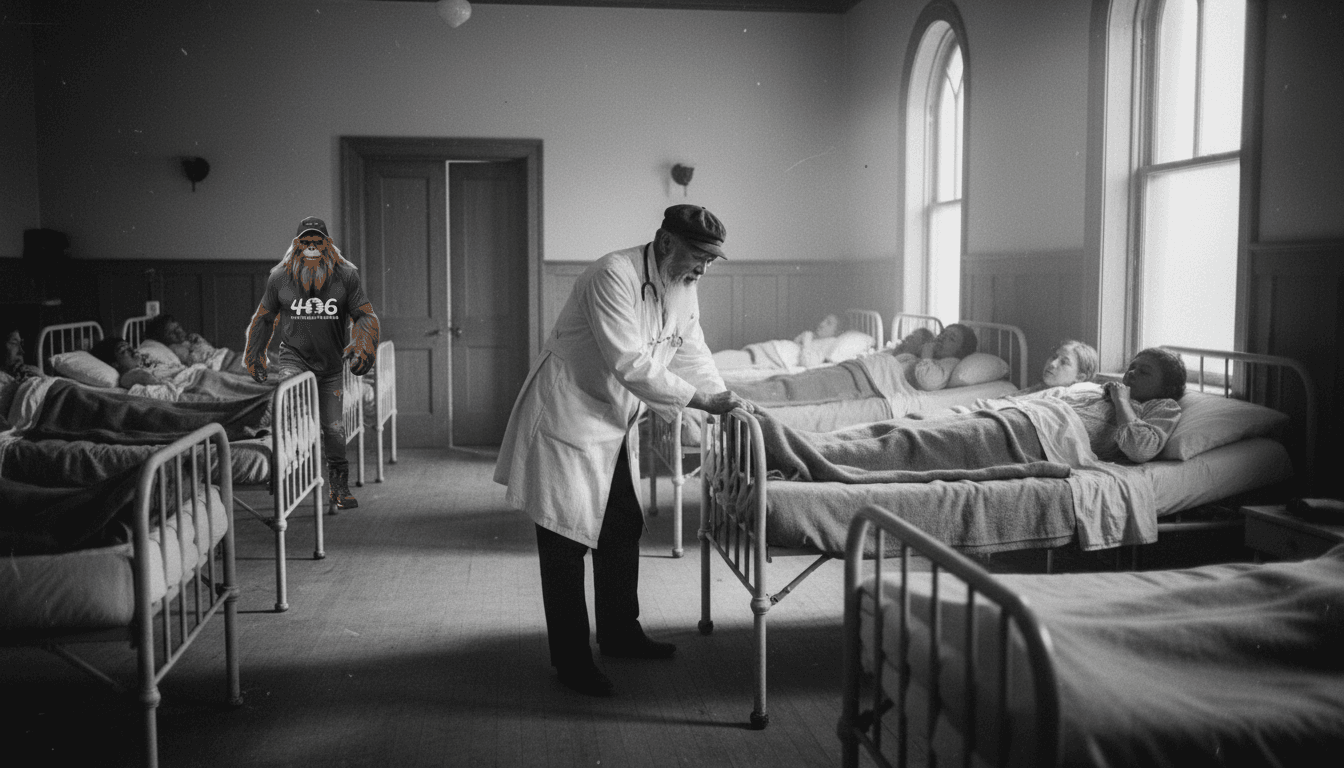
Two Buttes: One Flashy, One Forgotten
You ever stroll by a mansion so fancy you figure even the squirrels are wearin’ cufflinks? Well, William Andrews Clark built one of them in Butte—34 rooms, 630 windowpanes, French fireplaces so fine they probably made the local rattlesnakes feel underdressed.[1][2] But while Clark was busy importing marble and buying senators like I buy beef jerky, another fella just a few blocks away was quietly saving lives. His name? Dr. Huie Pock—a man whose heroics would’ve made any bigfoot’s hair stand on end (and that’s a LOT of hair, trust me).
While Clark’s legacy was all gold leaf and grand staircases, Dr. Pock’s was all grit, herbal tea, and a stubborn refusal to let prejudice win. He was the healer Butte tried its damnedest to forget, though he kept more folks upright than any of those rich fellas ever did.
The Copper Kings: All Hat, All Cattle
First, you gotta understand the racket in Butte back then. The Copper Kings—Clark, Daly, Heinze—were like the three loudest bears in the woods, always squabbling over who had the shiniest claws and the fattest honey pot.[4][5] Clark’s house alone cost half a million bucks in the 1880s. That’s enough to buy every huckleberry bush from here to the Idaho border and still have change left for a couple of gold-plated outhouses.
Clark’s appetite for attention was so big, I suspect he’d bribe the moon to shine brighter on his lawn. He once said, “I never bought a man who wasn’t for sale.”[6] Well, partner, I’ve never seen a bigfoot who could fit in a teacup, either. Some things just ain’t right.
These fellas fought over everything—mines, newspapers, even which city got to call itself Montana’s capital.[4] When Clark wanted to win folks over, he’d buy up the local press, run headlines like “Clark: Greatest Man Since Sliced Bread,” then sell it off once everyone was good and buttered up.[7][8] He even built an amusement park, Columbia Gardens, for the “children of Butte,” though it sure looked convenient how that lined up with his political campaigns.[8][9]
All flash, all noise, and a legacy you can still see if you wander downtown Butte. But if you drift a little further—maybe behind a noodle shop or a laundry, back in the old Chinatown—you’ll find the quiet footprints of Dr. Huie Pock.
Dr. Huie Pock: Healing Without Headlines
Now, I ain’t one for stereotypes, but let me tell you: if bigfoot had a doctor, I’d want it to be Dr. Pock. Born in China in 1849, the man came to Butte packing a lifetime of medical wisdom—herbs, acupuncture, remedies old as the mountains themselves.[10][11] By the time he got here, Western doctors were still prescribing leeches and prayers. (I tried a leech once. Didn’t fix my bunions, just made me grumpy.)
Problem was, Dr. Pock landed right when folks were treatin’ Chinese immigrants worse than a skunk at a garden party. The Chinese Exclusion Act of 1882 meant no new laborers could come, and the folks already here got hit with dirty looks and closed doors.[12][13] Butte’s Chinese community once made up a quarter of the population, but by 1940? Just a handful left, most chased out by hate and hard times.[14][16]
It wasn’t just sideways glances, either. In 1896, local unions started a full-on boycott. They’d block the doors of Chinese businesses—including Dr. Pock’s—trying to strangle ‘em out of existence.[17][18] Imagine that: you’re the only doc in town who can fix what ails folks, and there’s a pack of angry dudes telling folks not to see you. Bigfoot’s had his fair share of hunters, but at least no one ever tried to run me outta town for sellin’ pine needle tea.
But Dr. Pock? He didn’t run. He didn’t shout. He just grabbed a couple of fellow community leaders—Hum Fay and Quon Loy—and dragged those troublemakers to court.[14][18] And by the hair on my shaggy toes, they won! The judge put a stop to the boycott.[14][19] Of course, victory don’t always pay the bills. They got just enough to cover legal fees, and 350 Chinese folks still left Butte in the fallout.[14] But Pock stayed. He wasn’t done healing yet.
When the Spanish Flu Came Howling
Now, here’s where things get real hairy. In 1918, the Spanish flu rolled into Montana meaner than a bear with a toothache. Killed 50 to 100 million folks worldwide—over a thousand in Butte alone.[20][21][22] Western doctors were helpless. They tried bloodletting, aspirin (in doses that’d put a moose in the ground), and a whole mess of “remedies” that mostly amounted to wishful thinking and morphine.[20] Hell, even nurses were dropping like flies—come to work in the morning, dead by sundown.[22]
Ground was frozen so hard you couldn’t even dig a grave. Coffins stacked up like cordwood, and the only thing thicker than the smoke in the air was the fear.
But here’s the kicker: Dr. Pock’s herbal medicine worked.[10][3][25] He treated folks with ancient Chinese remedies—roots, teas, poultices—that actually did the trick. Word started spreading. Folks who’d never have set foot in Chinatown before were suddenly showing up at his door, lookin’ for a cure.
Funny thing about prejudice: it gets a whole lot quieter when your life’s on the line. Those who came to Dr. Pock often survived. Those who refused “foreign medicine” on principle, well… let’s just say the flu didn’t give a damn about your opinion.[10] Dr. Pock became a legend among the folks willing to listen, though many still let their stubbornness lead ‘em to the grave. I’ve heard of folks preferring to die on their feet than be healed on their knees, but this was a whole new level.
The Copper King’s Daughter, Healed by a “Foreign” Hand
Now here’s a juicy tidbit: rumor has it even ol’ William Clark had to tip his hat to Dr. Pock. Seems Clark’s daughter came down with a nasty ulcer that stumped every doc from Butte to Boston.[10][3] In desperation, the family knocked on Dr. Pock’s door.
What did he do? Whipped up a banana stalk poultice—a remedy as old as my grandpappy’s beard.[28][29][30] Cured her right up. Suddenly, the richest family in Montana was singing Dr. Pock’s praises. Did it change things for the rest of the Chinese community? Hell no. Clark went right back to building monuments and ignoring the suffering just down the street.[8][9] Generous to “the children of Butte,” sure, but stone-cold silent while whole families were run outta town.
Bigfoot lesson: folks love a miracle—so long as it’s just for them.
Heartbreak in the Healer’s Home
For all the lives Dr. Pock saved, fate dealt him some low blows. In 1923, his wife Chong Chie Huie died of botulism, right there in Butte, from a contaminated can.[10][3] The world’s finest doctor couldn’t save the one who mattered most. That’s a grief big enough to silence even a creature as loud as me.
He wanted her buried in China, but never got the chance. When Dr. Pock himself passed in 1927, his own son squandered the money meant to send him home.[3] His body sat in storage for 26 damn years—long enough for a bigfoot to grow a new set of footprints. Finally, in 1953, both Dr. Pock and his wife were laid to rest in unmarked graves, out by Mount Moriah Cemetery.[3]
For 80 years, not a stone marked the spot where Butte’s quiet hero lay. It took until 2007 before a group of Butte doctors—finally recognizing what the city had lost—paid for a headstone.[3] About time, if you ask me.
Monuments: Mansions Versus Memory
Look around Butte, and you’ll see Clark’s monuments everywhere. His mansion’s a museum. Columbia Gardens is a legend. Whole counties and towns out West bear his name.[1][6][31] Hell, there’s probably a gilded outhouse somewhere with his initials carved in the seat.
But Dr. Pock? Just a stone in the ground and the stories whispered by grateful families. No parks, no streets, no fancy plaques.
Here’s the real kicker: whose legacy mattered more when times got rough? Clark gave folks Ferris wheels; Dr. Pock gave ‘em their lives back. Clark bought power; Dr. Pock fought for justice in the courts. One built monuments to himself, the other quietly healed a broken city.
Lessons From the Quietest Voice
By the time the dust settled, Butte’s Chinese community was nearly gone.[14][16] Boycotts, violence, bad laws—they wiped out generations of wisdom, healing, and tradition. Only now, with modern science catching up, do we realize Dr. Pock’s herbal remedies weren’t just superstition—they worked. Studies today show Traditional Chinese Medicine is mighty effective for respiratory infections, just like the flu that tore through Butte in 1918.[32][33][34]
History’s funny, ain’t it? It remembers the folks who shout the loudest, build the biggest, or buy the most headlines. Meanwhile, the quiet heroes—the healers, the fighters, the ones who just get the damn job done—get buried, often literally, beneath the noise.
Butte tried to forget Dr. Huie Pock. His own town tried to silence him. Yet here I am, a shaggy bigfoot in a digital age, telling his story to anyone who’ll listen. ‘Cause some heroes don’t need monuments—they just need folks to remember.
The next time you wander through Butte, think about who you thank. The man with the biggest mansion, or the healer who saved lives for nothing more than a nod and a smile?
If you ask me, the true giants of Montana ain’t always the loudest, richest, or most visible. Sometimes, they’re the ones quietly making the world a little less painful—one life at a time.
Sources and Links
Primary Sources on Dr. Huie Pock
1. Montana Historical Society – Amazing Montanans Biographies
• https://mhs.mt.gov/education/bios/AM_Pock.pdf
• First-person narrative style biography of Dr. Huie Pock
2. Mai Wah Society – Doctor Huie Pock
• https://www.maiwah.org/explore/butte-chinese-experience/doctor-huie-pock/
• Comprehensive overview of his medical practice and legacy
3. Find a Grave – Dr Huie Pock Memorial
• https://www.findagrave.com/memorial/97900904/huie-pock
• Birth, death, and burial information
4. Montana Moments Blog – Friday Photo: Doctor Huie Pock
• http://ellenbaumler.blogspot.com/2013/02/friday-photo-doctor-huie-pock.html
• Historical photograph and context
5. Montana History Portal – Huie Pock’s Store
• https://www.mtmemory.org/nodes/view/73841
• Historical photograph of his mercantile store
Chinese Community in Butte
6. Mai Wah Society – Hum Fay
• https://www.maiwah.org/explore/butte-chinese-experience/hum-fay/
• Information about the 1896 boycott and legal fight
7. Butte-Silver Bow Public Archives – Chinese Community
• https://buttearchives.org/chinese-community/
• Overview of Chinese settlement and demographics
8. National Archives – Affidavit from Chinese Boycott Case
• https://www.archives.gov/education/lessons/chinese-boycott
• Primary source documents from the lawsuit
9. Montana Historical Society – Testimony from Hum Fay
• https://maiwahtrunk.wordpress.com/wp-content/uploads/2010/07/hum-fay-testimony-reprint.pdf
• Court testimony about the 1896 boycott
10. DocTeach – Flyers by Unions Supporting Boycott
• https://docsteach.org/document/flyers-by-unions-support-boycott-chinese-japanese/
• Historical documents from the boycott campaign
1918 Influenza Pandemic in Montana
11. KPAX News – Remembering the Brave
• https://kpax.com/news/montana-news/2018/11/01/remembering-the-brave-as-virus-killed-hundreds-in-butte-a-century-ago/
• Coverage of 1918 pandemic in Butte
12. Montana Tech News – PBS Blue Death Documentary
• https://www.pbs.org/video/blue-death-hxxsoi/
• Documentary about 1918 influenza in Montana
13. Montana Historical Society – “No More War, No More Plague”
• https://mths.mt.gov/education/wwi/harwellflu.pdf
• Detailed research paper on Montana flu deaths
14. YouTube – Montana Public Health Leaders Reflect
• https://www.youtube.com/watch?v=eOT1tYdxufQ
• Discussion of 1918 pandemic in Montana
William Andrews Clark and the Copper Kings
15. Wikipedia – William A. Clark
• https://en.wikipedia.org/wiki/William_A._Clark
• Comprehensive biography
16. Wikipedia – Copper Kings
• https://en.wikipedia.org/wiki/Copper_Kings
• Overview of the three Copper Kings
17. Butte-Silver Bow Public Archives – William A. Clark
• https://buttearchives.org/william-a-clark/
• Local historical records
18. Geri Walton – Copper King Mansion and William A. Clark
• https://www.geriwalton.com/copper-king-mansion-and-william-a-clark/
• Details about the mansion construction
19. PBS American Experience – William Andrews Clark
• https://www.pbs.org/wgbh/americanexperience/features/lasvegas-clark/
• Biography and political career
20. Montana Tech Professor – William Clark, The Copper King
• https://mtprof.msun.edu/Spr2014/edger.html
• Academic perspective on Clark as robber baron
21. Headframe Spirits – Three Copper Kings of Butte
• https://www.headframespirits.com/stories/three-copper-kings-of-butte-rivalry-riches-and-revolution/
• Overview of all three Copper Kings
Columbia Gardens
22. Copper King Mansion Blog – A Portrait of William A. Clark
• https://thecopperkingmansion.com/articles-and-content/a-portrait-of-william-a-clark-in-few-brushstrokes
• Information about Columbia Gardens construction and operation
23. Montana Historical Society – Columbia Gardens: William A. Clark’s Happy Legacy
• https://mths.mt.gov/education/StoriesOfTheLand/Part2/Chapter10/Ch10Educators/ColumbiaGardens
• Educational resource about the park
Chinese Exclusion and Discrimination
24. Wikipedia – Chinese Exclusion Act
• https://en.wikipedia.org/wiki/Chinese_Exclusion_Act
• Federal law details
25. National Archives – Chinese Exclusion Act (1882)
• https://www.archives.gov/milestone-documents/chinese-exclusion-act
• Primary source documents and analysis
26. Montana Women’s History – Discrimination: The Case of Mrs. Wo Hop
• https://montanawomenshistory.org/discrimination-the-case-of-mrs-wo-hop/
• Chinese women’s experiences with discrimination
27. Southwest Montana – Forgotten Pioneers
• https://southwestmt.com/blog/forgotten-pioneers/
• Overview of Chinese contributions to Montana
Traditional Chinese Medicine Research
28. Frontiers in Pharmacology – Progress in TCM Against Respiratory Viruses
• https://www.frontiersin.org/journals/pharmacology/articles/10.3389/fphar.2021.743623/full
• Scientific research on TCM effectiveness
29. PMC (NIH) – TCM Played Crucial Role in Battling COVID-19
• https://pmc.ncbi.nlm.nih.gov/articles/PMC7343649/
• Modern research validating traditional treatments
30. PMC (NIH) – Evaluation of Qiangzhu-qinggan Formula
• https://pmc.ncbi.nlm.nih.gov/articles/PMC8710932/
• Clinical trial of TCM for influenza
31. Vinmec – Medical Benefits of Banana Stem
• https://www.vinmec.com/eng/blog/health-benefits-of-banana-stem-en
• Traditional uses of banana plant parts in medicine
Historical Context and Analysis
32. Big Sky Journal – History: Keeping Chinese Culture Alive on the Frontier
• https://bigskyjournal.com/history-keeping-chinese-culture-alive-on-the-frontier/
• Lunar New Year celebrations and cultural preservation
33. University of Montana Dissertation – “The Coming Man from Canton”
• https://www.umt.edu/chinese-in-montana/documents/merritt_dissertation_complete1.pdf
• Comprehensive academic research on Chinese experience in Montana
34. CNN – 1918 Flu Quack Cures
• https://www.cnn.com/2020/10/17/health/1918-flu-quack-cures-coronavirus-wellness
• Western medicine’s failures during the pandemic
35. Yale Medicine – Nurses and Essential Workers
• https://medicine.yale.edu/news-article/nurses-and-essential-workers-the-sacrificial-lambs-of-us-pandemics-in-1918-and-2020/
• Sacrifice of healthcare workers during pandemics
36. Big Sky Chinese – Butte’s Mt. Moriah Cemetery
• https://www.bigskychinese.com/buttes-mt-moriah-cemetery
• Chinese burial practices and cemetery sections
All sources accessed January 2026.
Leave a Reply
You must be logged in to post a comment.