
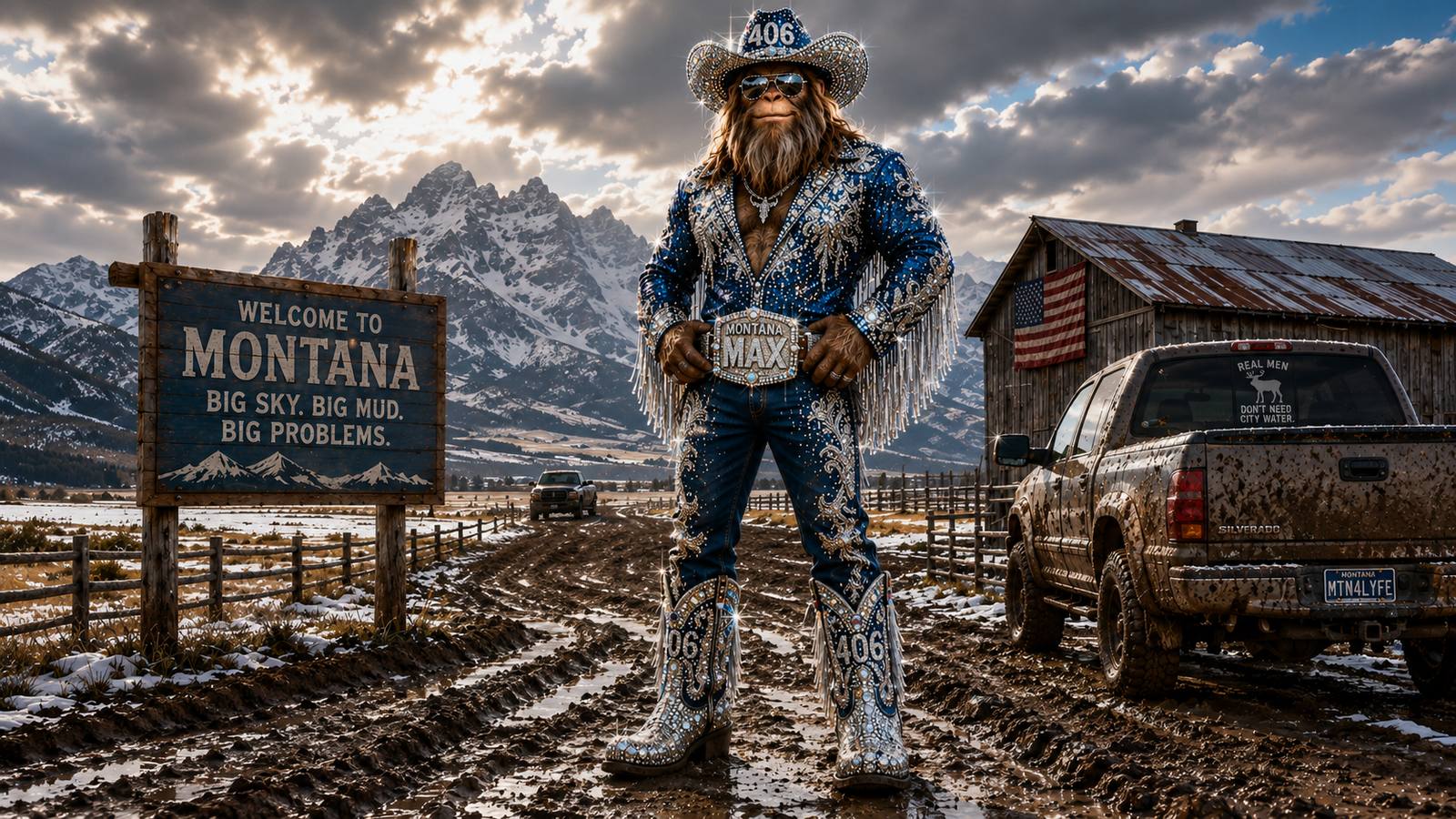
Montana vs. The Internet’s Montana: What’s Real, What’s Not, and What It’s Actually Costing People
The internet sells Montana as a wide-open paradise where you can buy a ranch and live your best Dutton life. The math tells a different story. Montana Max has been watching from the timber long enough to know which one’s true.
Now I’ve been watchin’ folks roll into Montana for a good long while. Long enough to see patterns. And lately, people are arrivin’ with something new tucked under their arm. It ain’t a bedroll or a hand tool or a plan that makes any practical sense. It’s a Pinterest board and a Paramount+ subscription.
I watched a fella step out of a California-plate pickup in Bozeman last summer. Clean boots. Spotless hat. One of those big insulated tumblers with a ranch brand on it that I’m pretty sure he bought at an airport in Denver. He stood there on the sidewalk, took a long slow breath, and said to whoever was behind him: “This is it. This is exactly like the show.”
I’ve been in this country for a few centuries, give or take. And I can tell you with full confidence: it is not exactly like the show.
The internet has built a version of Montana that is beautiful, cheap, empty, and drenched in golden-hour light. A place where you buy forty acres, work remotely from a cabin, and ride past your neighbor’s land disputes on horseback at sunset. The kind of place Kevin Costner would want to live, if Kevin Costner was the character he played on a TV show, which he is not.
That Montana is a good story. It’s also mostly fiction.
The real Montana is still worth loving. Genuinely. Maybe more so, because it don’t pretend to be anything other than what it is. But before you pack up your life and move here — or before you plan your big summer trip — you oughta know what you’re actually walking into.
Because the gap between the two Montanas is getting expensive. And real people are paying for it.
First: What the Real Montana Actually Is
Let’s get something clear before we start pulling myths apart. Montana is, in fact, remarkable. The sky is genuinely big. The rivers are cold and real. The winters will build your character or end your patience — sometimes both on the same Tuesday.
The people who’ve built their lives here carry themselves a certain way. Not because they’re performing anything for the camera. But because this place shapes you if you stick around long enough. That part is true. The show got that part right, at least in spirit.
Novelist Russell Rowland named the tension directly. He talked about the difference between people who love this place in theory and people who love it because it is part of who they are. That gap — between the postcard and the lived experience — is exactly what this piece is about.
Because Montana, the real one, deserves better than what the internet is selling in its name. And the people who call it home deserve to have that said out loud.
Myth #1: Montana Is a Wide-Open, Empty Paradise Waiting for You
Montana is a vast, uncrowded wilderness. Unlimited land, nobody around, unlimited space to breathe and roam free. Just you, the mountains, and your dreams.
About 7.5 people per square mile statewide — but roughly 70% of Montana’s jobs and people cluster in seven western urban hubs. The empty parts are genuinely empty. The popular parts? Not so much anymore.
Montana is the fourth-largest state by area and home to about 1.1 million people. That works out to around 7.5 people per square mile statewide. By any measure, that qualifies as open country.
But here’s what the Instagram feed doesn’t show you: about 70 percent of Montana’s jobs and roughly 68 percent of its people are concentrated in seven western urban hubs — Billings, Missoula, Bozeman, Kalispell, Great Falls, Helena, and Butte. The dreamy wilderness that draws people in is largely federal land. About 30 percent of Montana is federally owned. You can hike it. You can fish it. You cannot build on it.
Out east, Garfield County sits at about 0.3 people per square mile. That is legitimately empty. But that’s also not where most newcomers are landing. They’re landing in Gallatin County, which has nearly doubled its population since 2010.
I have watched folks buy land in eastern Montana thinkin’ they found the dream — wide open, nobody around, pure Montana freedom. Three winters later, they figure out that “remote” also means “two hours from a grocery store, four hours from a hospital, and zero bars of cell service when the truck don’t start.” The land ain’t lying to ’em. The internet is.
There’s also the matter of the nickname. “The Last Best Place” came from a 1988 literary anthology. A Las Vegas businessman tried to trademark it in 2001 for his resort. After years of fighting — Montana senators got involved — the U.S. Patent and Trademark Office permanently denied the trademark in 2012. The phrase stayed public.
The irony locals note: a slogan about preservation became one of the most effective marketing tools for exactly the kind of development it implied was being kept at bay.
Myth #2: The Yellowstone TV Show Made Montana What It Is
The Paramount TV show Yellowstone is why Montana is booming. Kevin Costner sold this whole state to America and everyone showed up because of it.
The show had real economic impact, but economists credit COVID, remote work, and retirement — not Dutton — for the actual population boom. And the study making the biggest claims was partly funded by Paramount itself.
The Paramount Network series Yellowstone — which ran from 2018 to 2024 — made Montana aspirational in a way no tourism campaign ever managed. And there’s data to back up the economic impact.
A January 2023 study by the University of Montana’s Bureau of Business and Economic Research (BBER) and the Institute for Tourism and Recreation Research (ITRR) found that roughly 2.1 million of Montana’s 2021 visitors said the show influenced their decision to come. Combined visitor and production spending tied to the show was credited with generating $730.1 million for the state economy and supporting more than 10,200 jobs. The lead researchers called it “eye-opening.”
Those are real numbers. But here is the part that usually gets left out: the study was funded in part by Paramount — the studio that makes the show.
A study funded by the company that profits from tourism it created, showing that its product drove tourism — should be cited, not treated as settled fact. The data may be accurate. The incentive structure is worth knowing.
Montana writers and economists push back hard on the idea that the show reshaped the state’s population. Rancher-writer Darby Minow Smith, writing in Mountain Journal in January 2025, argued she’s not convinced Yellowstone fueled a population boom — pointing to COVID, remote work, and retirement as the real drivers. She noted that Boise, Idaho is booming the same way without any TV show to credit.
Her deeper objection is about accuracy. Locals, she wrote, can forgive Yellowstone’s outlandish plot lines. But not the small details it gets wrong — the tells that prove the show is about Montana without being for Montanans. You can’t quickly tame a wild mustang. You don’t need gloves to pull a calf. The fictional Broken Rock Reservation doesn’t exist.
Bozeman business owner Hillary Folkvord told the Washington Post the same thing from a ranching angle: the show doesn’t show you “the hard days when it’s below zero and the calves are frozen.”
I’ve spent enough time near real ranches to know what the work actually looks like. It ain’t cinematic. It’s early and cold and there’s always something broke. The show gets the landscape right. It gets the labor wrong. And for the people who do that labor, the difference matters.
The show is a symptom of a bigger shift — not the cause. COVID made remote work possible. Remote work made it financially viable to live anywhere. People who had always romanticized Montana suddenly had the means to act on it. Yellowstone gave them a visual vocabulary for the fantasy. But the fantasy was already there.
Myth #3: Montana Is Still Affordable
Montana offers cheap land, lower cost of living, and a financial escape from high-cost cities. A place where your dollar still goes somewhere.
Montana’s median home price rose approximately 90% from 2018 to 2023 while median household income rose only about 28%. Clever Real Estate, updated April 2026, ranks Montana 3rd least affordable in the nation — behind only Hawaii and California — based on price-to-income ratio.
This is the one that stings the most for the people who actually live here. And it’s the one that gets smoothed over the fastest in lifestyle content about moving to Montana.
Between 2018 and 2023, the statewide median home sales price rose approximately 90 percent — from roughly $266,000 to over $505,000 — while median household income grew only about 28 percent. As of early 2026, depending on the data source and methodology, Montana’s median home value sits somewhere between $467,000 and $538,000. See the Data Notes section at the bottom of this article for details on where those figures diverge.
According to Clever Real Estate, updated April 2026, it takes 7.6 years of Montana’s median household income ($70,804) to afford the state’s median home sale price of $538,400. That earns Montana a ranking of 3rd least affordable in the nation — behind only Hawaii and California. The National Association of Realtors has used similar metrics to rank Montana as the least affordable state in the country in separate analyses. Both tell the same story with different numbers: the math is not in your favor.
- ~90% Rise in Montana median home price, 2018–2023
- ~28% Rise in median household income over the same period
- 7.6 Years of median income needed to afford median home (price-to-income ratio)
- 3rd Least affordable state nationally, behind Hawaii and California (Clever Real Estate, April 2026)
- 72% Montana wages as a share of the national average (BEA data)
- ~45–46% Share of Montana renters who are cost-burdened
- $810K Bozeman single-family home record high (2024, one source)
- ~$1M Approximate Whitefish median home price, after roughly doubling
In Bozeman, the numbers get harder to look at. One 2024 market report recorded a single-family home record of $810,000. In-city median figures for all home types in 2025–2026 range from $665,000 to $715,000, depending on the source. Out-of-city acreage properties push closer to $935,000. Whitefish home prices have roughly doubled toward $1 million.
And then there’s the wage problem. Montana wages sit at about 72 percent of the national average, according to an analysis of U.S. Bureau of Economic Analysis data by the Missoula Current. The state’s economy has grown — GDP rose significantly between 2021 and 2025 — but that growth didn’t translate into matching wage increases for most workers. When cost of living is factored in, Montana’s average weekly wage drops from a national ranking of 38th to 45th.
The people being priced out aren’t absentee investors or second-home buyers who simply lost out. They’re teachers. Nurses. Firefighters. The people who built the towns and keep them running. Missoula Mayor Andrea Davis put it plainly: higher-wage out-of-staters are “snapping up homes,” and locals are being left behind.
I’ve watched towns change. It happens slow and then all at once. First the coffee shop gets nicer. Then the old hardware store gets replaced by something with better signage. Then the folks who built that town — and their kids, and their kids’ kids — can’t afford to stay in it anymore. I ain’t sayin’ that’s all bad. I’m sayin’ that’s what’s happening, and it oughta be said out loud.
Montana passed a housing reform package in 2023, dubbed the “Montana Miracle,” that addressed zoning rules, accessory dwelling units, and parking reform. That legislation was expanded in 2025, and the Montana Supreme Court upheld the laws in March 2026. If the reforms work as intended, relief will come — but it’ll take years to show up in what homes actually cost.
Myth #4: Montana Is a Peaceful, Uncrowded Instagram Backdrop
Golden light. Lone cabins. Empty trails. Montana is serene, uncrowded, and perfectly ready for your content calendar.
A record 13,787,000 nonresident visitors came to Montana in 2024, spending $5 billion. Glacier hit 3.2 million visitors. Yellowstone hit 4.7 million. The most viral Montana content right now isn’t serene wilderness — it’s tourists getting charged by bison.
Let’s talk about the numbers first. In 2024, Montana received a record 13,787,000 nonresident visitors, according to the University of Montana’s Institute for Tourism and Recreation Research. Those visitors spent $5.0 billion — the highest visitor count the state has ever recorded, up about one million over 2023.
Glacier National Park drew 3,208,755 visitors in 2024, per National Park Service data — its fourth year above 3 million and second-highest on record. Yellowstone, which spans Montana, Wyoming, and Idaho, hosted 4,744,353 visitors in 2024, also its second-highest year on record. Glacier Country — the northwest region that includes Glacier Park and the Flathead Valley — captured a two-year average of $1.8 billion in annual nonresident spending, accounting for about a third of all traveler expenditures in the state.
Now here is the part the lifestyle content leaves out: the most viral Montana content on social media right now is not golden-hour mountain shots with nobody in them. It is the “Tourons of Yellowstone.”
That’s an Instagram and TikTok account whose name combines “tourist” and “moron.” It catalogs visitors approaching bison for photographs, walking up to bears, ignoring fencing, and generally treating a wild national park like a walk-through attraction. And it has no shortage of material.
In 2025 alone: an 83-year-old woman was gored on Yellowstone’s Storm Point Trail. A 47-year-old Florida man was gored. An Idaho man was cited by rangers for kicking a bison. The National Park Service notes that bison have injured more people in Yellowstone than any other animal. They can run three times faster than a human being.
I have shared territory with bison. Real ones, not the kind you see through a car window. Let me be clear about something: they do not care who you are, where you’re from, or how many followers you have. They have been in this country longer than the internet. They will still be here when the internet is gone. Do not walk up to a bison. Do not touch a bison. Do not take a photograph with a bison while standing close enough to be gored by a bison. This is not a difficult rule.
The Instagram aesthetic — golden hour, empty trails, no crowds — hides what actually drives to popular Montana destinations: traffic, timed-entry reservations, and seasonal smoke. It also hides the economics behind the scenes. Tourism directly supported an estimated 38,240 jobs in Montana in 2024 — down from 48,340 the year before — at wages that skew heavily toward the lower end of the pay scale. Leisure and hospitality workers average around $552 a week statewide. That’s the workforce making the postcard possible.
Montana outdoor writers have been sounding the alarm on geotagging for years. When a creator tags the exact location of a quiet local trail, it can become a crowded photo-op line within weeks. Leave No Trace guidelines recommend tagging general rather than specific locations for exactly this reason.
The “empty Montana” aesthetic isn’t just inaccurate. It’s actively harmful to the places it romanticizes. Every time someone posts coordinates to a quiet local spot, they are slowly destroying the thing they came to find.
Myth #5: Montana Is Beautiful and Manageable Year-Round
Montana is gorgeous in every season. The snow is picturesque. The summers are perfect. All you need is the right outdoor gear and a sense of adventure.
The contiguous U.S. cold record is −70°F, set at Rogers Pass, Montana in 1954. The town of Browning saw a 100°F temperature drop in 24 hours in 1916 — a U.S. record that still stands. Missoula ranks among the worst American cities for short-term air quality, mostly due to summer wildfire smoke.
The Instagram aesthetic of Montana almost never shows winter. This is a significant omission.
Montana holds the contiguous United States cold temperature record: −70°F, recorded at Rogers Pass on January 20, 1954. The town of Browning saw a 100°F temperature swing in a single 24-hour period in January 1916 — from 44°F down to −56°F — a national record for single-day temperature drop that still stands. In January 2024, a −74°F wind chill was recorded at Judith Peak. These are not historical curiosities. They’re part of the climate this state operates in.
I have been cold in ways that would rearrange your thinking on a lot of things. Montana cold is not photogenic. It ain’t cozy. It is not the kind of cold you manage with a better jacket. It’s the kind of cold that punishes you for leaving the house without a real plan, and it doesn’t care how many layers you’re wearing or what your app said the forecast was this morning.
And then there’s summer. The online version of a Montana summer is wildflowers and clear-sky hiking days and lake water you can actually swim in. What doesn’t get posted as often is wildfire smoke.
The American Lung Association has ranked Missoula among the worst U.S. cities for short-term particle pollution — most of it from wildfire smoke trapped in the bowl-shaped western valleys that make those locations so photogenic in the first place. That smoke can reduce visibility to near zero, force cancellation of outdoor events, and drive visitor drop-offs of up to one-third in national parks during bad fire seasons.
For small business owners who count on summer tourism revenue to carry them through the long winters, a bad smoke season is not an inconvenience. It’s a financial threat. The seasonal economy is as real as the landscape, and it’s more fragile than the content suggests.
Montana weather is also just fast. Clear mornings flip to thunderstorms. Snow happens in July at elevation. The state rewards people who check forecasts, carry layers, and don’t assume that what the sky looks like right now reflects what it’ll look like in two hours. It does not.
What All of This Actually Adds Up To
Montana is real. That’s the whole point. That’s always been the point.
It’s a place with genuinely remarkable land, genuinely complicated economics, genuinely severe weather, and genuinely proud people who have built something worth protecting. The version the internet sells — cheap, empty, cinematic, manageable — is a composite assembled from selective photography, a TV show about a fictional ranching empire, and the financial interests of people who benefit from you wanting to move here or visit.
The gap between those two things is costing real people real money. Longtime residents are being priced out of towns their families built. Teachers can’t afford to live where they teach. Service workers commute over mountain passes in black-ice conditions because the towns where they work have become too expensive to live in. The people who made Montana worth visiting are being pushed out by the cost of its own popularity.
Russell Rowland named the tension directly: people who love Montana in theory versus people who love it because it is part of who they are. The internet, the show, the lifestyle aesthetic — they’ve delivered millions of people in the first category. Some of them stay and become the second. Some of them leave before the first hard winter. Both groups made the right call for themselves.
But here’s what matters: the people in the second category — the ones for whom this is home, not a backdrop — are the ones carrying the cost. And that deserves to be said plainly, not wrapped in golden-hour photography.
Every once in a while, I hear someone say they “found” Montana. Always gets me. This place ain’t lost. Never was. You don’t find Montana. It either fits you or it doesn’t. And if you’re comin’ here for the version you saw on a streaming service, you might want to do a little more reading first.
The real one is harder. And it’s better for it. I’ve watched folks fall in love with this place on a single afternoon. I’ve also watched ’em pack up after one storm and never look back. Both made the right call — for them. Montana don’t pretend to be anything other than what it is. That’s the part worth keeping.
The internet didn’t find Montana. It invented a version of Montana that was easier to sell. The real one — bison charges, −70°F winters, a housing market that out-prices nurses and teachers, wildfire summers, and black-ice roads — is still out here. It just doesn’t photograph as easy. And it never asked to be a lifestyle brand.
Montana Max, over and out.
FAQ: Montana vs. The Internet’s Montana
Is Montana actually affordable to live in?
Not by national standards. As of April 2026, Clever Real Estate ranks Montana 3rd least affordable in the country based on a price-to-income ratio of 7.6 — meaning it takes more than 7.6 years of the median household income to afford the median home. Montana wages also sit at about 72% of the national average, which compounds the problem significantly for anyone already living here.
Did the Yellowstone TV show actually drive Montana’s population boom?
It had real tourism impact — a University of Montana study credited it with 2.1 million show-influenced visitors and $730.1 million in economic activity in 2021. But that study was funded in part by Paramount. Economists and Montana writers largely attribute the population boom to COVID, the rise of remote work, and retirement migration — not the show itself.
How crowded does Montana actually get in summer?
Very. Montana hit a record 13,787,000 nonresident visitors in 2024. Glacier National Park alone drew over 3.2 million visitors — its fourth consecutive year above 3 million. The “empty wilderness” aesthetic is real in some parts of the state and a marketing myth in others. The most popular destinations require early starts, advance planning, and sometimes timed-entry reservations.
How bad are Montana winters, really?
The contiguous U.S. cold record — −70°F — was set in Montana in 1954. The town of Browning holds the record for the largest single-day temperature drop in U.S. history: 100°F in 24 hours. More recently, a −74°F wind chill was recorded in January 2024. Long stretches between towns, black ice conditions, and limited services amplify the risk for the unprepared. It is not a manageable inconvenience. It is a serious safety condition.
Is the air quality really a problem in Montana summers?
In some western valleys, yes. The American Lung Association has ranked Missoula among the worst U.S. cities for short-term particle pollution, primarily from wildfire smoke trapped by surrounding terrain. Bad fire seasons can drive visitor drops of up to one-third in national parks and force cancellations of outdoor events that local businesses depend on.
Are bison actually dangerous at Yellowstone?
Yes. The National Park Service states that bison have injured more people in Yellowstone than any other animal. They can run three times faster than a human. In 2025, multiple visitors were gored, and at least one individual was cited for kicking a bison. The minimum safe distance recommended by NPS is 75 feet — roughly the length of two school buses.
The following figures had meaningful variation across sources. Verify before publishing.
- Affordability ranking: The National Association of Realtors has used its Affordability Distribution Curve and Score to rank Montana the least affordable housing state in the U.S. Separately, Clever Real Estate (updated April 2026) ranks Montana 3rd least affordable behind Hawaii (ratio 8.8) and California (ratio 8.2) using a price-to-income ratio methodology. These use different methodologies and time periods. Both are defensible. The current most-updated figure (April 2026) is Clever’s 3rd-least ranking, which is used in this article.
- Statewide median home price: Zillow (via Clever, Feb 2026) shows a median home value of $466,917. Realtor.com (via Clever, March 2026) shows a median home sale price of $538,400. The difference reflects different measurement methods (estimated value vs. actual sale price) and is cited as a range in this article. Both are from the same April 2026 Clever Real Estate report.
- Bozeman home prices: One 2024 market report cites a single-family record high of $810,000. Bozeman Real Estate Group (June 2026) shows in-city median for all home types at $665,000–$715,000; out-of-city acreage properties near $935,000. These figures measure different things (single-family only vs. all types, different geographies, different dates). Both are citable with proper attribution to their specific sources. This article presents the range.
- Tourism jobs supported: ITRR 2024 data estimates 38,240 Montana jobs directly supported by visitor spending — down from 48,340 the prior year. This is a significant year-over-year drop and worth noting if the piece is used in a tourism-economy context.
- Wages as % of national average: The 72% figure comes from an analysis of U.S. Bureau of Economic Analysis data by the Missoula Current’s Long Streets Project. It reflects all private-sector wages. The average weekly private-sector wage of $1,108 (38th nationally, 45th when cost-of-living adjusted) comes from USAFacts/BLS data. Both figures are complementary and consistent with each other.
- Mountain Journal — “Why ‘Yellowstone’ Became a Dirty Word to so Many Montanans” (Darby Minow Smith, January 2025): mountainjournal.org
- Mountain Journal — Russell Rowland interview on Montana authenticity: mountainjournal.org
- University of Montana BBER/ITRR — Yellowstone TV series economic impact study (January 2023): umt.edu
- NPR, The Indicator — “Why ‘Yellowstone’ is drawing people to Montana”: npr.org
- Washington Post — “‘Yellowstone’ is fueling Montana’s tourism boom”: washingtonpost.com
- Daily Montanan — “Tourists spent nearly $5 billion in Montana last year” (June 2025): dailymontanan.com
- Daily Montanan — “Gallatin, Flathead see highest nonresident visitor spending” (September 2025): dailymontanan.com
- Spokesman-Review — “Glacier, Yellowstone notch second-highest visitation on record” (February 2025): spokesman.com
- Clever Real Estate — Montana Housing Market (updated April 2026): listwithclever.com
- Montana Budget & Policy Center — Rental Affordability in Montana (April 2025): montanabudget.org
- Daily Montanan — “Wages up, housing still out of reach” (October 2024): dailymontanan.com
- Missoula Current — “Where are the jobs? Why are wages so low?”: missoulacurrent.com
- State Court Report — “Montana’s Housing Crisis Fix Survives Constitutional Challenge”: statecourtreport.org
- Reason Foundation — “The ‘Montana Miracle’ continues through housing reform passed in 2025”: reason.org
- Bozeman Real Estate Group — Home Buying Guide, June 2026: bozemanrealestate.com
- Taunya Fagan Bozeman Real Estate — Price Trends Report: taunyafagan.com
- University of Montana — “Montana Winters Aren’t for Wimps”: umt.edu
- NBC News — “The remote workers have left, but the housing havoc they created remains”: nbcnews.com
- The Cool Down — Tourons of Yellowstone bison incidents (2025): thecooldown.com
- Flathead Beacon — “Glacier Park Considers Shelving Reservation Pilot in Summer 2026”: flatheadbeacon.com
- Wikipedia — “The Last Best Place” (trademark history): wikipedia.org
- USAFacts — Average wage in Montana: usafacts.org
Wanna keep up with Montana Max and the wild ride that is The 406 Life? Follow us on Instagram for daily snapshots of Big Sky livin’, and join our Facebook crew—both the main page and the group—for local biz shoutouts, behind-the-scenes shenanigans, and real-deal Montana grit. Whether you’re scrollin’ from the mountains or missin’ ‘em from afar, we’ve got a seat ’round the digital campfire waitin’ for ya.
And don’t forget to roam through our blog, where Montana Max dishes out tales from the trail, cultural deep-dives, and a whole lotta backwoods wisdom.
Leave a Reply
You must be logged in to post a comment.