
One Tank Trips in Montana:
Hidden Roads, Ghost Towns & Backcountry You’ll Never Forget
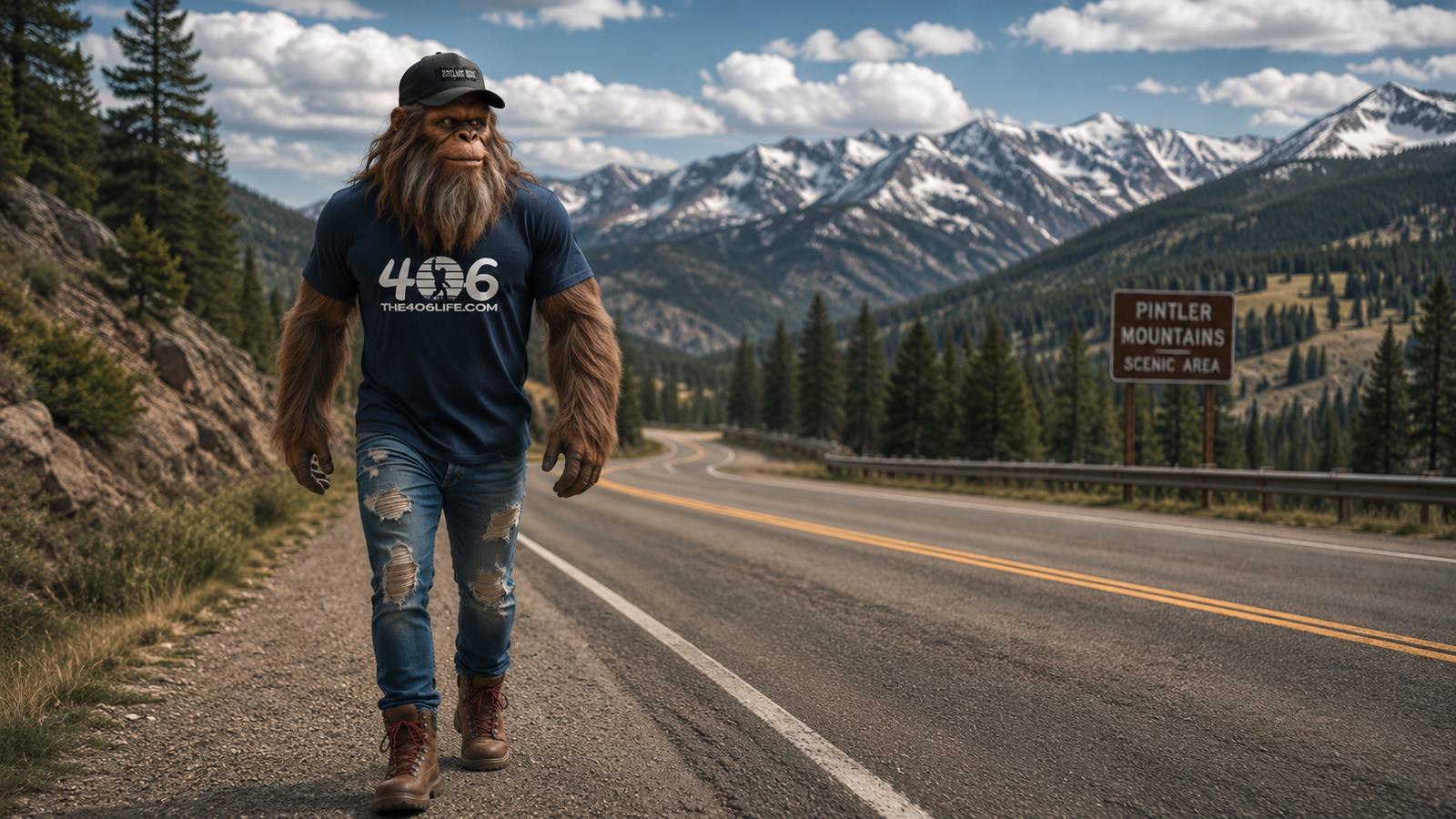
A grizzled bigfoot’s guide to the scenic drives, forgotten passes, and wilderness corridors most folks roll right past.
Now, I’ve covered a lot of ground in my time. A few centuries’ll do that to you. And I’ll tell you something nobody in a tourism brochure ever will — the best roads in Montana ain’t on your map app. They’re on the other side of a cattle gate, winding up a canyon the color of old rust, with a waterfall sprayin’ your windshield and zero cell service between you and the nearest gas station. That’s not a problem. That’s the point.
Folks always ask me where to go. I usually just point at the horizon and grunt. But today I’m feelin’ generous. So sit down, top off your tank, and listen close. This is your guide to one-tank trips across Montana — the kind where you fill up once and come back a different person.
Northwest Montana: Rainforests, Ghost Cabins & a Saloon That Brews Huckleberry Beer
Most people who come to northwest Montana are headed to Glacier. Which is fine. It’s beautiful. But they’re missin’ the weird, quiet, mossy heart of the place — and that heart beats up in the Yaak.
The Yaak River Scenic Byway
The Yaak River Scenic Byway runs about 29 miles north from the town of Troy — which sits at Montana’s lowest elevation, just shy of 1,900 feet — up into the isolated mountain valley of Yaak. I’ve spent more than a few November nights in those trees. The valley smells like rain and fir resin and something older than both. It’s temperate rainforest territory up there, and the biodiversity is something else — glacier lilies, calypso orchids, and a little waterfall called Yaak Falls that deserves a lot more attention than it gets.
There’s a saloon up there in Yaak that brews its own huckleberry beer. I’ve watched grown men weep at the taste of it. Mostly because they know they’re four hours from the nearest anything. That combination’ll move you.
The town itself — and I use that word loosely — has fewer than 500 year-round residents. There’s a one-room schoolhouse, a mercantile with basic fuel and supplies, and the Dirty Shame Saloon. That last one is worth the drive alone. Combine the byway with Pipe Creek Road or Forest Development Road 228 to loop back toward Libby.
Yaak River Scenic Byway
Troy to Yaak on Highway 508. Short hike to Yaak Falls via the Dipper Trail (#704). Combine with FDR 228 for a longer loop back to Libby.
Lake Koocanusa — The Reservoir That Crosses Into Canada
East of the Yaak, the Lake Koocanusa Scenic Byway runs 67 miles between Libby and Eureka, hugging a massive reservoir that stretches 90 miles and crosses the U.S.-Canada border. The standard route (Highway 37) runs the east side. But Forest Development Road 228 on the west side is quieter, prettier, and puts you next to the water instead of above it. Watch for the MacGillivray Campground and the Barron Creek boat launch — good spots for trout fishing or just staring at the water like a reasonable person.
Glacier’s Quiet Side: Chief Mountain & the Two Medicine Road
Everyone talks about the Going-to-the-Sun Road. And yeah, it’s spectacular. But if you want the version of Glacier that doesn’t have a line of rental cars backed up to the entrance booth, try the edges.
The Chief Mountain International Highway climbs through glaciated terrain into Canada’s Waterton Lakes National Park and offers views of Mount Cleveland — at 10,466 feet, the highest peak in the Waterton-Glacier International Peace Park. It’s strictly seasonal (mid-May to mid-September), so plan accordingly. Heavy mountain fog is common. Drive like you mean it.
Down on the southeastern edge of the park, Looking Glass Road (Highway 49) cuts through the Blackfeet Reservation with sharp curves and dramatic views of the Two Medicine valley. Low traffic. High wildlife activity. Grizzlies, moose, wolves — the full Montana welcome committee. I’ve seen things along that road I won’t put in writing.
The Cabinet Mountains Wilderness & Ross Creek Cedars
Between the Kootenai and Clark Fork river drainages, the Cabinet Mountains rise up sharp and glaciated, with Snowshoe Peak topping out at 8,738 feet. The western gateway is the Bull Lake corridor on Highway 56. Bull Lake is a four-mile natural body of water sitting between the Cabinets and the Scotchman Peaks — beautiful in a way that makes you feel small, which is the correct way to feel in this country.
Don’t miss the Ross Creek Cedars Scenic Area. Ancient Western Red Cedars — some up to eight feet in diameter — with a boardwalk trail that keeps boot traffic off the forest floor. It’s a short, easy walk. Bring someone you want to impress. It works every time.
West & Southwest Montana: High Passes, Silver Towns & One Road That’ll Test Your Nerves
Southwest Montana is fault-block mountain country — complex geology, high-altitude valleys, and a history that runs deep with precious metal mining. The roads that connect these valleys cross some narrow, white-knuckle passes. Worth it every time.
The Bitterroot Valley: Eastside Highway & the Backcountry Beyond
Most folks barrel down Highway 93 through the Bitterroot Valley without a second glance. That’s a shame. The Eastside Highway (Highway 269) runs the other side of the valley — slower, quieter, and lined with historic ranches, cottonwood-fringed riverbanks, and the kind of light that photographers would sell a kidney for.
You’ll pass through Stevensville, Montana’s oldest permanent non-Indigenous settlement, established in 1841. The Historic St. Mary’s Mission is still there. So is the Western Heritage Days celebration every June — chuckwagon cook-offs, historical reenactments, the whole thing.
Further south, Darby connects you to the West Fork Road, which runs 25 miles up the canyon to Painted Rocks Reservoir. Good boating, flat-water kayaking, and the kind of quiet that feels earned. For the truly ambitious, the Magruder Corridor begins off that road — a 101-mile single-lane primitive track crossing the Selway-Bitterroot Wilderness. High-clearance four-wheel-drive. July through September only. And genuine self-reliance required. This is not a road for people who get nervous when the GPS loses signal. I love it.
The Skalkaho Highway — Montana’s Most Dramatic Shortcut
Highway 38 is 45 miles of mountain road connecting Hamilton to Philipsburg. Originally built in 1924, it follows an old Indigenous route the Salish called “many trails.” The name was accurate. Twenty-one of those miles are unpaved, narrow, and characterized by steep drop-offs and blind curves that will get your full attention.
Trailers and large RVs are prohibited on the Skalkaho. This is not a suggestion. I once watched a man try it in a travel trailer. I watched from the trees. The look on his face when he realized his mistake was… educational.
Skalkaho Falls drops about 150 feet right alongside the road during spring runoff — close enough to spray you through an open window. The pass sits at 7,260 feet in dense subalpine forest. Elk herds, mountain goats, moose, black bears. Drive east to west (Philipsburg to Hamilton) if you want the inside lane on those cliff curves. Mud Lake near the descent offers a nice stop for photographing water lilies before the gravel gives way to pavement near Sand Basin Road.
Skalkaho Highway (MT 38)
Hamilton to Philipsburg (or reverse). 150-foot waterfall, alpine pass at 7,260 ft, wildlife corridor. Preferred direction: Philipsburg to Hamilton for inside-lane safety.
Philipsburg, Gem Mountain & the Granite Ghost Town
When you come down the eastern slope of the Sapphires, the road drops into the Flint Creek Valley and into Philipsburg. This little town punches well above its weight. You can sift through glacial gravel at Gem Mountain Sapphire Mine — the state’s oldest and largest — and walk away with raw Montana sapphires you can have cut and heat-treated on-site. I’ve seen full-grown adults cry happy tears at that mine. Can’t fault ’em.
A short drive north brings you to Granite Ghost Town State Park. Back in the 1880s, Granite was a mining camp of 3,000 people built around silver. When the Sherman Silver Purchase Act was repealed in 1893, the whole town emptied out in under a year. The Miners’ Union Hall and the Mine Superintendent’s house still stand, looking out over the valley like they’re waiting for someone who’s never coming back.
In town: the Philipsburg Brewing Company (beautiful restored historic bank building) and the Sweet Palace, which produces over a thousand varieties of chocolates, fudge, and saltwater taffy. Start at the brewery. End at the candy store. That’s the correct order.
Pioneer Mountains, Big Hole Valley & Big Sheep Creek
South of Philipsburg, the Pioneer Mountains Scenic Byway runs 49 fully paved miles through the Beaverhead-Deerlodge National Forest, between the West and East Pioneer ranges. You’ll pass Coolidge Ghost Town — another failed silver-mining venture slowly being swallowed by the forest — and Crystal Park, where you can dig for quartz, smoky quartz, and amethyst crystals. That last one is genuinely fun. Even I’ve picked up a few pieces over the years.
The byway connects directly to the Big Hole Valley, one of Montana’s finest stretches of high alpine basin — blue-ribbon fly fishing on the Big Hole River, hot mineral pools at Jackson Hot Springs, and the Big Hole National Battlefield preserving the site of the August 1877 clash between the U.S. Army and the fleeing Nez Perce.
For the rough-road crowd: Big Sheep Creek Backcountry Byway. Fifty miles of primitive dirt road. Narrow canyon walls. Bighorn sheep on the ledges. Wide-open sagebrush plains in the Medicine Lodge Valley. Requires high-clearance four-wheel-drive and is completely impassable when wet. At the northern end, Highway 324 leads to Bannack State Park — Montana’s first major gold rush site in 1862, preserved as one of the country’s premier historic ghost towns.
Central Montana: Island Ranges, Ice Caves & the Charlie Russell Trail
Central Montana is defined by what geologists call “island ranges” — isolated forested mountain uplands rising out of a sea of wheat and prairie. These ranges catch orographic precipitation, feeding cold streams, limestone caverns, and some of the state’s most unusual ecosystems. I’ve napped in their shadows. They’re good country.
The Kings Hill Scenic Byway — Belt Creek to White Sulphur Springs
The Kings Hill Scenic Byway (Highway 89) runs 71 paved miles through the Little Belt Mountains, climbing past the historic silver-mining towns of Monarch and Neihart before topping out at Kings Hill Pass at 7,393 feet. Below the pass on the north end, Sluice Boxes State Park follows Belt Creek through sheer limestone gorges several hundred feet tall. Great birding — Calliope hummingbirds, white-throated swifts, mountain chickadees in the spray zone.
At the summit, Showdown Ski Area has been running on natural Rocky Mountain powder since 1936. Montana’s oldest ski hill. The Silver Crest Cross-Country Trail System is there too — groomed Nordic skiing and snowshoeing through hushed pine forests. For panoramic views of the Castle, Crazy, Highwood, and Snowy mountains, a high-clearance vehicle can take the dirt road up to the Porphyry Peak Lookout tower.
The byway descends into White Sulphur Springs, where the mineral-rich thermal pools provide a historic soaking spot and Main Street holds cozy stops like Parberry Coffee & Mercantile and Bar 47.
Kings Hill Scenic Byway (US 89)
Great Falls south through Monarch, Neihart, Kings Hill Pass (7,393 ft), down to White Sulphur Springs. Connects to the “Big Loop Ride” east to Lewistown and back.
The Judith Basin & the Charles Russell Country
The northern slopes of the Little Belt Mountains are Charlie Russell country — the legendary cowboy artist spent his early years working alongside ranchers in this very basin. Stanford, Moore, Judith Gap, and Lewistown are the community hubs out here. Lewistown, with around 6,200 residents, is the regional center.
Worth stopping for: the Judith Basin County Museum in Stanford (extensive photographic archives of Russell and homesteader artifacts), Ackley Lake State Park for flat-water fishing and camping, the Gigantic Warm Spring eight miles from Lewistown (a natural warm spring discharging millions of gallons of geothermal water daily — the scale of it will stop you cold), and the Stanford Bluebird Trail, which has successfully fledged more than 7,000 bluebirds since 1992 via 90-plus nesting boxes. April through August is prime viewing.
The Big Snowy Mountains & the Ice Caves Trail
Southeast of Lewistown, the Big Snowy Mountains rise abruptly out of the plains. The Crystal Lake Recreation Area sits at 5,700 feet — a 45-acre natural lake on a porous limestone bottom that can dry up in drought years. Crystal Lake Campground has 28 spacious sites in dense spruce stands.
From the lake, you’ve got options. The Crystal Lake Loop Trail is easy and flat. The Grandview Trail climbs 1,000 feet in 3.5 miles to panoramic ridge views. The Crystal Cascades Trail reaches a hundred-foot waterfall that emerges directly from a limestone cave. And the Ice Caves Trail — nearly five miles to the Snowy Crest ridge, gaining 2,200 feet in the first three steep miles — leads to a massive limestone cavern with permanent ice formations that hold solid through the hottest summer months. On a clear day, you can see over 200 miles to the Grand Tetons in Wyoming.
I’ve been to those ice caves in August. Standing in a cavern full of solid ice while it’s 90 degrees outside is one of those Montana moments that doesn’t translate to a photograph. You just have to stand there and let it mean something.
Carry all your water. There’s none on that ridge. And be prepared for sudden high-altitude lightning — the Snowy Crest is fully exposed.
Southeastern Montana: Badlands, River Breaks & One Very Sacred Mountain
The southeast is where Montana gets strange in the best way. Semi-arid badlands, deeply eroded canyons, and sheer cliffs carved by the post-glacial Yellowstone River. This is paleontology country, Crow Tribe country, and some of the darkest skies in the lower 48.
Billings Gateways: Rims, Rocks & Prehistoric Caves
Billings doesn’t get enough credit as a base camp. From the city limits, you’re close to some remarkable things. The “Rims” — sheer sandstone cliffs estimated at 70 million years old — ring the city. On a clear day from Swords Park up top, you can see five mountain ranges: the Bighorn, Pryor, Beartooth-Absaroka, Crazy, and Bull Mountains. That’s not nothing.
Just south of the city, Pictograph Cave State Park sits behind a short 0.4-mile loop trail. Three massive sandstone caves. Thousands of artifacts. Ancient pictographs over 2,000 years old. Prehistoric hunters used these caves for shelter, and the artwork they left behind is extraordinary. No bigfoot pictographs that I can confirm. Though I’ve looked.
Chief Plenty Coups State Park, at the base of the Pryor Mountains, preserves the historic log home of the last traditional chief of the Crow Tribe. He gave his land as a public park to foster cross-cultural understanding. That act of generosity deserves more than a passing mention.
Bighorn Canyon & the Wild Mustangs of the Pryor Mountains
Bighorn Canyon National Recreation Area centers around an 71-mile-long reservoir with limestone walls rising more than 1,000 feet above the water. The Ok-A-Beh Marina Road — narrow, steep, no shoulders — is the primary scenic route in the North Unit. Stay on the road; the surrounding terrain is private tribal land.
The Pryor Mountains themselves straddle the Montana-Wyoming border and are as close to desert as Montana gets. The lower country receives less than seven inches of precipitation annually. Up high, the Pryor Mountain Wild Horse Range protects a feral herd descended from Spanish mustangs brought north by Native American tribes in the 1700s. They roam freely. No pavement required to find them — just patience and a capable vehicle. The Big Ice Cave, a limestone sinkhole with year-round solid ice, requires rough four-wheel-drive roads and genuine self-reliance.
The Terry Badlands — Hoodoos, Stargazing & Bentonite Clay That’ll Swallow Your Tires
Following the Yellowstone northeast from Billings leads to the Terry Badlands Wilderness Study Area — multi-colored sandstone bluffs, hoodoos, natural bridges, all estimated at 70 million years old. Two routes in:
State Secondary Highway 253 climbs to a clifftop overlook with world-class stargazing. Montana’s Trail to the Stars designation isn’t marketing — the absence of light pollution out here is real. The Calypso Trail, accessed off Old Highway 10 west of Terry, is a different story. Primitive dirt. High-clearance four-wheel-drive only. Completely impassable when wet. The bentonite clay in those badlands doesn’t just get muddy — it undergoes rapid volume expansion when hydrated, fills your tire treads, and renders steering impossible. I am not exaggerating. Abort the trip if rain is coming. Full stop.
Bentonite soils (Terry Badlands, Pryor Mountains) become impassable in minutes when wet. If rain is coming, abort the route. This is not optional.
Sharp limestone and volcanic shale routes like Big Sheep Creek will destroy tires. High-ply all-terrain rubber, a full-size spare, tire plugs, and a heavy-duty air compressor are not luxuries out here.
Cell coverage disappears the moment you drop into any serious mountain pass or river break. A satellite communicator (Garmin InReach or equivalent) is the right call for any of the primitive routes in this guide. Emergency food, warm clothes, and potable water are non-negotiable.
The isolation on routes like the Magruder Corridor or Calypso Trail is the whole point — and it shifts the safety burden entirely onto you. Prepare accordingly.
Fort Peck, Fossils & the Far Northeast
In the far northeastern corner of the state, Fort Peck Lake is a massive Missouri River reservoir with a story worth knowing. The Fort Peck Interpretive Center houses “Peck’s Rex” — a complete Tyrannosaurus rex skeleton excavated locally. The historic Fort Peck Summer Theatre, built in the 1930s during dam construction, still hosts professional theatrical productions June through July. The Bowdoin National Wildlife Refuge is nearby, along with the isolated Bitter Creek Wilderness Study Area for those who want the true end-of-the-road experience.
Up in Arlee, the Garden of One Thousand Buddhas is a public monument and botanical garden designed around the teachings of peace and non-violence. It’s peaceful in a way that doesn’t feel like it belongs in the same state as the Calypso Trail. Both are worth your time.
Before You Go: The One-Tank Mindset
Every one of these trips can be done on a single tank of gas. But that’s not really the point. The point is slowing down enough to let this place work on you. Montana doesn’t rush. It never has. The roads that go somewhere worth going take time, demand attention, and don’t apologize for the inconvenience.
Fill up before you leave town. Download the maps offline — you won’t have signal where you’re headed. Check the weather, especially if you’re heading into the badlands. Tell someone where you’re going. And then go.
I’ve watched a lot of people roll through this state in a hurry to get to the next thing. Most of ’em miss everything. The best stuff in Montana doesn’t have a sign out front. It’s just there, waiting on whoever’s willing to take the slow road.
That’s always been enough for me.
Frequently Asked Questions
- What is a one-tank trip in Montana?
- A one-tank trip is a self-contained regional day trip or overnight excursion you can complete on a single tank of fuel — no long-distance driving required. Montana’s size and density of scenic routes make it ideal for this style of exploration, especially from regional hubs like Billings, Missoula, Great Falls, or Bozeman.
- What kind of vehicle do I need for Montana’s backcountry roads?
- It depends on the route. Paved scenic byways like Kings Hill and the Pioneer Mountains Byway are fine for a standard passenger car. Routes like the Skalkaho Highway require high-clearance AWD or 4WD. Primitive routes like the Magruder Corridor, Big Sheep Creek, and the Calypso Trail demand high-clearance 4WD with low-range capability and a full-size spare. Always verify current road conditions before departing.
- When is the best time to drive Montana’s mountain scenic byways?
- Late May through September covers most routes. High mountain passes like Skalkaho (Highway 38) typically open in late May and close with the first significant autumn snows in October. The Chief Mountain International Highway is strictly seasonal — mid-May to mid-September. Winter driving is possible on paved routes but requires serious preparation.
- Are there ghost towns worth visiting in Montana?
- Yes — several. Granite Ghost Town State Park near Philipsburg preserves ruins of a silver-mining boomtown from the 1880s. Bannack State Park near Dillon is Montana’s best-preserved ghost town and the site of the state’s first major gold rush in 1862. Coolidge Ghost Town along the Pioneer Mountains Byway is a more rugged, forest-reclaimed site. All three are legitimate historical stops.
- What should I bring on a Montana backcountry drive?
- Emergency food, extra water (many desert mountain ranges have zero potable sources), warm layers regardless of season, a full-size spare tire, tire repair kit, air compressor, paper maps, and a satellite communicator for routes with no cell coverage. The isolation is the appeal — and it shifts full responsibility onto the traveler.
- Can I visit Montana’s backcountry roads with kids?
- Many routes are completely family-friendly — the Ross Creek Cedars boardwalk trail, Crystal Lake Recreation Area, Pictograph Cave State Park, and the Pioneer Mountains Scenic Byway are all accessible and worthwhile for families. The more primitive routes (Magruder, Big Sheep Creek, Calypso Trail) are better suited to experienced backcountry travelers.
Sources
SEO Package
Meta Description
Montana’s best one-tank trips: scenic drives, ghost towns, ice caves, and backcountry roads locals love — guided by Montana Max. Plan your adventure today.
Meta Tags
one tank trips Montana, Montana scenic drives, backcountry roads Montana, Montana hidden gems, Montana day trips, best drives in Montana, Montana ghost towns, things to do in Montana, Montana travel guide, Montana Max 406 Life
Five SEO Title Options
- Direct SEO: One Tank Trips in Montana: Scenic Drives, Ghost Towns & Hidden Roads
- Curiosity-Driven: The Montana Roads Nobody Tells You About (Until Now)
- Local Angle: Montana’s Best Backcountry Day Trips — Straight From a 400-Year-Old Bigfoot
- Long-Tail Keyword: Best One-Tank Road Trips in Montana: Backcountry Drives, Hidden Waterfalls & Ghost Towns
- Montana Max Voice: Fill Up Once. Come Back Different. Montana’s Greatest One-Tank Trips.
Leave a Reply
You must be logged in to post a comment.