
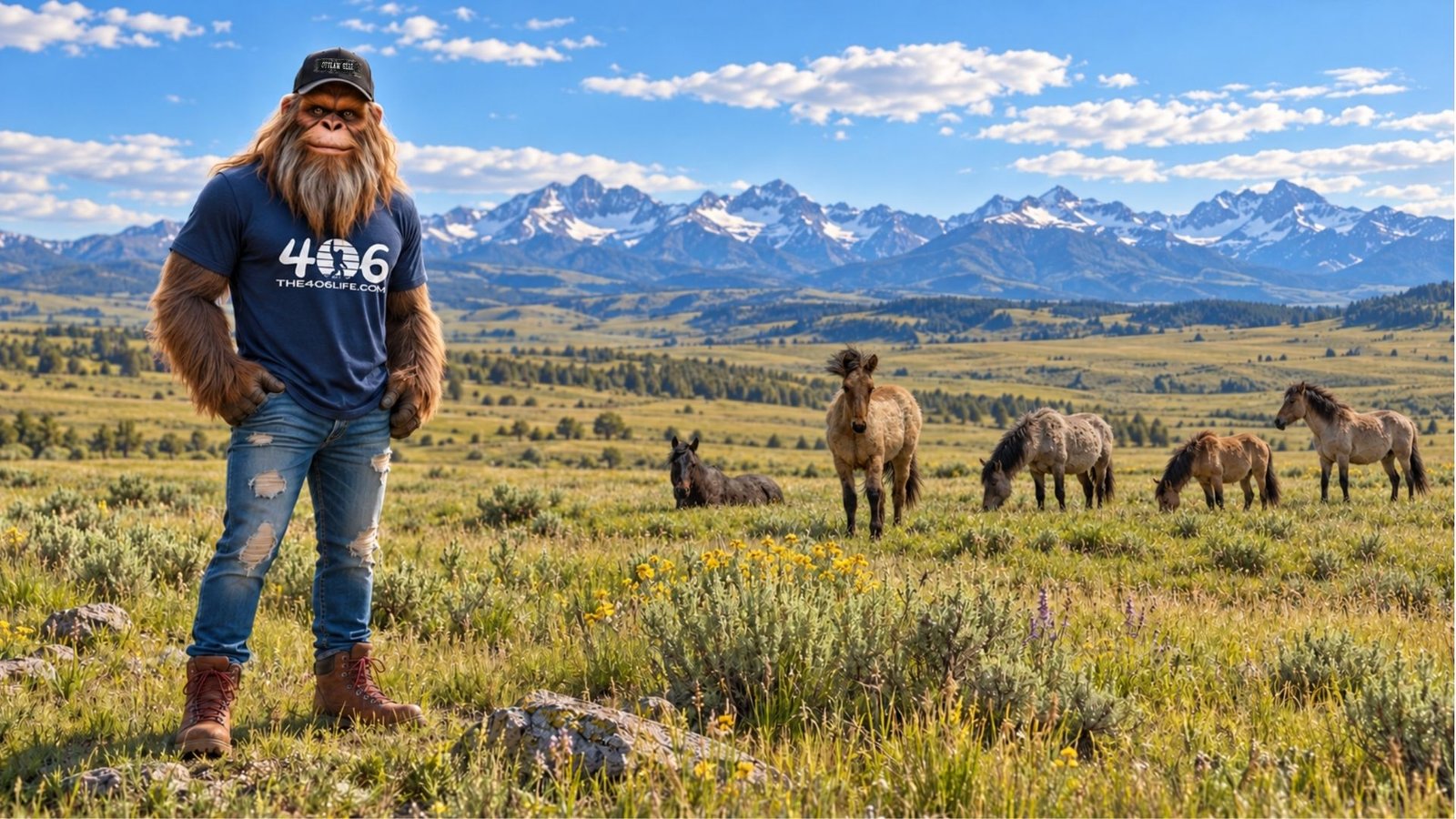
The wild horses of the Pryor Mountains have a preservation story with a victory in the middle and an argument still unfolding at the end. According to the National Park Service, a two-year citizen campaign helped secure a public range for the horses in 1968. More than half a century later, the question is how to keep that herd on the landscape while caring for the country that sustains it. [S2]
I appreciate a story where local people refuse to shrug and walk away. Being a Bigfoot, I also appreciate any creature whose preferred living arrangement involves open country and limited human supervision. Unfortunately, admiration alone does not settle questions about forage, water, or which horses should stay on a mountain.
A place worth protecting
The Pryor Mountain Wild Horse Range straddles Montana and Wyoming south of Billings. The Bureau of Land Management (BLM) describes a landscape rising from dry shrub country into subalpine forest and meadows, with water limited across much of the range. That variety is part of the fascination: the horses belong to a place whose habitats change dramatically with elevation. [S1]
BLM’s visitor brochure describes bands containing a stallion, mares, and young horses, alongside bachelor stallions. It also notes the role of lead mares in the daily routine. That is worth remembering when a discussion turns entirely into population totals: a herd is made up of animals living in social groups. [S7]
Humans have our own complicated social arrangements, of course. We simply make ours harder to follow by adding committee meetings. I have watched enough of those from outside the window to understand why horses prefer the mountain.
The campaign before the designation
NPS credits concerned citizens with persuading Interior Secretary Stewart Udall to protect the horses in 1968. BLM gives the establishment date as September 9 of that year. Those descriptions provide the outline of the victory, although the available institutional histories differ on some details. [S1, S2]
The part that stays with me is the decision to care before preservation became an accomplished fact. A protected range can look inevitable once its name is printed on a map. The campaign behind it reminds us that a designation begins with people deciding the existing situation is not good enough.
There is a particular kind of persistence associated with small communities. Someone notices a problem, someone else knows whom to call, and eventually the person hoping everyone will lose interest discovers they have badly misjudged the available supply of stubbornness. The Pryor story offers a good reason to appreciate that quality.
Spanish ancestry with qualifications
The phrase Spanish mustang can suggest a tidier family history than the evidence supports. BLM describes the Pryor horses as having mixed ancestry that includes measurable Spanish influence. Its genetic summary also points to ancestry associated with other riding and racing breeds. [S1]
That distinction does not drain the romance out of the horses. It gives the romance some boundaries. Their value need not depend on an untouched bloodline or a perfectly documented journey from the sixteenth century to a modern Montana hillside. A complicated history can be worth preserving without being made simpler for the brochure.
What BLM planned in October
In its October 19, 2026 announcement, BLM estimated the population at about 185 horses and identified its management target as 107 to 120. The agency attributed deteriorating range conditions to prolonged numbers above that target. Those are BLM’s estimate and assessment, rather than an independently settled answer to every management question. [S3]
BLM’s operation page says the gather began October 19. Its stated plan was to capture approximately 100 horses using bait traps, remove up to 37, and return other horses to the range, including mares receiving fertility control. A capture target and a removal target describe different actions; they should not be mistaken for the same number. [S4]
In this operation, horses are attracted into temporary corrals using hay or water. The method matters, but so do the decisions that follow: which animals are retained, which are removed, and how the remaining population changes afterward. Calling a gather a management tool does not answer every question about how that tool should be used.
Why advocates question the plan
The Pryor Mountain Wild Mustang Center’s August 15 statement focused on removal criteria, the herd’s age structure, genetic diversity, and representation of family lines. It argued that removals and fertility treatment need to be considered together because both can influence future generations. The Center presented those concerns as an argument for more careful management, rather than opposition to any removal under any circumstances. [S5]
That is a more useful discussion than dividing the room into people who care about horses and people who care about grass. BLM’s stated concern is the condition of the range and the animals using it. The Center questions whether particular decisions adequately protect this particular herd. Readers deserve to understand those claims without being told the disagreement has already been solved.
There is a difference between agreeing that a place needs care and agreeing on the treatment. Anybody who has attended a small-town meeting about a park, a road, or a school building has probably seen that distinction develop a full evening’s worth of legs.
A dated update rather than a live count
When this article was checked on October 26, the latest daily entry I could verify on BLM’s gather page was October 21. It reported zero horses gathered, shipped, or released, and zero deaths. Those are the posted totals for that report date, not a verified count through October 26. [S4]
BLM also issued a temporary access order associated with the gather. Anyone planning a visit should consult the current order, its map, and operational updates before traveling. This story is an introduction to the horses and their history; it is not a promise that a particular road or viewing location will be open. [S9]
The work after the victory
The most interesting part of the Pryor story may be what it asks of the word saved. Establishing a range was a consequential act of protection. Keeping a herd and its habitat healthy requires later decisions, with consequences that deserve attention long after the original celebration.
I would like to tell you this ends with everyone agreeing and the horses wandering into a conveniently placed sunset. That would be a handsome ending, but it would duck the story. The better reason to keep watching is that the work continues, and the people making decisions should be willing to explain their evidence and listen when it is challenged.
The horses give us a reason to care about this corner of Montana and Wyoming. The preservation campaign gives us a reason to remember what concerned people can accomplish. What comes next deserves the same persistence, along with enough humility to admit that a protected place can still present difficult questions.
Share this story with someone who loves Montana’s wild places, and follow The 406 Life Podcast for more overlooked stories from around the state. You can explore more at The406Life.com and browse The 406 Life merchandise to help support the next round of research. The horses have managed without T-shirts. My media operation apparently has different requirements.
SOURCES
BLM Pryor range profile and management FAQ
BLM October 19 2026 gather announcement
BLM 2026 gather status and daily reports
Mustang Center August 15 2026 position statement
Mustang Center October 21 2026 update
BLM Nevada Wild Horse Range history
Leave a Reply
You must be logged in to post a comment.