
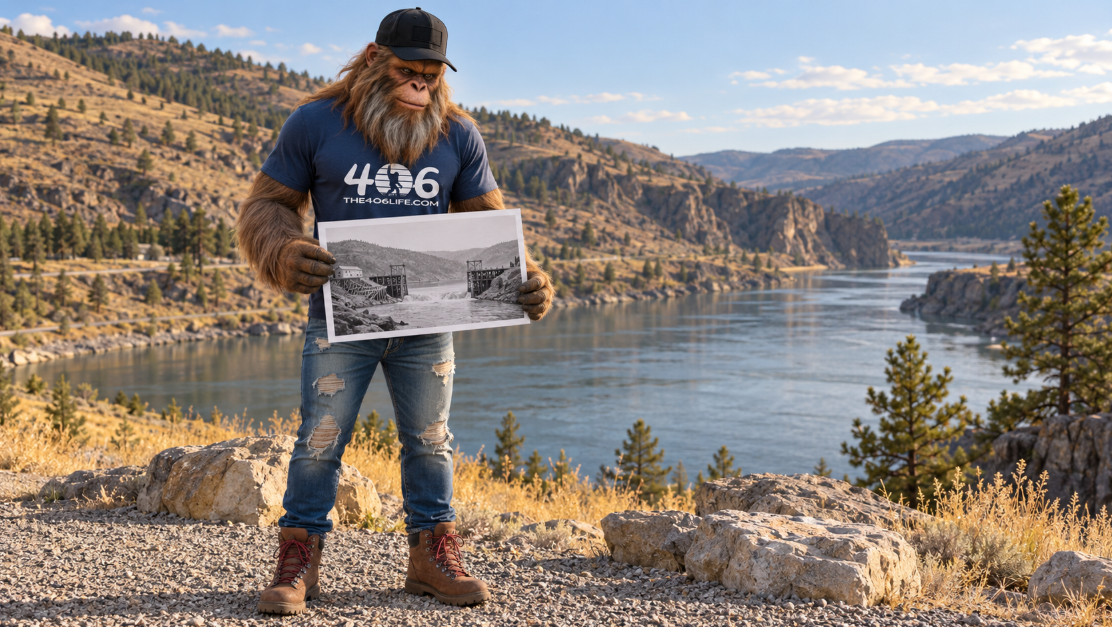
If you’ve ever spent time around Hauser Dam northeast of Helena, it’s easy to think of the place as permanent.
The Missouri slides through the canyon, the concrete structure holds steady, anglers work the water, boats come and go, and everything looks exactly where it belongs.
It wasn’t always that way.
The Hauser Dam standing today is not the original dam.
The first one lasted a little more than a year.
Then, on April 14, 1908, roughly 300 feet of it gave way and sent a major flood downstream.
And as much as I enjoy a good Montana story involving questionable engineering decisions, enormous amounts of water and humans confidently assuming they have everything under control, the most interesting part of this story might not be the dam breaking.
It might be what happened after it broke.
Because the Missouri was moving downstream, and somebody had to warn everyone in its path.
This was 1908.
No emergency text alerts. No weather radio. No cell phones. No county Facebook page where sixteen people could immediately ask whether the bridge was open.
They had telephones, telegraph lines and railroads.
So that’s what they used.
Before the Dam Broke
At the beginning of the twentieth century, Montana was changing quickly.
Mining, industry and growing communities needed more electricity, and the Missouri River represented an enormous source of power. Former Montana territorial governor Samuel T. Hauser was heavily involved in the push to develop hydroelectric projects along the river, and the dam that carried his name was part of that effort.
Construction on the original Hauser Dam began in 1905, and the project was operating by 1907.
It was an unusual structure.
The dam stood about 75 feet high and stretched roughly 630 feet across the river. Much of it was made of steel, which made Hauser one of a relatively small number of large steel dams being tried during that era.
Steel had some appeal. Components could be fabricated to known standards, transported to the site and assembled differently than the enormous masonry structures engineers had relied on for generations.
Humans saw a new technology and immediately thought, “Let’s make it hold back a river.”
I respect the confidence.
I also spend most of my time behind trees.
The Real Trouble Was Under the Dam
If you look at the historical photographs taken after the failure, your eyes go straight to the steel.
Sections are bent, twisted and collapsed into the river. The whole thing looks like somebody grabbed a giant piece of sheet metal and folded it.
That makes it tempting to say the steel simply wasn’t strong enough.
The engineering record tells a more complicated story.
The riverbed beneath Hauser Dam was not uniform. Some portions of the structure could be tied into solid rock, while others sat over gravel, ash and other alluvial material.
That foundation became the critical weakness.
Water worked around and beneath portions of the dam. Material around the footings eroded. Support beneath part of the structure weakened.
Eventually, the dam above could no longer remain stable.
That’s an important distinction. The twisted steel is what we can see in the photographs, but the failure began below it.
A dam can be made from the strongest material humans can manufacture, but if the ground underneath decides it no longer wishes to participate, everybody has a problem.
Even Bigfoot understands foundations.
Mostly because I weigh more than your average historian.
April 14, 1908
At about 2:30 in the afternoon on April 14, the original Hauser Dam failed.
Roughly 300 feet of the structure gave way.
Professional dam-safety accounts estimate that the initial flood surge near the failed dam may have been roughly 20 to 30 feet high. That figure is an estimate rather than a precise measured wall of water, but either way, an enormous amount of water was suddenly headed downstream.
The surviving photographs are remarkable.
Large sections of the steel structure sag into the Missouri. Supports are bent and displaced. Pieces of a dam that had been completed barely a year earlier are sitting where absolutely no engineer intended them to be.
And unlike plenty of old Montana tales, we don’t have to rely on some fellow at the end of the bar telling us his grandfather saw it happen.
We have the pictures.
We also have engineering reports, newspaper accounts, company records and federal documentation.
That makes Hauser one of those wonderful historical stories where the truth is already dramatic enough.
No embellishment required.
The Water Was Coming. Now What?
Once the dam failed, the problem changed immediately.
The engineering failure had already happened.
Now it was an emergency.
Downstream were construction workers, ranches, railroad infrastructure and communities along the Missouri. Farther ahead sat Craig, Ulm and Great Falls.
Someone had to warn them.
So people started using every communication tool available.
Telephone calls were made.
Telegrams went downstream.
And according to the professional dam-safety history of the event, a locomotive was sent along the rail corridor to help carry the warning.
That detail may be my favorite part of the whole story.
A dam has just failed.
A flood is moving down the Missouri.
And somebody says, essentially, “Get the train.”
Not because it was old-fashioned.
Because it made sense.
Railroads connected towns and work sites along the river. Telegraph offices connected people. Telephones were increasingly available.
The emergency network of 1908 was not one fancy system.
It was people stitching together the technology they had.
And using it quickly.
Holter Dam Was Still Under Construction
Farther downstream, another major hydroelectric project was already taking shape.
Holter Dam.
Or, more accurately, what would eventually become Holter Dam.
Construction crews were working on that project when news arrived that the upstream Hauser Dam had failed.
That is one of those moments where I imagine the workday changed rather abruptly.
You’re building a dam.
Then somebody tells you another dam upstream has disappeared.
At that point, I assume the day’s agenda gets revised.
The flood hit the Holter construction area before continuing toward Craig.
Historic engineering records show that the Hauser failure caused serious problems for the project and added to the financial trouble surrounding Samuel Hauser’s hydroelectric developments.
But the more immediate concern was the water itself.
It kept moving.
Craig Was in the Path
Today, Craig is known to a lot of Montanans as a fishing town along one of the most famous trout stretches of the Missouri.
In 1908, people there were waiting for a flood.
Historical accounts describe damage to structures, transportation infrastructure and railroad property along the river corridor.
But the warning system had done something important.
It bought people time.
That may sound simple, but in any fast-moving emergency, time is about the most valuable thing you can give somebody.
The dam had already failed.
Nobody in Craig could change that.
What they could change was where they were standing when the water arrived.
The technology involved was basic by modern standards.
Telephone.
Telegraph.
Train.
But “basic” and “ineffective” are not the same thing.
Sometimes simple systems work because the people using them understand exactly what needs to happen.
Down Toward Great Falls
The flood continued toward Ulm and Great Falls.
By the time the surge reached Great Falls, it had diminished considerably from the estimated height near the failed dam, although it was still serious enough that crews prepared downstream infrastructure for the approaching water.
Emergency work was undertaken around Black Eagle Dam and other facilities.
This is also where the historical record gets less tidy.
You may see versions of the Hauser Dam story claiming that nobody died.
That statement is too broad for me to repeat comfortably.
Professional and official sources reviewed for this story do not identify deaths directly attributed to the Hauser Dam failure itself. The Association of State Dam Safety Officials reports no deaths in the major flooding it describes around Holter, Craig and Ulm, and Montana Department of Natural Resources and Conservation material says no deaths were officially attributed to the dam failure.
Other later accounts describe fatalities during emergency work elsewhere along the river as communities prepared for the approaching water.
Those reports are not documented as cleanly in the sources I reviewed, so I’m not going to turn either version into a neat little headline.
History is often inconvenient that way.
The truth occasionally refuses to fit inside a catchy sentence.
The Damage Was Enormous
Historical engineering accounts place the property damage at more than $1 million in 1908 dollars.
That was an extraordinary amount of money at the time.
Railroad infrastructure was damaged. Property downstream took losses. The unfinished Holter project was affected.
And Samuel Hauser’s hydroelectric companies were left facing both engineering and financial problems.
The Missouri River had delivered a fairly expensive performance review.
Still, the failure did not end hydroelectric development at Hauser.
People went back to work.
Was the Steel Dam a Bad Idea?
The wreckage certainly did not improve the reputation of steel dams.
There is something about seeing an enormous section of a dam bent into a river that makes people reconsider the brochure.
But it would be misleading to reduce the Hauser failure to “steel dams don’t work.”
The historical engineering record focuses heavily on the foundation.
The dam lost support underneath part of the structure as material around the footings eroded. Once that happened, the steel above bent and collapsed.
The entire system failed.
That includes the foundation.
So the better lesson is not that steel itself was automatically doomed.
It’s that a dam is only as secure as the geology and engineering underneath it.
Which is one of those lessons that sounds wonderfully obvious after something very expensive has already fallen apart.
Hauser Dam Gets a Second Chance
The original dam was replaced.
This time engineers built a concrete structure.
The replacement was completed in 1911, and that project became the Hauser Dam people recognize today.
NorthWestern Energy now operates Hauser as part of its Missouri-Madison hydroelectric system. Montana Department of Environmental Quality and NorthWestern identify the current facility as a six-unit, 19-megawatt run-of-river hydroelectric plant.
So if you’ve stood near Hauser Dam, fished the river around it, launched a boat nearby or driven through that part of Montana, you’ve been looking at the second version.
The one that came after the lesson.
Same river.
Different dam.
Considerably longer résumé.
The Records Are Part of What Makes This Story So Good
One reason I like the Hauser story is that we have unusually good documentation.
Historical photographs survive in Montana collections. The U.S. Geological Survey documented the event. Engineering publications examined the failure almost immediately. Newspapers reported it. Company records and correspondence survive.
That gives historians a chance to do something we don’t always get to do with old Montana stories.
Compare.
We can look at what engineers said in 1908.
We can compare contemporary newspaper coverage with later research.
We can identify details that appear in several independent records.
And we can spot the parts that became a little more polished every time somebody retold them.
That matters.
Montana has no shortage of stories that begin with, “Well, my uncle knew a guy…”
I enjoy those as much as the next large forest-dwelling mammal.
But there is something satisfying about being able to point to a photograph and say:
Nope.
That part really happened.
Maybe the Most Important Part Wasn’t the Dam
When I started digging into this story, I figured the dam failure would be the whole thing.
Big structure.
Big river.
Big mistake.
That’s usually enough to keep me interested for a while.
But I keep coming back to the warning effort.
The dam failed at Hauser.
The water moved downstream.
Then information started moving too.
Someone had to recognize the problem.
Someone had to pick up a telephone.
Someone had to send a telegram.
Somebody put a locomotive on the line and sent warning along the river corridor.
And downstream, people had to believe the message and act.
More than a century later, our emergency systems are faster, louder and much more sophisticated.
The basic job is still the same.
See the danger.
Tell somebody.
Get people out of the way.
The 1908 Hauser Dam failure is an engineering story, a Montana history story and a Missouri River story.
But underneath all of that, it’s also a story about communication.
The river was moving.
So were the warnings.
And in Montana that afternoon, the difference mattered.
For more overlooked Montana history, wild places, strange stories and the people who shaped the 406, follow The 406 Life Podcast and explore more at The406Life.com.
If you enjoyed this one, share it with somebody who likes finding the Montana stories hiding just beneath the surface.
And if you’d like to help keep me wandering around Montana instead of being assigned an actual office, check out The 406 Life merchandise.
I have seen offices.
They have terrible hiding places.
Sources
• Association of State Dam Safety Officials: Hauser Dam failure
• Montana Historical Society magazine archive
• Montana History Portal archival Hauser Dam photograph
• NorthWestern Energy hydropower facilities
About our sources: This story draws on U.S. Geological Survey records, contemporary engineering publications, Montana Historical Society collections and scholarship, the Association of State Dam Safety Officials, Historic American Engineering Record material and current Montana and NorthWestern Energy sources. Historical accounts agree on the April 14, 1908 failure and major downstream flooding, but some details vary between sources. In particular, we do not use the broad claim that “no one died.” A professional dam-safety history reports no deaths in flooding at the Holter construction site, Craig and Ulm, while separate historical accounts report two fatalities during emergency work at Black Eagle Dam as Great Falls prepared for the approaching flood.
Also check out these Articles:
Fort Peck Dam History: Montana’s Boomtown Giant
What Happened to Granite Ghost Town? Montana’s Silver Bonanza Explained
What 150 Years of Mistakes Taught Yellowstone About Tourists
Leave a Reply
You must be logged in to post a comment.